Unlock instant, AI-driven research and patent intelligence for your innovation.

Using hall sensors to detect insertion and locking of a portable device in a base

a portable device and sensor technology, applied in the field of contactless, can solve the problems of not having such contacts in other mounting assemblies, increasing the chances of improper operation of such devices, and other mounting assemblies, however, not having such contacts

Active Publication Date: 2017-06-22
DATALOGIC IP TECH
View PDF7 Cites 0 Cited by
  • Summary
  • Abstract
  • Description
  • Claims
  • Application Information

AI Technical Summary

Benefits of technology

This mounting assembly and position-detection method allow for easy and cost-effective detection of when a portable device is fully inserted into a base without the need for contacts that would otherwise detect position. This is useful for wireless charging and ensuring optimal coupling between the device and base. Additionally, it can detect when an obstacle interferes with the coupling, preventing false detection of complete insertion.

Problems solved by technology

Other mounting assemblies, however, do not have such contacts.
The absence of contacts between the portable device and the base increases the opportunities for improper functioning of such devices.
This is particularly the case in devices having a symmetrical form factor where improper insertion within a base can be frequent.

Method used

the structure of the environmentally friendly knitted fabric provided by the present invention; figure 2 Flow chart of the yarn wrapping machine for environmentally friendly knitted fabrics and storage devices; image 3 Is the parameter map of the yarn covering machine
View more

Image

Smart Image Click on the blue labels to locate them in the text.
Viewing Examples
Smart Image
  • Using hall sensors to detect insertion and locking of a portable device in a base
  • Using hall sensors to detect insertion and locking of a portable device in a base
  • Using hall sensors to detect insertion and locking of a portable device in a base

Examples

Experimental program
Comparison scheme
Effect test

Embodiment Construction

[0026]The subject matter of embodiments of the present invention is described with specificity herein to meet statutory requirements. But the description itself is not intended to define what is regarded as the invention, which is what the claims do. The claimed subject matter might be embodied in other ways to include different steps or combinations of steps similar to the ones described in this document, in conjunction with other present or future technologies. Terms should not be interpreted as implying any particular order among or between various steps herein disclosed unless and except when the order of individual steps is explicitly described.

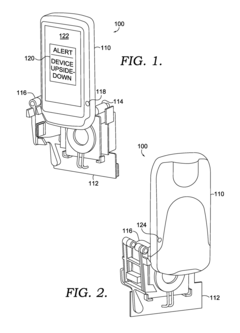
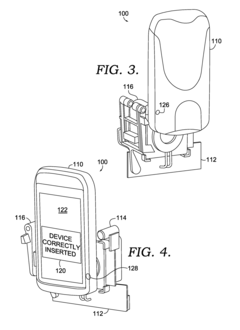
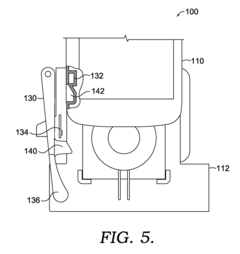
[0027]Embodiments of the present invention generally relate to using contact-less sensors to detect the orientation and the adequacy of insertion of a portable device in a mating seat or base. In embodiments, the mating seat or base includes a mechanical locking mechanism and is geometrically-conformed to receive and temporarily secure t...

the structure of the environmentally friendly knitted fabric provided by the present invention; figure 2 Flow chart of the yarn wrapping machine for environmentally friendly knitted fabrics and storage devices; image 3 Is the parameter map of the yarn covering machine
Login to View More

PUM

No PUM Login to View More

Abstract

A mounting assembly and method that utilize Hall effect sensors to detect orientation and insertion of a portable device in a base are provided. Hall effect sensors positioned on one of a portable device and a base are arranged to interact with one or more magnets positioned on the other of the portable device or the base such that a change in proximity of at least one of the magnets to at least one of the sensors will cause the sensor to output a voltage signal that differs depending on the nearness of the magnet. Depending on at least one of the magnitude of the signal, the profile of the signal over time, and the identity of the sensor that output the signal, it is determined whether the orientation of the portable device in the base is correct and / or if the portable device is fully inserted in the base.

Description

CROSS-REFERENCE TO RELATED APPLICATIONS[0001]This application claims priority to U.S. Provisional Patent Application No. 62 / 269,742 entitled “Using Hall Sensors to Detect Insertion and Locking of a Portable Device in a Base,” filed Dec. 18, 2015, which is incorporated herein by reference in its entirety.TECHNICAL FIELD[0002]The present invention relates to using contact-less sensors to detect proper insertion and locking of a portable device in a base. More particularly, the present invention relates to using Hall effect sensors to detect proper orientation and complete insertion of a portable device, for instance a portable electronic device, in a mating seat or base.BACKGROUND OF THE INVENTION[0003]Portable electronic devices are becoming increasingly common in the modern world. Portable electronic devices often are positioned on a base or cradle for transmitting information to and from such devices and / or for battery charging between locationally-remote uses, among other function...

Claims

the structure of the environmentally friendly knitted fabric provided by the present invention; figure 2 Flow chart of the yarn wrapping machine for environmentally friendly knitted fabrics and storage devices; image 3 Is the parameter map of the yarn covering machine
Login to View More

Application Information

Patent Timeline
no application Login to View More
IPC IPC(8): G01D5/14G01D18/00
CPCG01D18/00G01D5/145H04M1/04H04M2250/12G01D5/142G01R15/20G01R15/202G01R21/08G01R33/06G01R33/07G01R33/077
Inventor PIFFERI, MARCORICCARDI, ALESSIO
Owner DATALOGIC IP TECH