
Gas turbine exhaust cooling system
a technology of exhaust cooling system and gas turbine engine, which is applied in the direction of machines/engines, mechanical equipment, light and heating apparatus, etc., can solve the problems of reducing the cooling effectiveness, high pressure loss in view, and high manufacturing cost of cooling holes, so as to reduce the interaction between the flows, reduce the effect of cooling efficiency, and prevent mixing
- Summary
- Abstract
- Description
- Claims
- Application Information
AI Technical Summary
Benefits of technology
Problems solved by technology
Method used
Image

Examples
Embodiment Construction
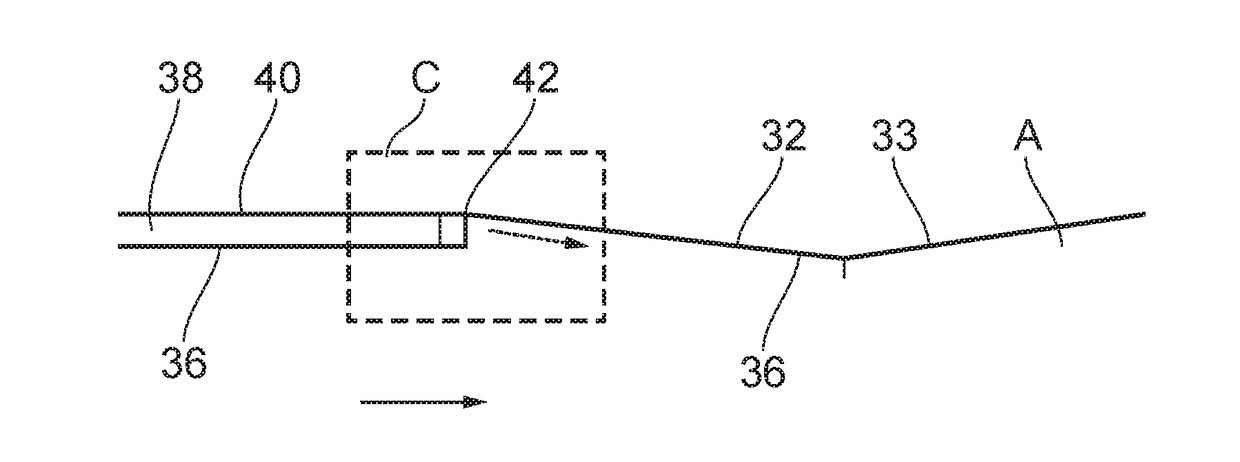
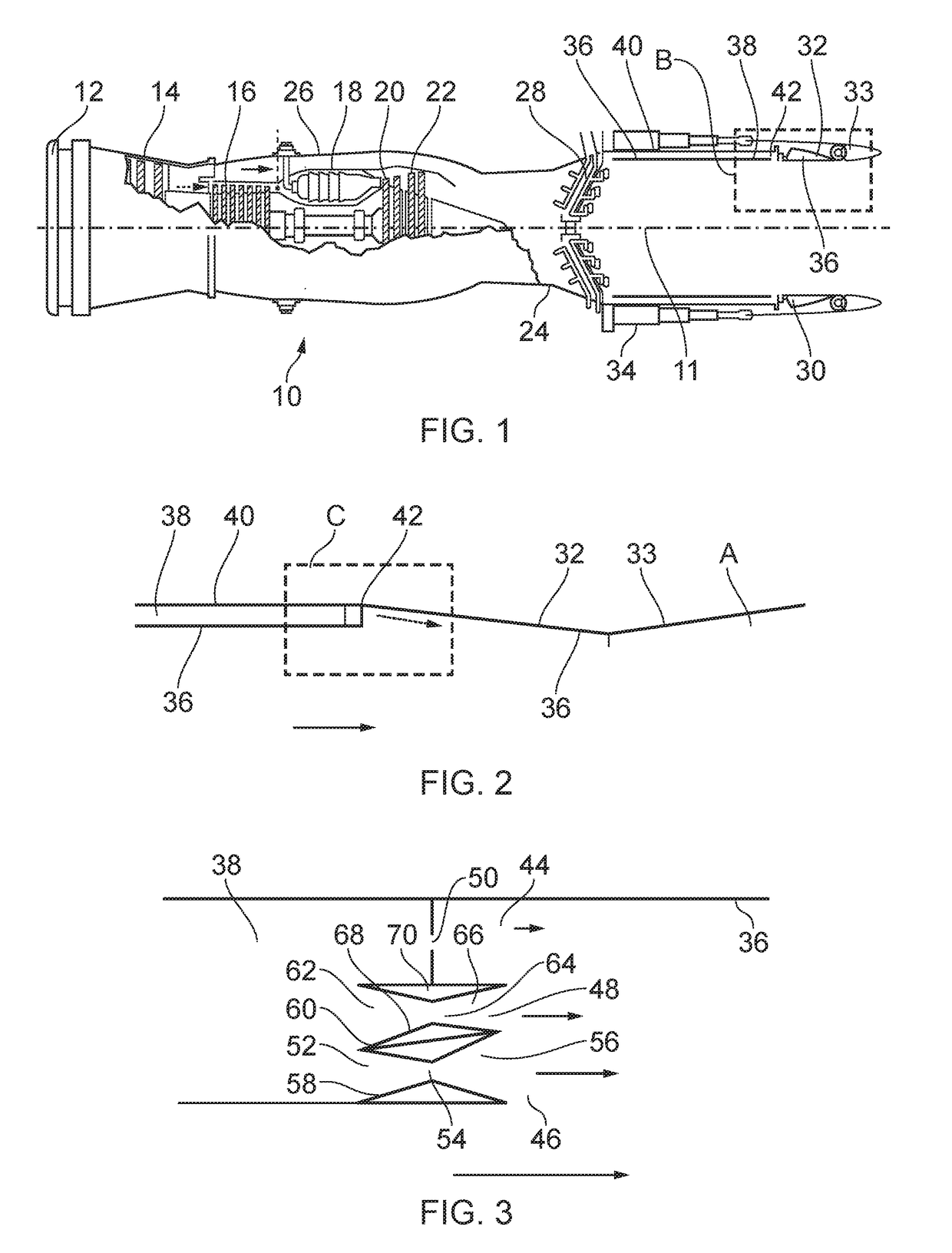
[0018]With reference to FIG. 1, a gas turbine engine is generally indicated at 10, having a principal and rotational axis 11. The engine 10 comprises, in axial flow series, an air intake 12, a propulsive fan 14, a compressor 16, combustion equipment 18, a high-pressure turbine 20, a low-pressure turbine 22 and an exhaust nozzle 20. A nacelle 21 generally surrounds the engine 10 and defines both the intake 12 and a mixing duct 24.
[0019]The gas turbine engine 10 works in the conventional manner so that air entering the intake 12 is accelerated by the fan 14 to produce two air flows: a first air flow (shown by a dotted arrow in FIG. 1) into the compressor 16 and a second air flow (shown by a solid arrow in FIG. 1) which passes through a bypass duct 26 to provide propulsive thrust. The compressor 16 compresses the air flow directed into it before delivering that air to the combustion equipment 18 where it is mixed with fuel and the mixture combusted. The resultant hot combustion product...
PUM
 Login to View More
 Abstract
Description
Claims
Application Information
 Login to View More