Method and apparatus for detection of estrus and optimal time for embryo transfer or artificial insemination in animals

a technology of estrus and detection method, which is applied in the field of electronic estrus detection devices, can solve the problems of affecting the success or failure of breeding efforts, difficult to see in direct sunlight, and devices that cannot reliably maintain adhesion to animals

Active Publication Date: 2019-07-25
JACKSON III WILLIAM R
View PDF1 Cites 4 Cited by
  • Summary
  • Abstract
  • Description
  • Claims
  • Application Information

AI Technical Summary

Benefits of technology

The invention is a device that can detect when an animal is in heat and the best time to inseminate or transfer an embryo. The device is placed on the animal's tail and is less likely to be moved. The information collected can include the length of the mount, the animal's location, and its internal and external temperatures. This data is transmitted to a database and can be used by veterinary professionals and others. The invention allows for the monitoring of many animals with one device and can be used in different terrains and climates to improve breeding practices.

Problems solved by technology

External conditions of the environment such as geographic location, outside temperature, age of the embryo, the type or condition of the semen used, and feeding and nutritional status of the animal can also affect the success or failure of the breeding effort.
Though useful, these visual indications can be difficult to see in direct sunlight and required the viewer to be in the proximity of the device.
Other prior art systems have used radio communications to monitor standing mounts, but the devices were unable to reliably maintain adhesion to the animal.
Other prior art systems monitored the motion of the animal, temperature or other conditions, but were not designed to include a direct and reliable determination of the existence and duration of a standing mount, the most reliable indicator of estrus.
Other prior art systems did not include an extremely resilient radio transmission such as LoRa radio using the LoRaWAN protocol and were not able to be received over relatively long distances, even in terrain with obstacles blocking direct line of sight, such as trees, buildings or other objects.
Other prior art systems did not provide such a transmission capability with extremely low power consumption permitting the use of small batteries, retention of narrow and low device profile on the animal, and very long periods of operation without recharging.
Other prior art systems did not provide a case that has been demonstrated to be able to withstand the extreme pressure, shock, torque and humidity associated with monitoring standing mounts.
Other prior art devices were not rechargeable.
Other prior art systems did not permit the retention of data when out of the range of the receiver and the transmission of data updates when in range, so that data useful for either estrus detection or embryo transfer may be retained, even if it was obtained while the end device was outside of the range of the receiver.
Other prior art systems provided data regarding the occurrence of a standing mount but did not provide direct and reliable data regarding the existence of a standing mount and its duration, the most reliable criteria for determining estrus.
Other prior art systems did not use the LoRaWAN protocol and therefore were not able to reliably monitor very large numbers of animals on a single gateway.
These systems are not well suited to a global system of raw data collection permitting the use of analytical systems such as machine learning that can provide superior prediction of estrus in cows and other animals under varying conditions such as breed, temperature, motion and restlessness and location.
Other prior art systems did not provide raw data regarding the existence of a standing mount and its duration in conjunction with raw data such as location, motion, and temperature and therefore, though they provide some raw data, they were not well suited to a global system of raw data collection permitting the use of analytical systems such as machine learning or deep learning employing neural nets to provide superior prediction of estrus in cows and other animals under varying conditions.
Other prior art systems did not provide the ability to combine raw data from the animal, such as the existence of a standing mount, motion, temperature and location with other data such as type of semen, age and type of embryo, outside temperature at the location, breed, feeding and nutritional status of the animal, outcome of breeding effort, or other data for use in developing better models for the prediction of estrus.
Other prior art systems were not as well suited for the monitoring of animals in less-developed areas of the world having wide ranging animals and animals that are difficult to locate or monitor due to type of terrain.
Other prior art systems were not as well-suited for the development of methods for breeding cattle and the development of breeds for use in tropical climates not presently favorable for the production of milk or the development of breeds for use in changing climatic conditions not favorable for the production of milk.


Method used

the structure of the environmentally friendly knitted fabric provided by the present invention; figure 2 Flow chart of the yarn wrapping machine for environmentally friendly knitted fabrics and storage devices; image 3 Is the parameter map of the yarn covering machine
View more

Image

Smart Image Click on the blue labels to locate them in the text.
Viewing Examples
Smart Image
  • Method and apparatus for detection of estrus and optimal time for embryo transfer or artificial insemination in animals
  • Method and apparatus for detection of estrus and optimal time for embryo transfer or artificial insemination in animals
  • Method and apparatus for detection of estrus and optimal time for embryo transfer or artificial insemination in animals

Examples

Experimental program
Comparison scheme
Effect test

Embodiment Construction

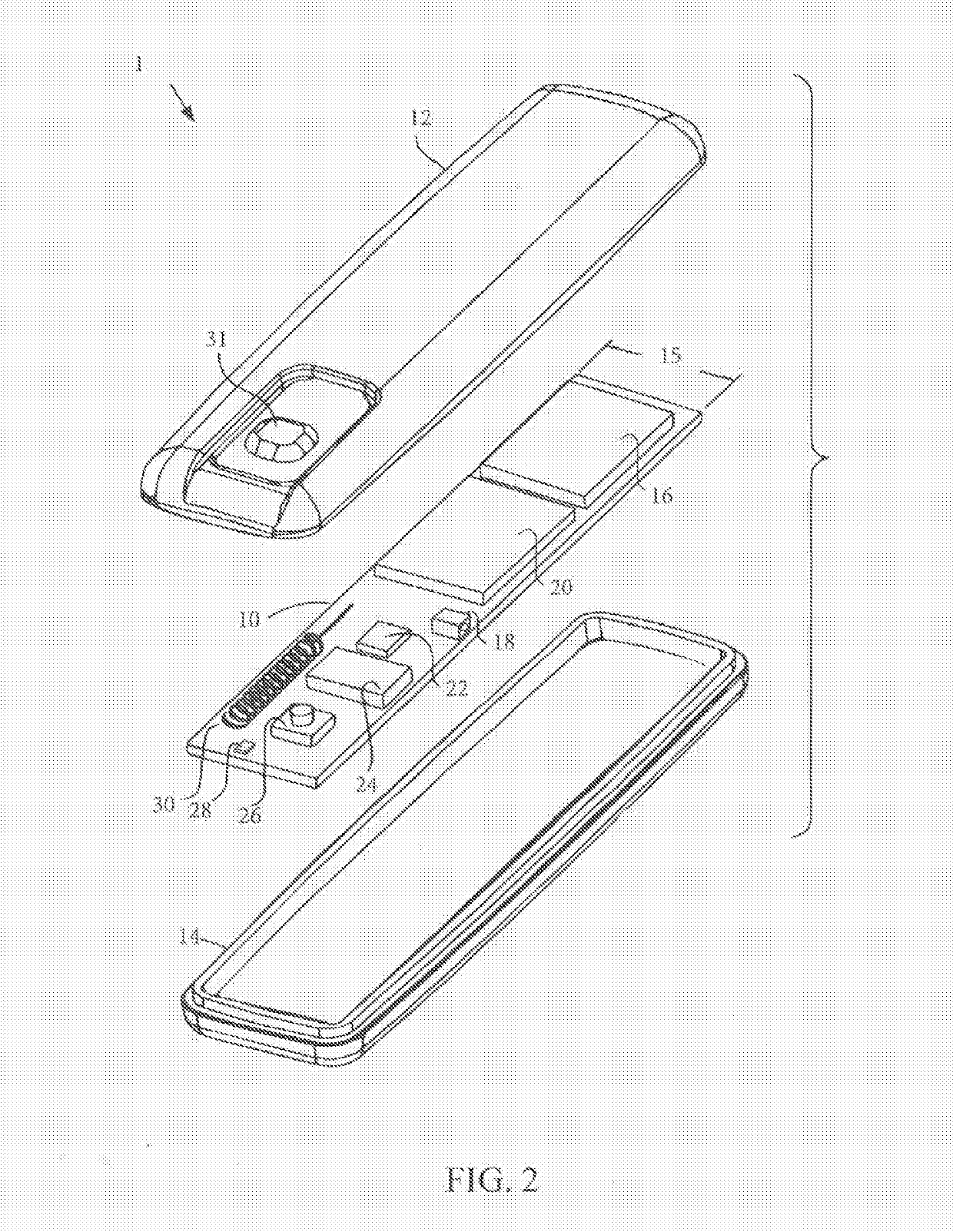
[0041]Some embodiments of the present invention will now be described more fully hereinafter with reference to the accompanying drawings, in which some, but not all, embodiments of the invention are shown. Indeed, various embodiments of the invention may be embodied in many different forms and should not be construed as limited to the embodiments set forth herein; rather, these embodiments are provided so that this disclosure will satisfy applicable legal requirements. Like reference numerals refer to like elements throughout. Some components of the apparatus are not shown in one or more of the figures for clarity and to facilitate explanation of embodiments of the present invention.

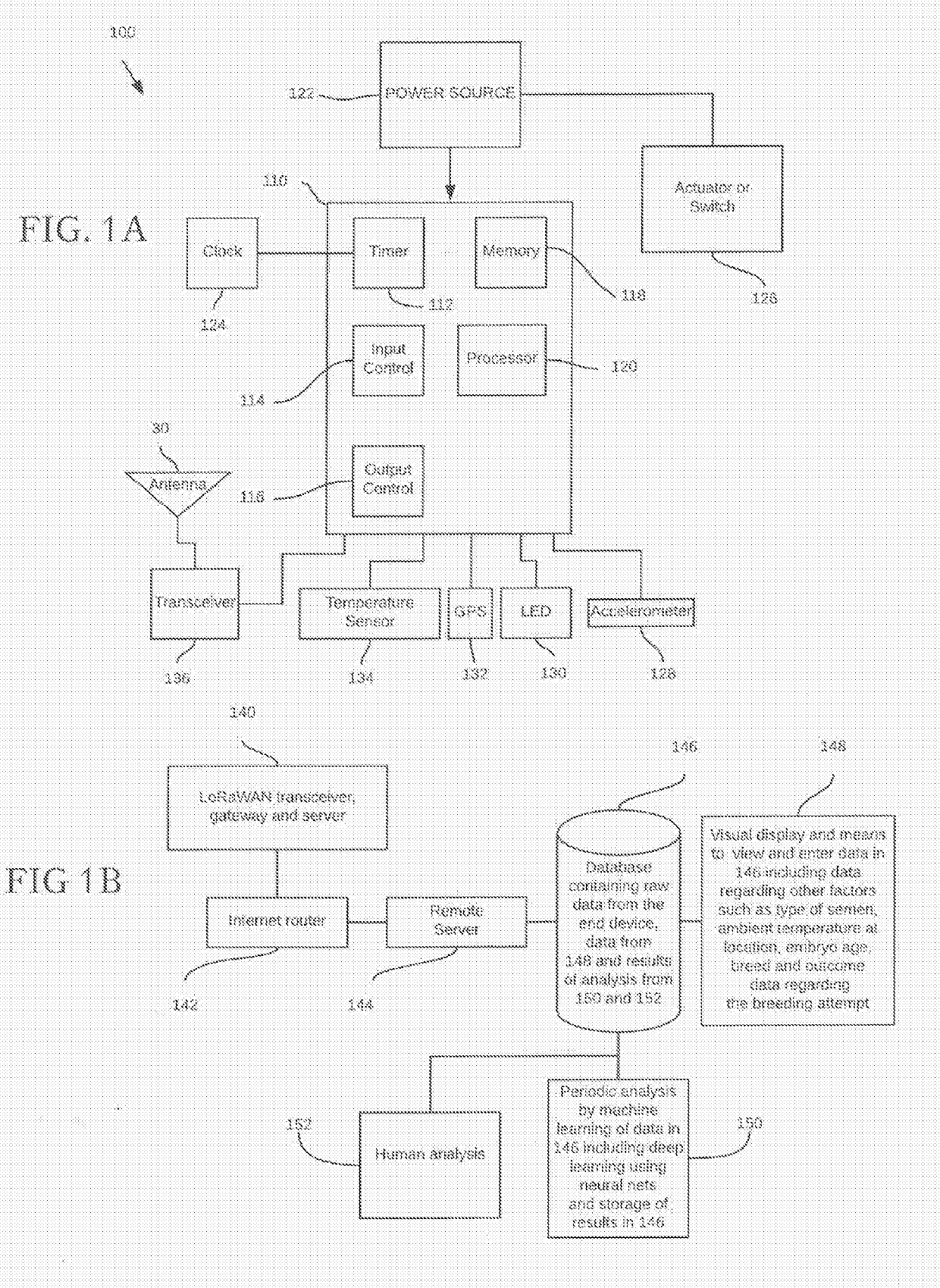
[0042]FIG. 1A and FIG. 1B illustrate a block diagram exemplary operating environment 100 suitable for practicing the present invention. Operating environment 100 is provided for illustrative purposes to describe an exemplary embodiment for performing the functionality described in the flow diagrams, whic...

the structure of the environmentally friendly knitted fabric provided by the present invention; figure 2 Flow chart of the yarn wrapping machine for environmentally friendly knitted fabrics and storage devices; image 3 Is the parameter map of the yarn covering machine
Login to View More

PUM

No PUM Login to View More

Abstract

An apparatus and methods for detection of estrus and optimal time for embryo transfer or artificial insemination in animals. An arched polycarbonate housing is attached to an animal. A circuit board is disposed within the housing. A rechargeable battery mounted on the circuit board provides power to the apparatus. A switch mounted on the circuit board is actuated when a breeding behavior occurs. A controller mounted on the circuit board detects actuations of the switch to generate data indicative of breeding behavior. A transmitter transmits data indicative of breeding behavior to a remote receiver

Description

CROSS-REFERENCE TO RELATED APPLICATIONS[0001]This application claims priority to U.S. Provisional Patent Application No. 62 / 620,687, filed on Jan. 23, 2018, the entirety of which is hereby incorporated herein by reference.[0002]U.S. Pat. No. 7,230,535, filed on Jun. 30, 2004, is incorporated by reference for all that it contains.FIELD OF THE INVENTION[0003]This invention relates to the fields of electronics devices and computer programming. More particularly, it relates to an electronic estrus detection device that transmits data based on external stimuli.BACKGROUND[0004]In order to determine the best time to artificially inseminate or to conduct embryo transfer for animals such as cows, the time the animal is or has been in estrus must be known. Practitioners vary in their opinions as to the optimal time from estrus to artificial insemination or embryo transfer. Therefore, a method and apparatus (hereinafter the apparatus is referred to as the “end device”) for providing that infor...

Claims

the structure of the environmentally friendly knitted fabric provided by the present invention; figure 2 Flow chart of the yarn wrapping machine for environmentally friendly knitted fabrics and storage devices; image 3 Is the parameter map of the yarn covering machine
Login to View More

Application Information

Patent Timeline
no application Login to View More
IPC IPC(8): A01K29/00A01K21/00A61D17/00A61B5/00
CPCA01K29/005A01K21/00A61D17/002A61D17/004A61B5/0004A61B5/0022A61B5/6801A61B5/725A61B5/7264A61B5/7275A61B5/721A01K2227/101A61B2010/0019A61B5/002A61B2503/40A61B5/4368A61B2560/0214A61B5/1112A61B5/1118A61B5/01G16H50/20G16H50/30Y02A90/10
InventorJACKSON, III, WILLIAM R.
OwnerJACKSON III WILLIAM R