Information processing apparatus, information processing system, and information processing method, and program
Active Publication Date: 2019-12-05
SONY CORP
View PDF0 Cites 12 Cited by
Summary
Abstract
Description
Claims
Application Information
AI Technical Summary
This helps you quickly interpret patents by identifying the three key elements:
Problems solved by technology
Method used
Benefits of technology
Benefits of technology
This patent describes an apparatus and method that allows for accurate estimation of a user's intent from their spoken words. This is achieved through an analysis of multiple user interactions and the creation of learning data that associates entities in the user's words with correct intent. This learning data is then used to estimate the intent of a new user's word as they speak it. Overall, this technology allows for more precise speech recognition.
Problems solved by technology
However, there is a case where it is difficult to correctly understand the user utterance intent even if the natural language understanding (NLU) process is applied due to individual differences in wording or the like.
Utterances of such various types of users have characteristics and are difficult for the system to understand in some cases.
However, it is difficult to accurately understand the intents of ail the diverse user utterances even if such a learning process is used.
Users often stop talking to the system in a case where the system does not understand their utterance intents.
For example, in a case where a user utterance has not been correctly converted to text (has been erroneously recognized) in the speech recognition (ASR) process included in the above-described processing, it is difficult to correctly execute the natural language understanding (NLU) process in the intent understanding unit at a later stage, and a result such as erroneous intent understanding and intent understanding incapability is output.
For example, there are individual differences in user's personal articulation, and there is also a limit in performance of automatic speech recognition (ASR).
Therefore, it is difficult to completely prevent an error (erroneous recognition) in the automatic speech recognition (ASR) process and the natural language understanding (NLU) process.
Method used
the structure of the environmentally friendly knitted fabric provided by the present invention; figure 2 Flow chart of the yarn wrapping machine for environmentally friendly knitted fabrics and storage devices; image 3 Is the parameter map of the yarn covering machine
View more
Image
Smart Image Click on the blue labels to locate them in the text.
Viewing Examples
Smart Image
Click on the blue label to locate the original text in one second.
Reading with bidirectional positioning of images and text.
Smart Image
Examples
Experimental program
Comparison scheme
Effect test
specific example 5
[0471]User utterance=“Tell me how to cut (how to burn)”
[0473]When an uttering user is in the kitchen, “how to cut (how to burn) as a recipe” is presented.
[0474]When the uttering user is operating a device such as a PC, “how to turn off the power as a device operation method, how to burn on media” is presented.
[0477]When an uttering user is in the kitchen, how to fry an “octopus” is presented as a recipe.
[0478]If a child appears near the uttering user, how to raise a “kite”, which is a way of playing, is presented.
[0479]In this manner, the learning data is recorded together with the context information including the environment information and the user information at the time of the user utterance, and the collation between the context acquired at the time of a new user utterance and the context recorded in the learning data is performed, so that it is possible to perform more correct intent estimation even in a case where the user utterance includes the polysemic word.
4. Regarding Countermeasures against Erroneous Learning Process
[0480]The utterance learning adaptive processing unit 108 of the information processing apparatus 100 of the present disclosure generates the learning data to correctly execute the user ...
specific example 1
[0585]Learning data relating to an event-related word, the event occurring once in a year or several years, is stored in the utterance learning data storage unit 112 for a long time.
[0586]For example, if “will it be fine on a day of the athletic meet?” and “Has XX won a gold medal today?” are uttered every day for several days, learning data relating to this utterance is stored in the utterance learning data storage unit 112 for a long time.
[0587]As a result, the learning data remains in the utterance learning data storage unit 112 even after the lapse of one to several years.
[0588]On the other hand, for example, in a case where it is configured to perform automatic discard based on an utterance count in units of several months, learning data is not present in the utterance learning data storage unit 112 after the lapse of one to several years, and thus, a new learning process is required for the same user utterance after the lapse of one to several years.
[0589]Note that the likelih...
the structure of the environmentally friendly knitted fabric provided by the present invention; figure 2 Flow chart of the yarn wrapping machine for environmentally friendly knitted fabrics and storage devices; image 3 Is the parameter map of the yarn covering machine
Login to View More
PUM
Login to View More
Abstract
Implemented are an apparatus and a method that enable highly accurate intent estimation of a user utterance. An utterance learning adaptive processing unit analyzes a plurality of user utterances input from a user, generates learning data in which entity information included in a user utterance with an unclear intent is associated with a correct intent, and stores the generated learning data is a storage unit. The utterance learning adaptive processing unit generates learning data in which an intent, acquired from a response utterance from the user to an apparatus utterance after input of a first user utterance with an unclear intent, is recorded in association with entity information included in the first user utterance. The learning data is recorded to include superordinate semantic concept information of the entity information. At the time of estimating an intent for a new user utterance, learning data with similar superordinate semantic concept information is used.
Description
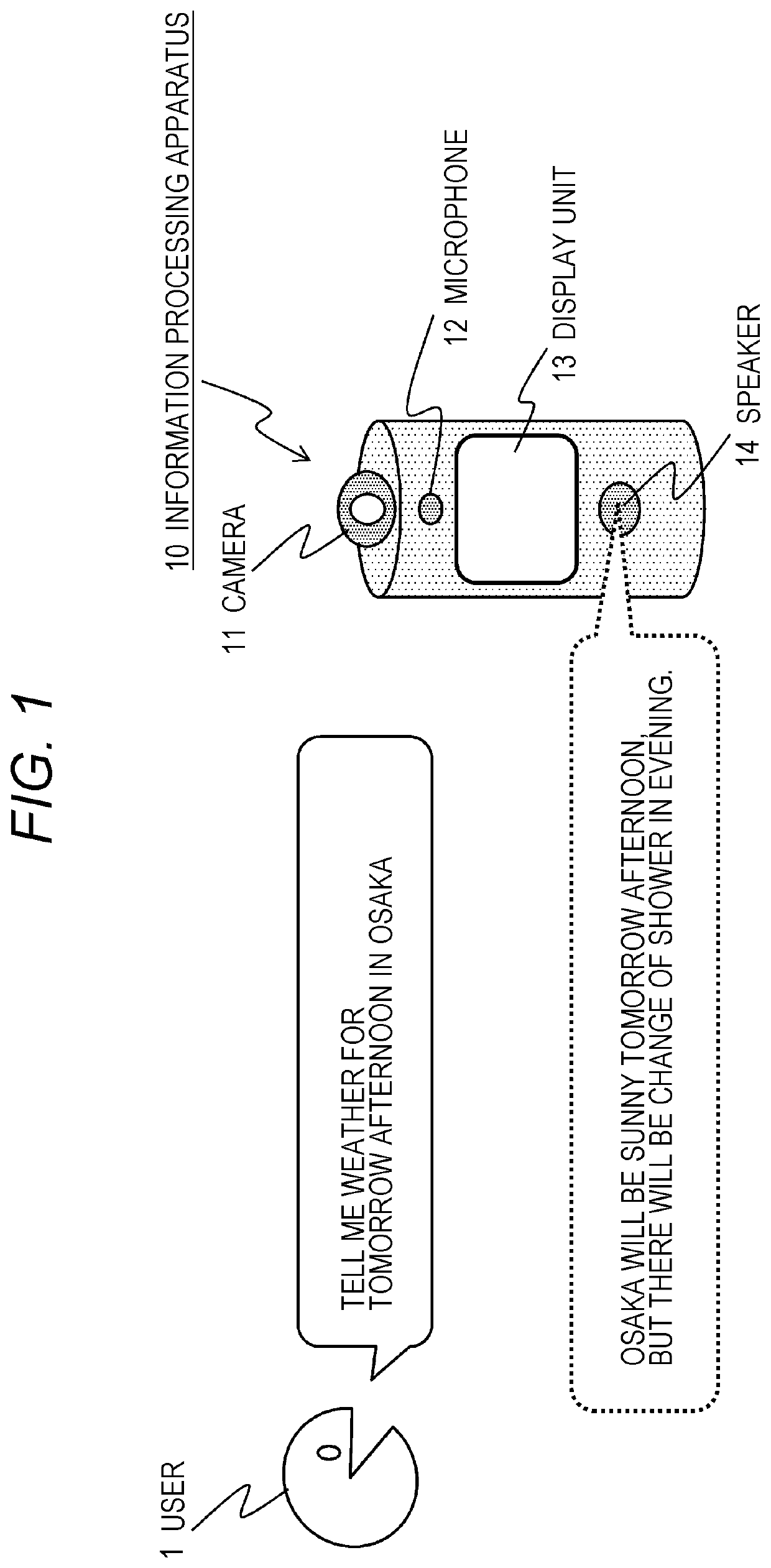
TECHNICAL FIELD[0001]The present disclosure relates to an information processing apparatus, an information processingsystem, and an information processing method, and a program. More specifically, the present invention relates to an information processing apparatus, an information processing system, and an information processing method, and a program that perform a speech recognition process of a user utterance.BACKGROUND ART[0002]Recently, there is an increasing use of a speech dialogue system that performs speech recognition of a user utterance and performs various processes and responses based on recognition results.[0003]In such a speech recognition system, the user utterance input via a microphone is recognized and understood, and processing is performed in accordance with the recognized and understood result.[0004]For example, in a case where the user utters “tell me the weather of tomorrow”, processing is performed to acquire weather information from a weather information pr...
Claims
the structure of the environmentally friendly knitted fabric provided by the present invention; figure 2 Flow chart of the yarn wrapping machine for environmentally friendly knitted fabrics and storage devices; image 3 Is the parameter map of the yarn covering machine
Login to View More
Application Information
Patent Timeline
Application Date:The date an application was filed.
Publication Date:The date a patent or application was officially published.
First Publication Date:The earliest publication date of a patent with the same application number.
Issue Date:Publication date of the patent grant document.
PCT Entry Date:The Entry date of PCT National Phase.
Estimated Expiry Date:The statutory expiry date of a patent right according to the Patent Law, and it is the longest term of protection that the patent right can achieve without the termination of the patent right due to other reasons(Term extension factor has been taken into account ).
Invalid Date:Actual expiry date is based on effective date or publication date of legal transaction data of invalid patent.


 Login to View More
  Login to View More