

Model parameter learning device, control device, and model parameter learning method
a technology of model parameter and learning method, which is applied in the direction of biological models, process and machine control, instruments, etc., can solve the problems of increasing the susceptibility to noise, increasing the noise component of image data, and increasing the travel state of autonomous driving vehicles. the effect of noise suppression
- Summary
- Abstract
- Description
- Claims
- Application Information
AI Technical Summary
Benefits of technology
Problems solved by technology
Method used
Image



Examples
first embodiment
[0041]The following will describe a model parameter learning device according to the present invention with reference to the accompanying drawings. As will be described below, the model parameter learning device of the present embodiment is adapted to carry out various types of arithmetic processing, including model parameter learning processing, at a predetermined control cycle ΔT. Specifically, the model parameter learning device is constituted of a controller (not illustrated). The controller is provided with a processor, storage, and a memory (not illustrated).
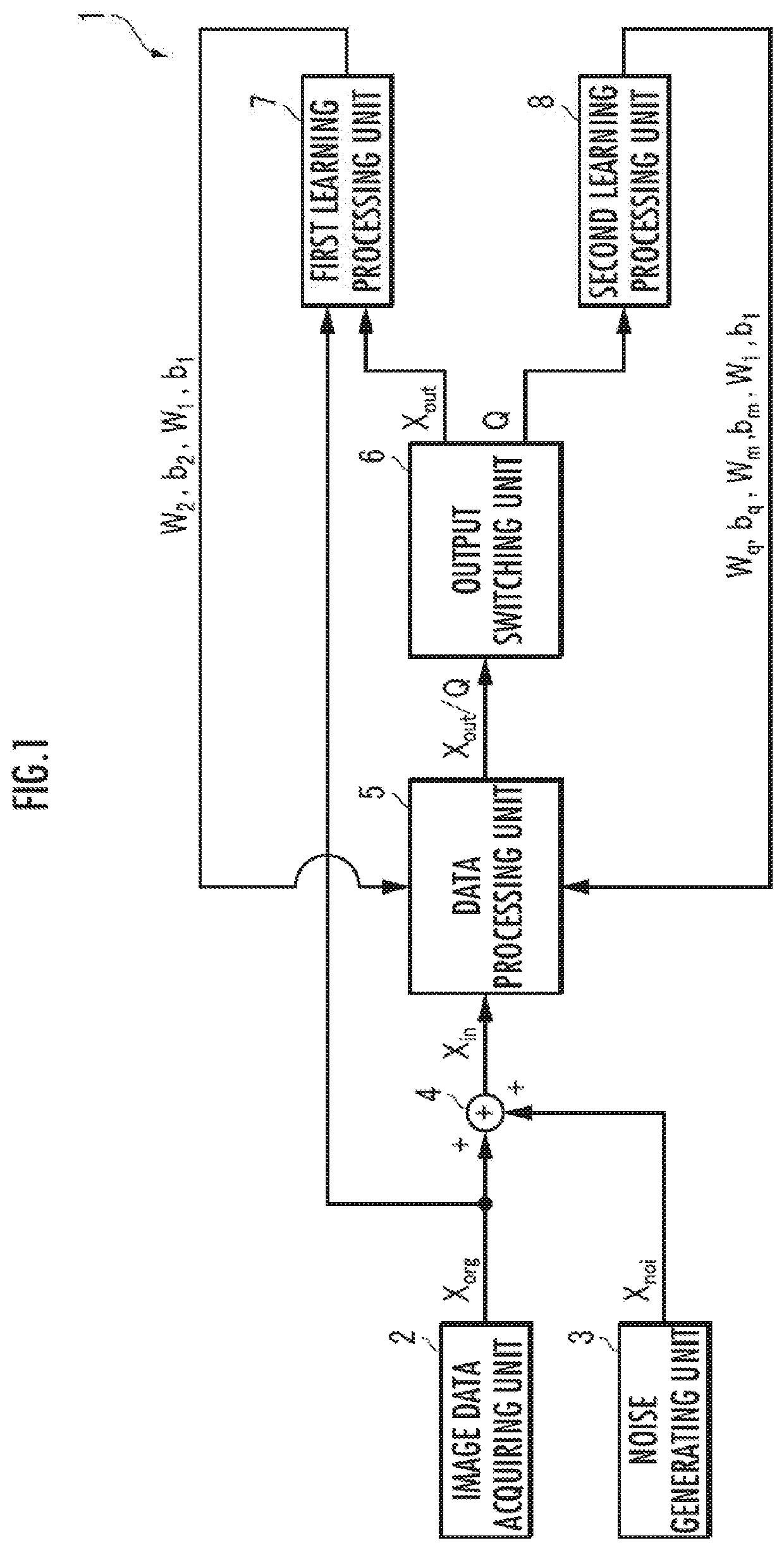
[0042]Referring to FIG. 1, a model parameter learning device 1 according to the present embodiment includes an image data acquiring unit 2, a noise generating unit 3, an adder 4, a data processing unit 5, an output switching unit 6, a first learning processing unit 7, and a second learning processing unit 8. In the following description, various types of values acquired or calculated are to be stored in a memory of the con...
second embodiment
[0131]The second embodiment is an example in which an action is selected from an element Qn of the output Q. If a continuous value is used as an output value, then the hostile perturbation can be calculated by using a cost function J indicated in expression (24) given below in place of the cost function J of the foregoing expression (22).
J=−∫Xδ(X−Xq)·log p(X)dX (24)
[0132]In expression (24) given above. δ(X−Xq) denotes a function that takes a value 1 when X=Xq or takes a value 0 when X≠Xq. Further, p(Xq) of expression (24) given above is a value that indicates the probability distribution that can be taken by the output of a continuous value of the control processing NN model 20, and Xq denotes an output value of the control processing NN model.
[0133]Further, in the present invention, an algorithm for extracting a feature amount (e.g. a HOG algorithm, a Hough transform algorithm, a canny transform algorithm, or a Sobel transform algorithm) and a quadratic curve fitting algorithm may...
PUM
 Login to View More
 Abstract
Description
Claims
Application Information
 Login to View More