

Method of fabricating nanowire connected with optical fiber
- Summary
- Abstract
- Description
- Claims
- Application Information
AI Technical Summary
Benefits of technology
Problems solved by technology
Method used
Image

Examples
Embodiment Construction
Technical Problem
[0006]In order to solve the problem that light scattering occurs at the connection portion between the optical fiber and the nanowire which cannot be solved by the conventional technique, the object of the invention is to provide a method for minimizing a light loss in the connection portion between the optical fiber and the nanowire by directly growing a nanowire from a distal end of the optical fiber in alignment with an optical axis.
[0007]Further, the invention aims at controlling reception, transmission and reflection of light according to the control of a distal end portion of the nanowire.
Technical Solution
[0008]A method of fabricating a nanowire connected to an optical fiber according to the invention comprises:
a) filling a micropipette with a material solution to form a nanowire;
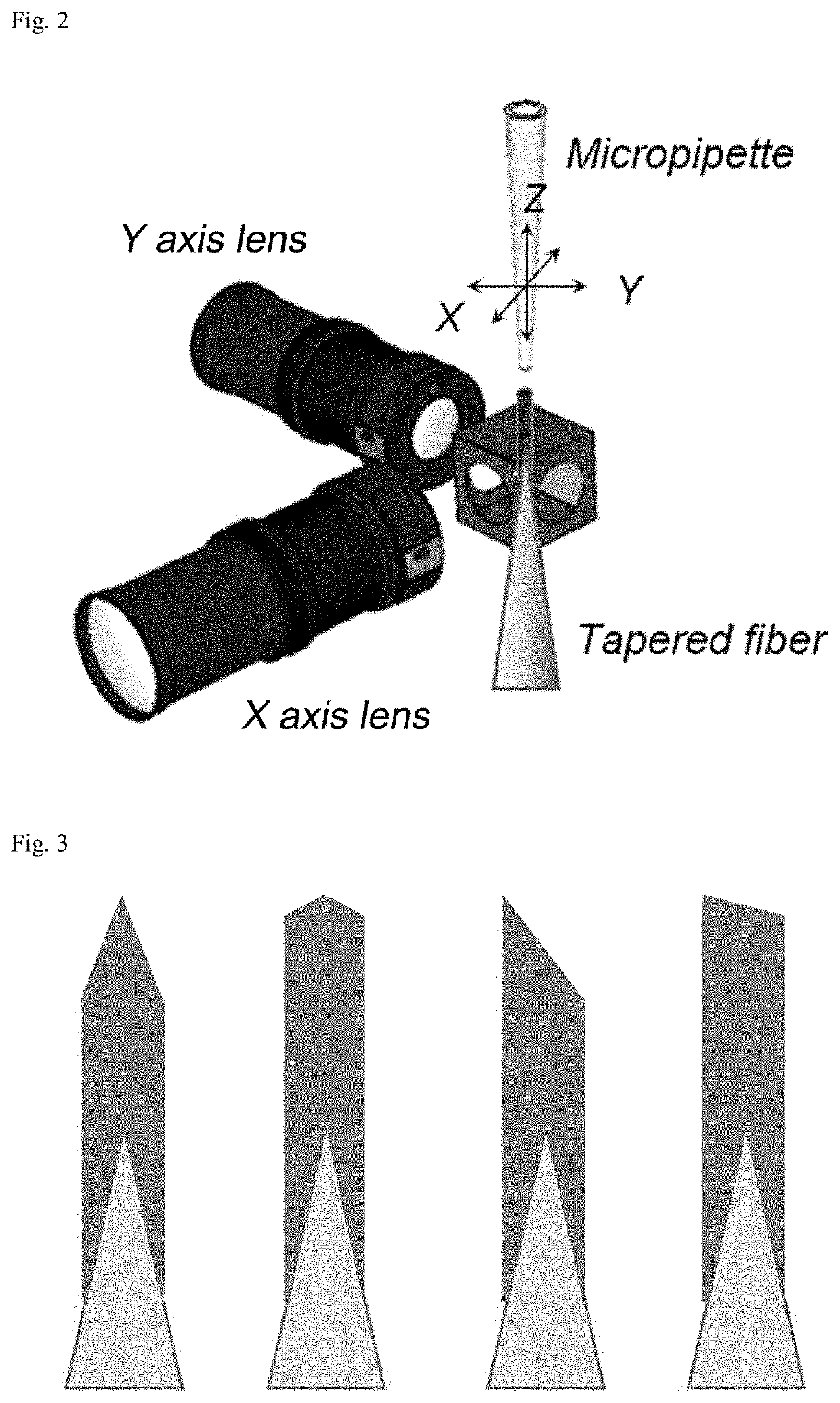
b) coaxially aligning the micropipette with the optical fiber at one end of the optical fiber such that a longitudinal axis of the optical fiber and a longitudinal axis of the microp...
PUM
 Login to View More
 Abstract
Description
Claims
Application Information
 Login to View More