Communication system of quality of experience oriented cross-layer admission control and beam allocation for functional-split wireless fronthaul communications

a technology of cross-layer admission control and communication system, applied in the field of communication system, can solve the problems of short transmission distance, limited diffraction ability of 5g signals, and inability to bypass moving or non-moving obstacles

a technology of cross-layer admission control and communication system, applied in the field of communication system, can solve the problems of short transmission distance, limited diffraction ability of 5g signals, and inability to bypass moving or non-moving obstacles

US20200163153A1Active Publication Date: 2020-05-21NAT CHIAO TUNG UNIV

Image

Smart Image Click on the blue labels to locate them in the text.
Viewing Examples
Smart Image
  • Communication system of quality of experience oriented cross-layer admission control and beam allocation for functional-split wireless fronthaul communications
  • Communication system of quality of experience oriented cross-layer admission control and beam allocation for functional-split wireless fronthaul communications
  • Communication system of quality of experience oriented cross-layer admission control and beam allocation for functional-split wireless fronthaul communications

Examples

Experimental program
Comparison scheme
Effect test

first embodiment

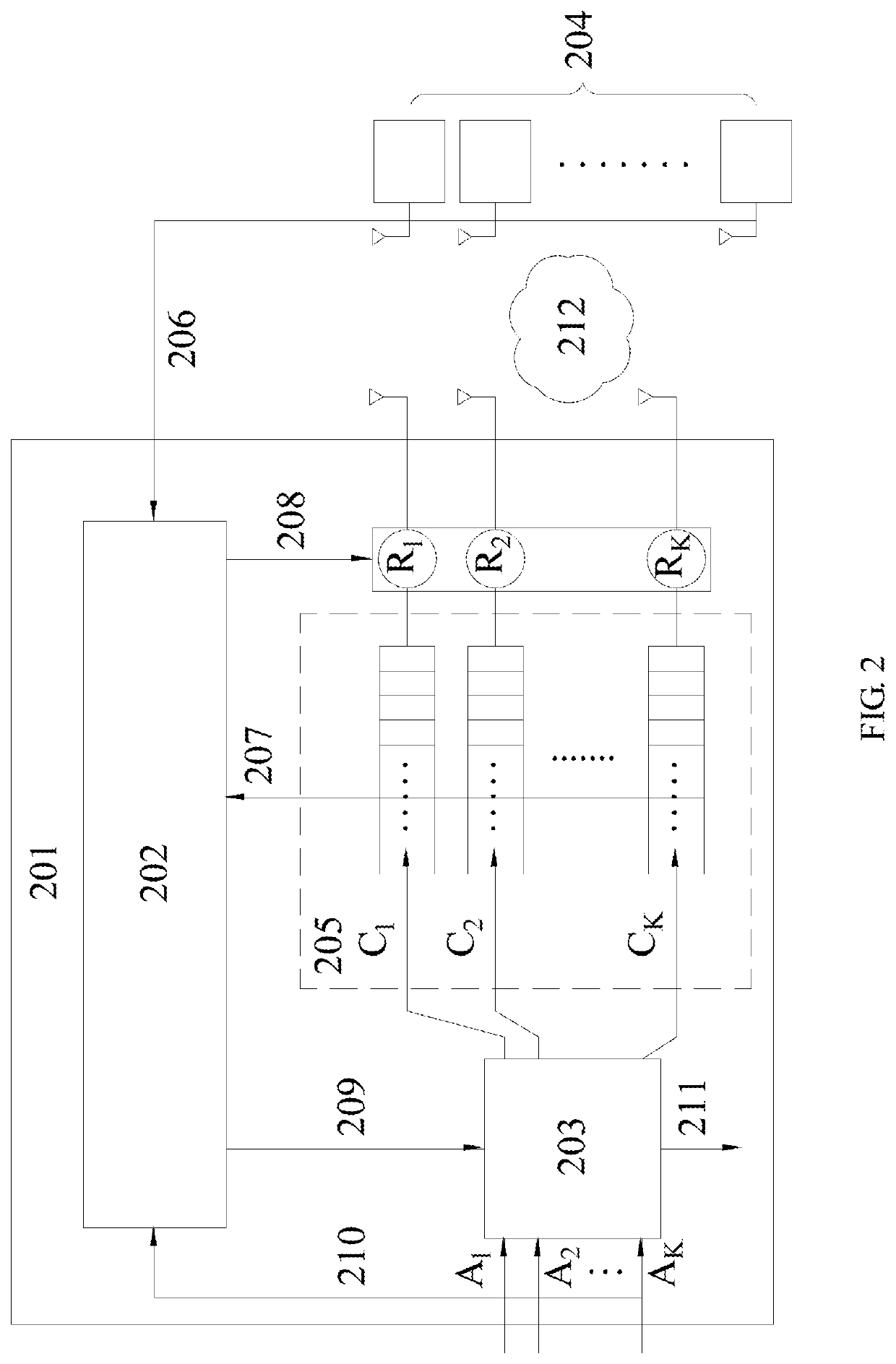
[0041]The first embodiment relates to a communication system of quality of experience oriented cross-layer admission control and beam allocation for functional-split wireless fronthaul communications for a cloud radio access network, which executes the CU-based beam allocation and admission control algorithm (CU-BAACA).

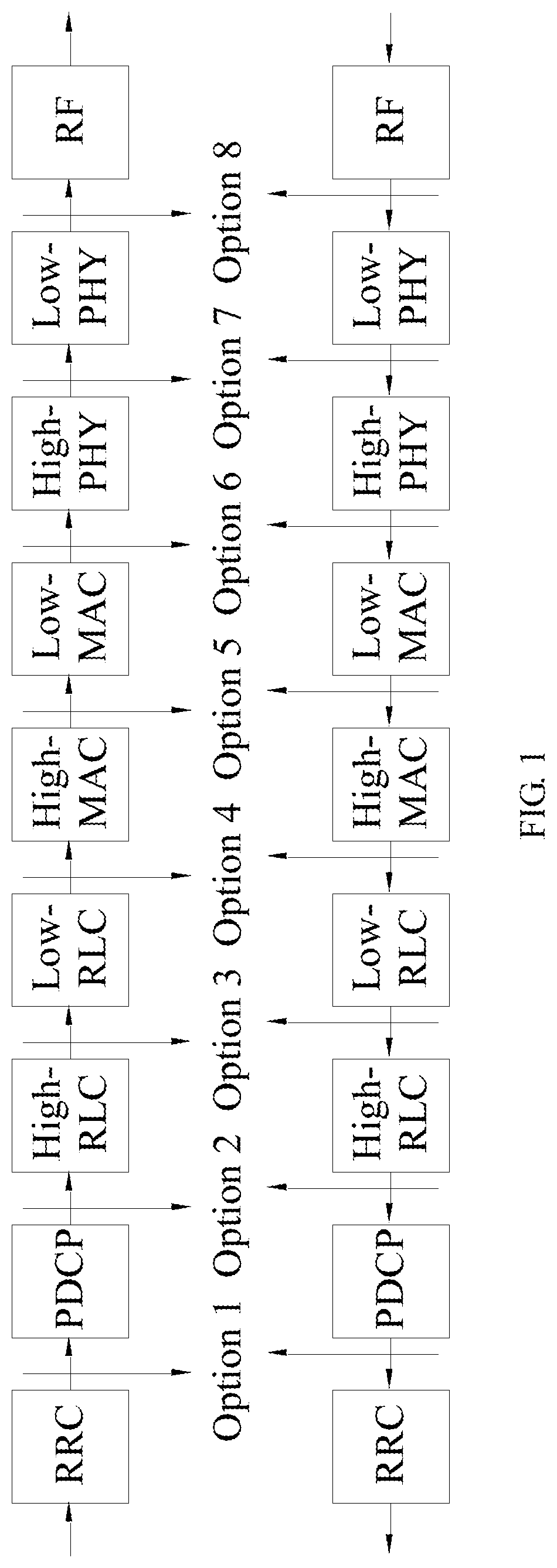
[0042]FIG. 2 depicts the structure of the communication system according to the first embodiment of the present application. FIG. 2 depicts the communication structure of the system in which the central unit CU executes the algorithm. In this structure, High-MAC layer is allocated to the CU end 201 (central unit end 201). Since the entire structure is more central, the CU end 201 has High-MAC for consonantly executing scheduling, managing interference coordination and controlling data admission. Since the algorithm is executed in the central unit CU, the distributed unit end 204 needs to process one-way transmission of the channel state information (CSI) 206 to the ce...

second embodiment

[0073]The second embodiment relates to a communication system of quality of experience oriented cross-layer admission control and beam allocation for functional-split wireless fronthaul communications for a cloud radio access network, which executes the DU-based (distributed unit based) beam allocation and admission control algorithm (DU-BAACA).

[0074]FIG. 4 depicts structure of the system according to the second embodiment of the present application. FIG. 4 depicts structure of the system in which the distributed units DU executes the algorithm. In this structure, High-MAC layer is allocated to the DU end 404 (distributed unit end 404). Therefore, the position where the algorithm is executed is the DU end 404 as well. In the case of executing DU-BAACA by the distributed units, each distributed unit DU would not get information of interference coming from other distributed units, which is the main difference between the DU-BAACA and the CU-BAACA. Therefore, the interference is herein...

the structure of the environmentally friendly knitted fabric provided by the present invention; figure 2 Flow chart of the yarn wrapping machine for environmentally friendly knitted fabrics and storage devices; image 3 Is the parameter map of the yarn covering machine
Login to View More

PUM

No PUM Login to View More

Abstract

Two algorithms for different functional-split network models are provided, which are the CU-based (central unit based) beam allocation and admission control algorithm (CU-BAACA) and the DU-based (distributed unit based) beam allocation and admission control algorithm (DU-BAACA). Difference between the CU-BAACA and DU-BAACA includes whether the algorithm is implemented at the CU site or at the DU site. Proposed algorithms aim to optimize DUs' quality of experience (QoE) by admission control to determine the amount of data from application layer entering into traffic queue and allocating beam in physical layer at the fronthaul network between CU and DUs. On the other hand, queueing delay and queue stability are taken into consideration to maintain the system steadiness. Simulation results compare performance of two functional split models to find the appropriate scenario for each function split option, which provide technical requirement and applicability of the proposed algorithms for practical system.

Description

CROSS-REFERENCE TO RELATED APPLICATION[0001]This application claims priority from Taiwan Application No. 107141380, filed on Nov. 21, 2018, in the Taiwan Intellectual Property Office, the content of which is hereby incorporated by reference in their entirety for all purposes.BACKGROUND OF THE INVENTIONField of the Invention[0002]The present application relates to a communication system. Specifically, the present application relates to a communication system of quality of experience oriented cross-layer admission control and beam allocation for functional-split wireless fronthaul communications for a cloud radio access network.Description of the Related Art[0003]On Jun. 13, 2018, the San Diego 3GPP conference set the first international 5G standard, which defines a data transmission rate of 10 Gbps. The data rate can support 10,000 users, providing a data transmission rate of 1 Gbps to users in the same area and support at least tens of thousands of mobile devices simultaneously conn...

Claims

the structure of the environmentally friendly knitted fabric provided by the present invention; figure 2 Flow chart of the yarn wrapping machine for environmentally friendly knitted fabrics and storage devices; image 3 Is the parameter map of the yarn covering machine
Login to View More

Application Information

Patent Timeline
21 May 2020
Publication
US20200163153A1
IPC
H04W80/08; H04W72/04; H04W28/02; H04W80/02; G06F9/455
CPC
H04W72/046; H04W28/0268; G06F2009/45595; G06F9/45558; H04W72/0446; H04W80/02; H04W80/08; H04B7/022
Inventors
FENG, KAI-TEN; HUANG, TUN-PING