Stack oriented data processing device

a data processing device and stack technology, applied in the direction of multi-programming arrangements, memory adressing/allocation/relocation, instruments, etc., can solve the problems of waste of storage space on the stack, large stack use,

US6557093B2Inactive Publication Date: 2003-04-29KONINKLIJKE PHILIPS ELECTRONICS NV
5 Cites 10 Cited by

Patent Information

Authority / Receiving Office
US · United States
Patent Type
Patents(United States)
Current Assignee / Owner
Publication Date
2003-04-29
Estimated Expiration
Not applicable · inactive patent

Smart Images

  • Figure 1
    Figure 1
  • Figure 2
    Figure 2
  • Figure 3
    Figure 3
Patent Text Reader

Abstract

The data processing device maintains two stacks. The length of the basic unit of information is different for each stack. Pops and pushes cause a change in the stack pointer which differs dependent on which stack is used. Instructions refer to different locations on the stack as registers defined by an offset of a number of basic units relative to the top of stack. In an embodiment a reference to registers is normally interpreted as a reference to one of a set of registers (including the top of stack register) without push or pop, but a reference to one register is interpreted as a reference to top of stack including a push or pop.
Need to check novelty before this filing date? Find Prior Art

Description

1. Field of the InventionThe invention relates to a data processing device, such as, for example, the data processing device described in the architectural overview of the Philips 80C51XA processor, published in the 1996 data handbook IC25 published by Philips Semiconductors, pages 33 to 56.2. Description of the Related ArtA stack can be maintained for example by a stack pointer register which stores a memory address pointer. During a push operation the memory address pointer is incremented and information is stored at the memory location to which it points. By means of successive pushes information is thus written into a series of consecutive memory locations. This information can be read by addressing memory locations relative to the top of stack.The pop operation is the reverse of the push operation. During a pop operation information is read from the memory location to which the address pointer points and the memory address pointer is decremented.The 80C51XA processor supports s...

Examples

Embodiment Construction

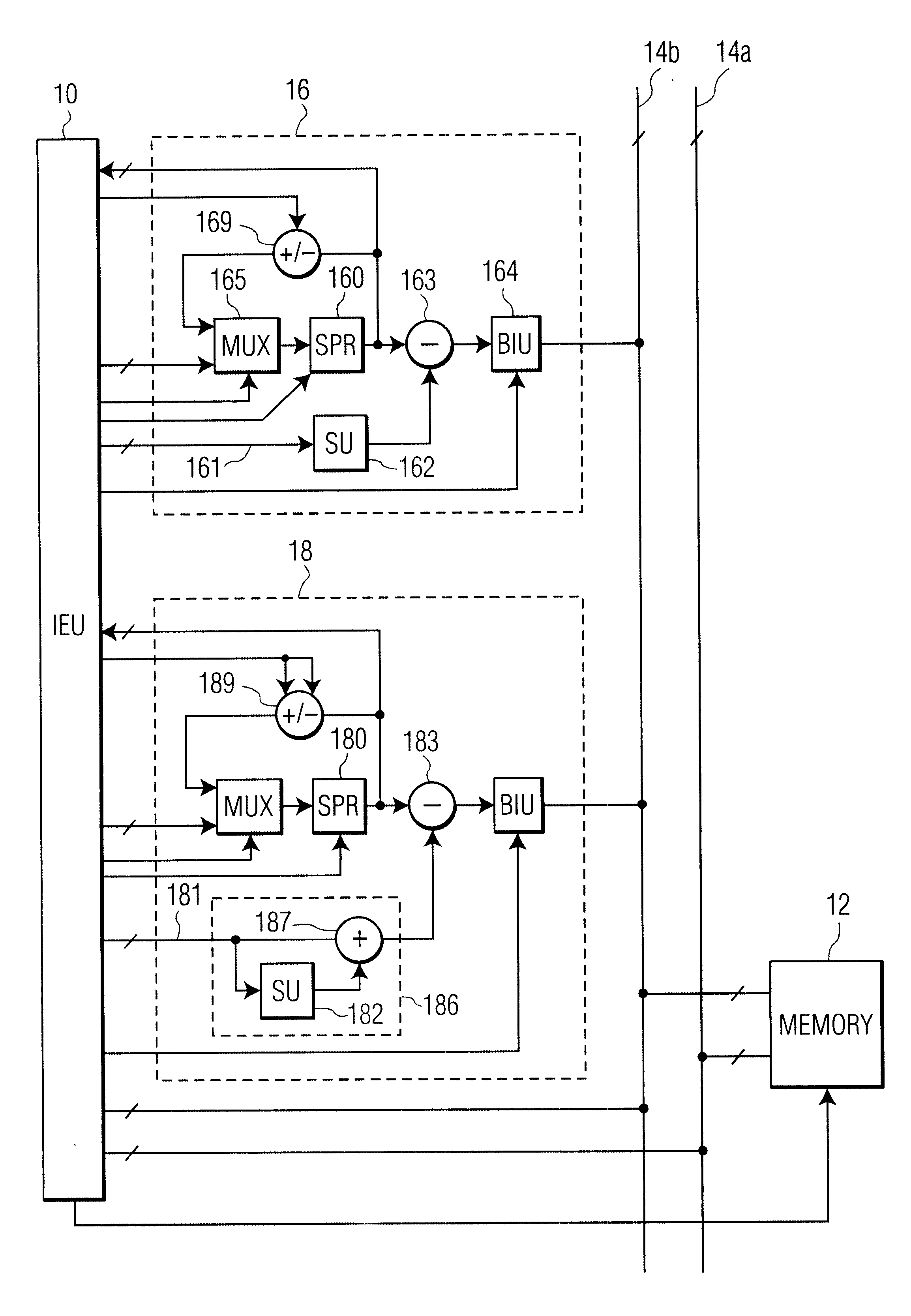
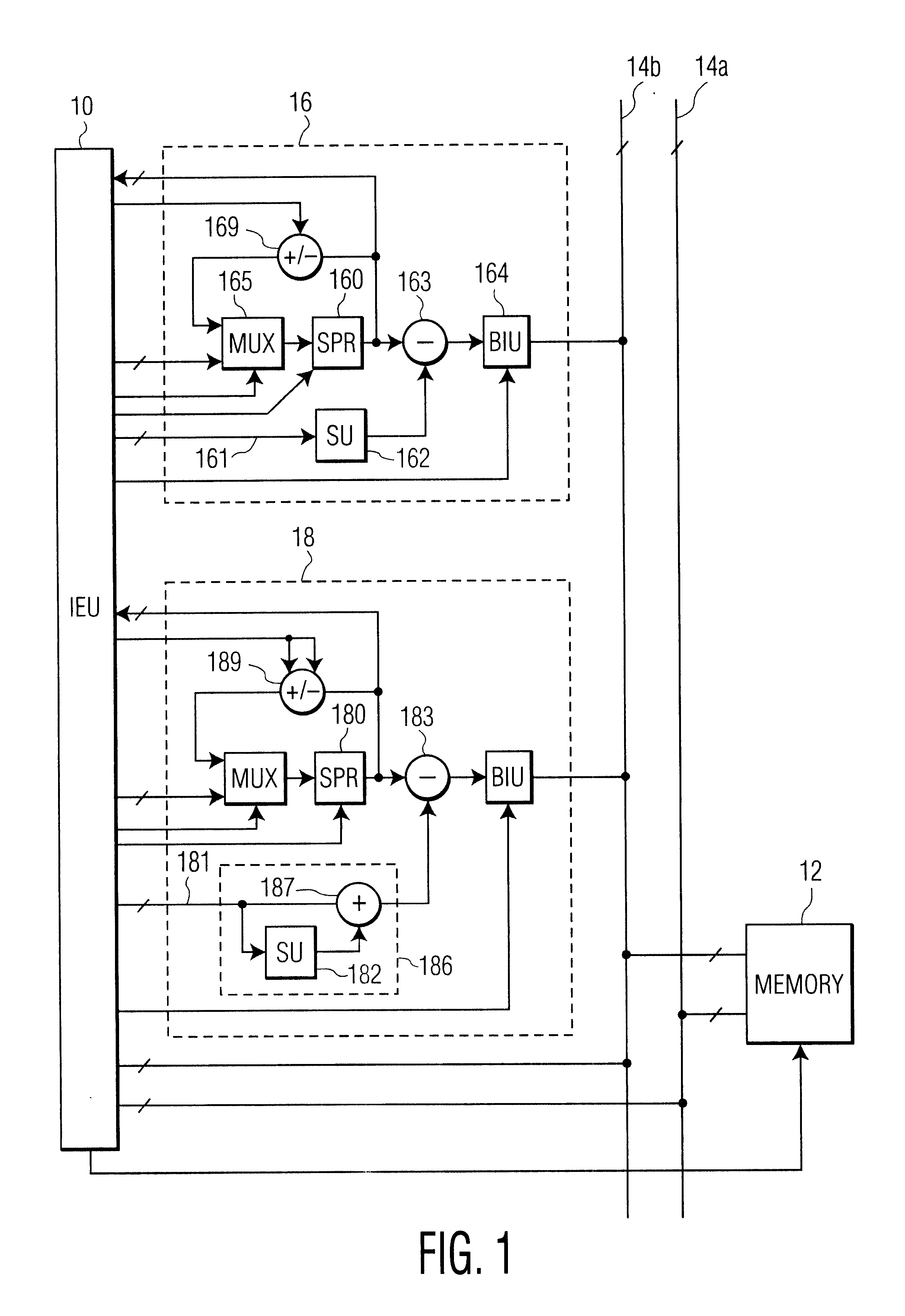
FIG. 1 shows a simplified data processing apparatus for demonstrating a principle of the invention. The apparatus contains an instruction execution unit ("IEU") 10 and a memory 12 both connected to a data bus 14a and an address bus 14b. The apparatus also contains a first and second stack control unit 16, 18, which have a control interface coupled to the instruction execution unit 10 and an output coupled to the address bus 14b.

The first stack control unit 16 contains a stack pointer register ("SPR") 160 with an output coupled to an offset subtractor 163. The control interface to the execution unit 10 contains an offset input which is coupled to an input of the offset subtractor 163 via a shift unit ("SU") 162. The output of the offset subtractor 163 is coupled to the address bus 14b via a bus interface unit ("BIU") 164. The output of the stack pointer register is also coupled to a first input of a multiplexer 165 via an incremeter / decrementer 169. A second input of the multiplexer ...