

Anti-hijacking system operable in emergencies to deactivate on-board flight controls and remotely pilot aircraft utilizing autopilot
a technology of hijacking system and autopilot, which is applied in the direction of vehicle position/course/altitude control, process and machine control, instruments, etc., can solve the problems of hijacking, continuing to haunt airlines and the flying public, and inconvenience of passengers, flight crew, passengers and passengers of aircra
Inactive Publication Date: 2003-11-04
CUBIC DEFENSE SYST
View PDF17 Cites 115 Cited by
- Summary
- Abstract
- Description
- Claims
- Application Information
AI Technical Summary
Problems solved by technology
Aircraft hijacking has been a longstanding problem that continues to haunt airlines and the flying public.
At best, hijacking merely inconveniences an aircraft's passengers, flight crew, airline company, and people waiting for the flight to arrive.
At worst, hijacking can cause substantial loss of life and property aboard the aircraft and on the ground.
On rare occasion, though, hijackings still occur.
Still, these measures offer little resistance to a hijacking in progress.
Hijackers of sufficient motivation, numbers, brutality, and intimidation can still appear aboard an aircraft despite existing security measures, in which case the flight crew and passengers are utterly helpless.
Air marshals cannot be present in every flight due to government budget limitations.
Although use of the "7500" transponder code alerts air traffic controllers to the hijacking, this does nothing to stop a hijacking in progress, and knowledgeable hijackers have been known to disable aircraft transponders.
As shown above, existing measures are not always sufficient to prevent armed hijackers from boarding commercial aircraft.
And, once aboard an aircraft, hijackers of sufficient motivation can wreak havoc with little or no meaningful resistance.
Few defensive measures are available to deter or inhibit terrorists from achieving their objectives once the aircraft is airborne and the terrorists have assumed control.
Clearly, then, the state of the art is plagued with certain unsolved problems that stymie efforts to provide a completely safe flying environment.
Method used
the structure of the environmentally friendly knitted fabric provided by the present invention; figure 2 Flow chart of the yarn wrapping machine for environmentally friendly knitted fabrics and storage devices; image 3 Is the parameter map of the yarn covering machine
View moreImage
Smart Image Click on the blue labels to locate them in the text.
Smart ImageViewing Examples

Examples
Experimental program
Comparison scheme
Effect test
Embodiment Construction
While the foregoing disclosure shows a number of illustrative embodiments of the invention, it will be apparent to those skilled in the art that various changes and modifications can be made herein without departing from the scope of the invention as defined by the appended claims. Furthermore, although elements of the invention may be described or claimed in the singular, the plural is contemplated unless limitation to the singular is explicitly stated. Additionally, ordinarily skilled artisans will recognize that operational sequences must be set forth in some specific order for the purpose of explanation and claiming, but the present invention contemplates various changes beyond such specific order.
the structure of the environmentally friendly knitted fabric provided by the present invention; figure 2 Flow chart of the yarn wrapping machine for environmentally friendly knitted fabrics and storage devices; image 3 Is the parameter map of the yarn covering machine
Login to View More PUM
 Login to View More
 Abstract
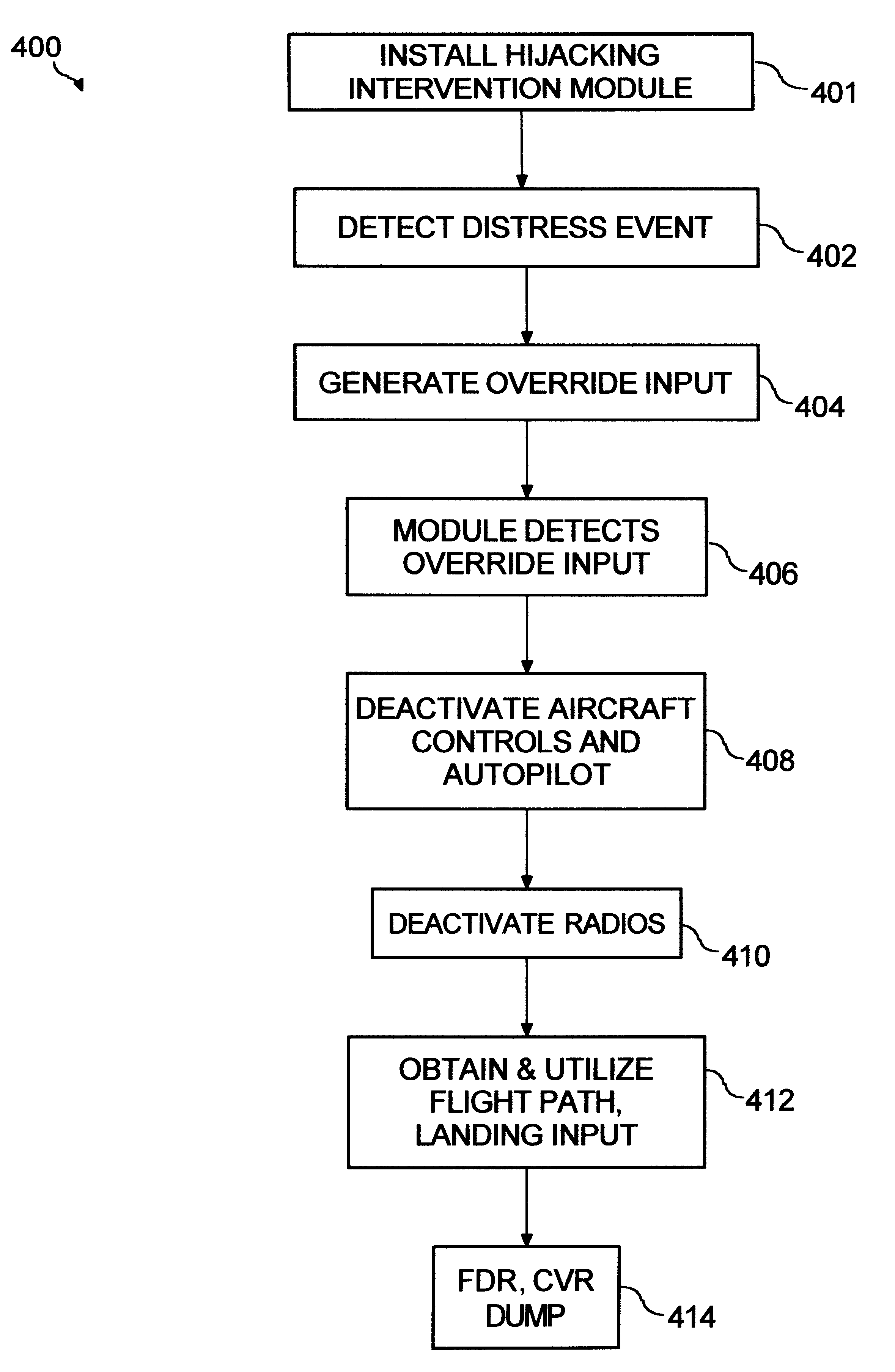
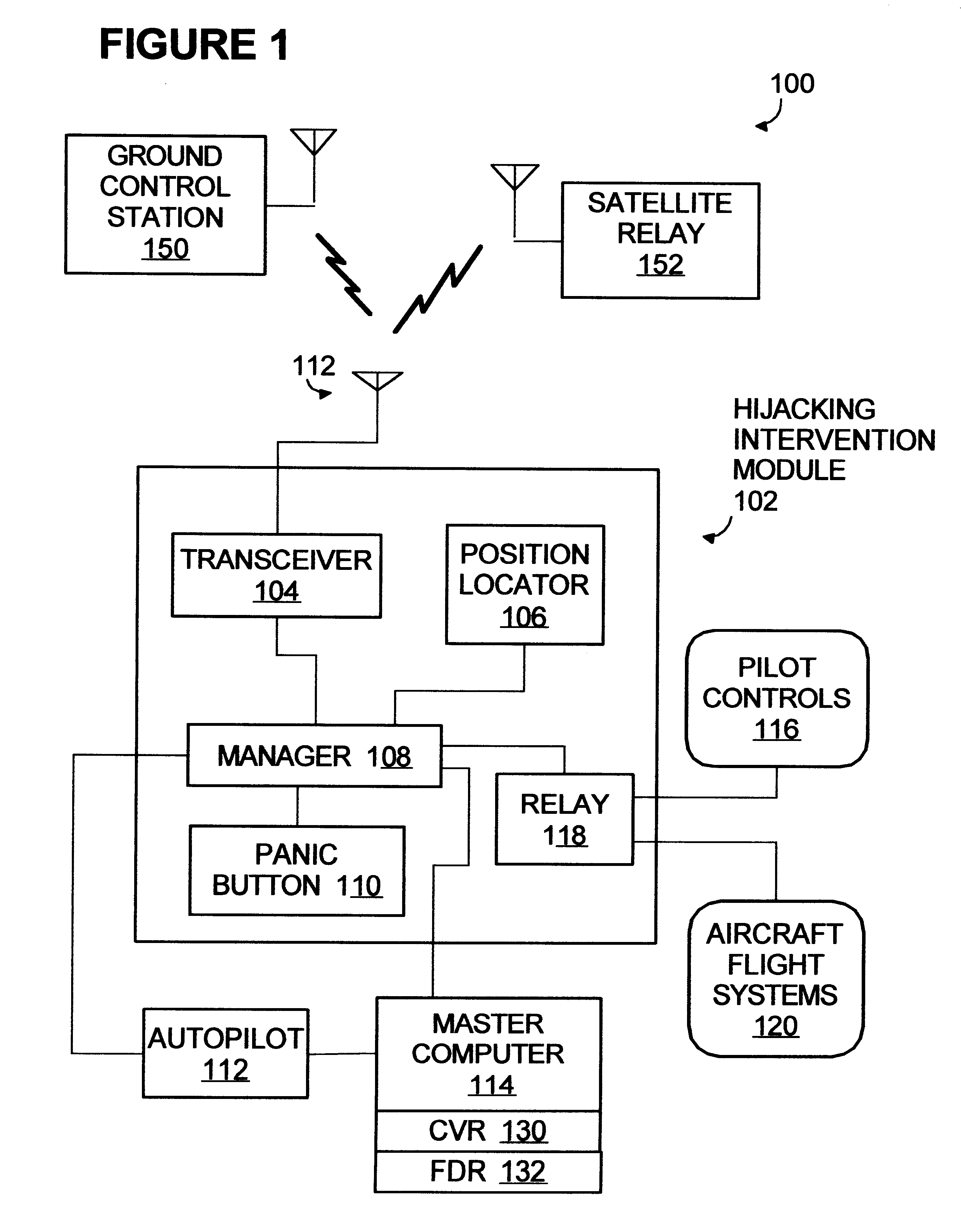
In an anti-hijacking system for autopilot equipped aircraft, a transceiver communicates with at least one remote guidance facility. A panic button is activated by flight crew in case of hijacking. A manager is coupled to the transceiver and the panic button, as well as existing avionics including the aircraft's master computer and autopilot. Optionally, a relay is coupled between the pilot controls and selected aircraft flight systems. The manager recognizes predetermined override inputs, such as activation of the panic button or receipt of override signals from the remote guidance facility. Responsive to the override input, the manager deactivates on-board control of selected aircraft flight systems and the autopilot system, and directs the autopilot to fly the aircraft to a safe landing. Flight routing and landing instructions are obtained from the remote guidance facility, or by self-evaluating nearby airports in view of the aircraft's position and various preestablished criteria.
Description
1. Field of the InventionThe present invention relates to piloting of commercial aircraft. More particularly, the invention concerns an anti-hijacking system responsive to activation of a panic button aboard the aircraft or by remote override signal to deactivate the pilot's normal flight controls and program the autopilot system to fly the aircraft to a safe landing.2. Description of the Related ArtAircraft hijacking has been a longstanding problem that continues to haunt airlines and the flying public. At best, hijacking merely inconveniences an aircraft's passengers, flight crew, airline company, and people waiting for the flight to arrive. At worst, hijacking can cause substantial loss of life and property aboard the aircraft and on the ground.Responding to the ever present threat of hijacking, airports, airlines, and government authorities are implementing different anti-hijacking measures. In airports, numerous measures are taken to screen passengers and their luggage for weap...
Claims
the structure of the environmentally friendly knitted fabric provided by the present invention; figure 2 Flow chart of the yarn wrapping machine for environmentally friendly knitted fabrics and storage devices; image 3 Is the parameter map of the yarn covering machine
Login to View More Application Information
Patent Timeline
 Login to View More
 Patent Type & AuthorityPatents(United States)
IPC IPC(8): B64D45/00G05D1/00
CPCB64D45/0015G05D1/0061B64D2045/0055B64D45/0031B64D45/0034
InventorNELSON, DOUGLAS G.
OwnerCUBIC DEFENSE SYST