
Deformable curvature mirror with unipolar-wiring
a curvature mirror and unipolar technology, applied in the field of deformation curvature mirrors, can solve the problems of large fitting errors, limited accuracy and degree of optical correction that can be applied to stack actuator type mirrors, and complex prior techniques and systems. achieve the effect of more control over the deformation of the mirror
- Summary
- Abstract
- Description
- Claims
- Application Information
AI Technical Summary
Benefits of technology
Problems solved by technology
Method used
Image

Examples
third embodiment
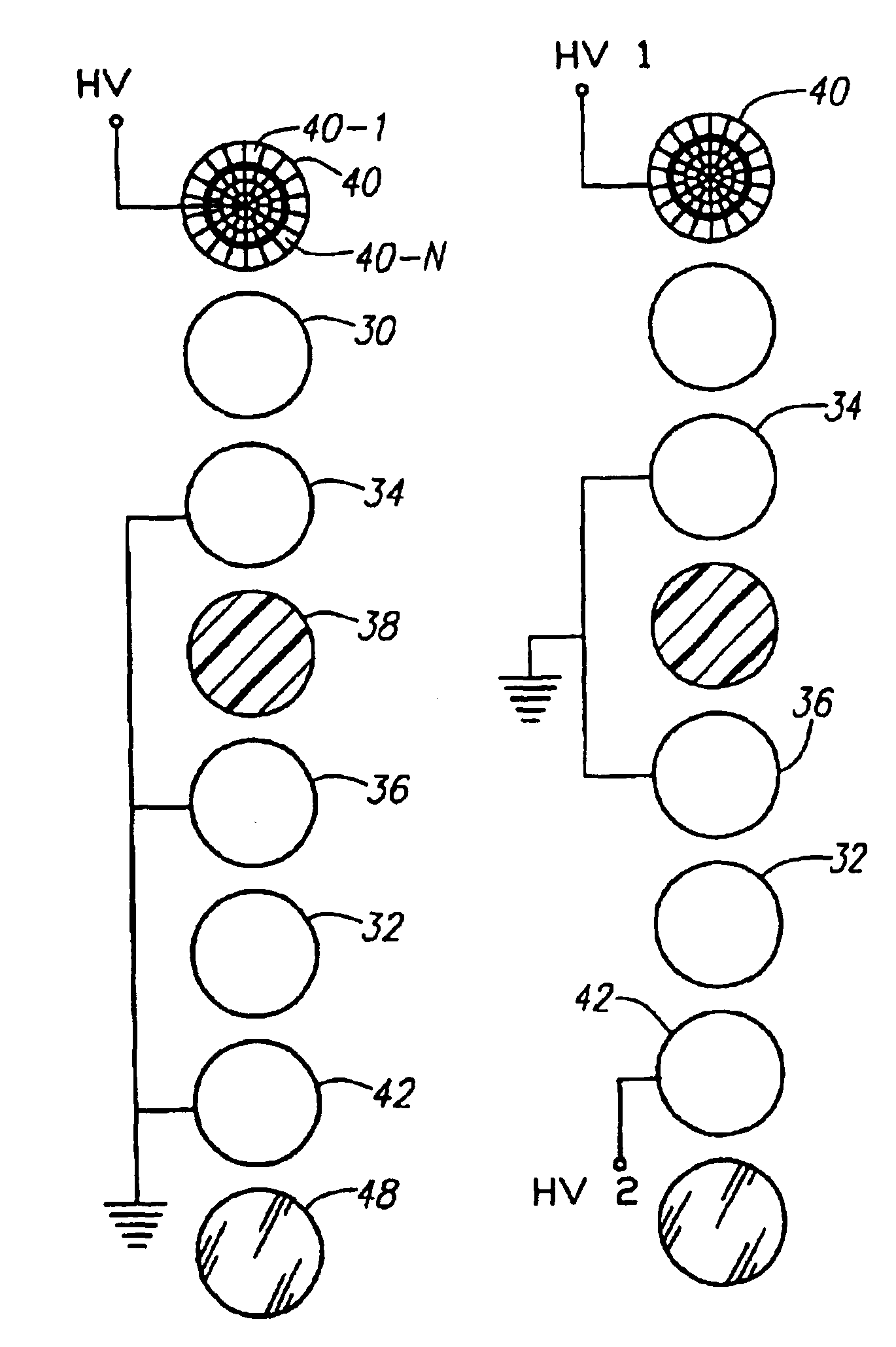
[0047]Central gold layers 34 and 36 are connected to a second unipolar voltage source UV 2. The second unipolar source UV 2 provides a unipolar voltage to central gold layers 34 and 36. Preferably the voltage provided by unipolar voltage source UV 2 is chosen such that the voltage across the electro-restrictive plate 32 to the gold layer 42 is in the same direction of the polarity of the electro-restrictive plate 32. Gold layer 42 is connected to electrical ground. In one embodiment, the second unipolar source UV 2 is held at a constant value, and varying the voltage provided by the first unipolar voltage source UV 1 controls the curvature of the mirror. In another embodiment, both unipolar voltage sources UV 1 and UV 2 are varied to control the curvature of the mirror. In yet a third embodiment, the first unipolar source UV 1 is held at a constant value, and the curvature of the mirror is controlled by varying the voltage provided by the second unipolar voltage source UV 2.
[0048]FI...
embodiment 14
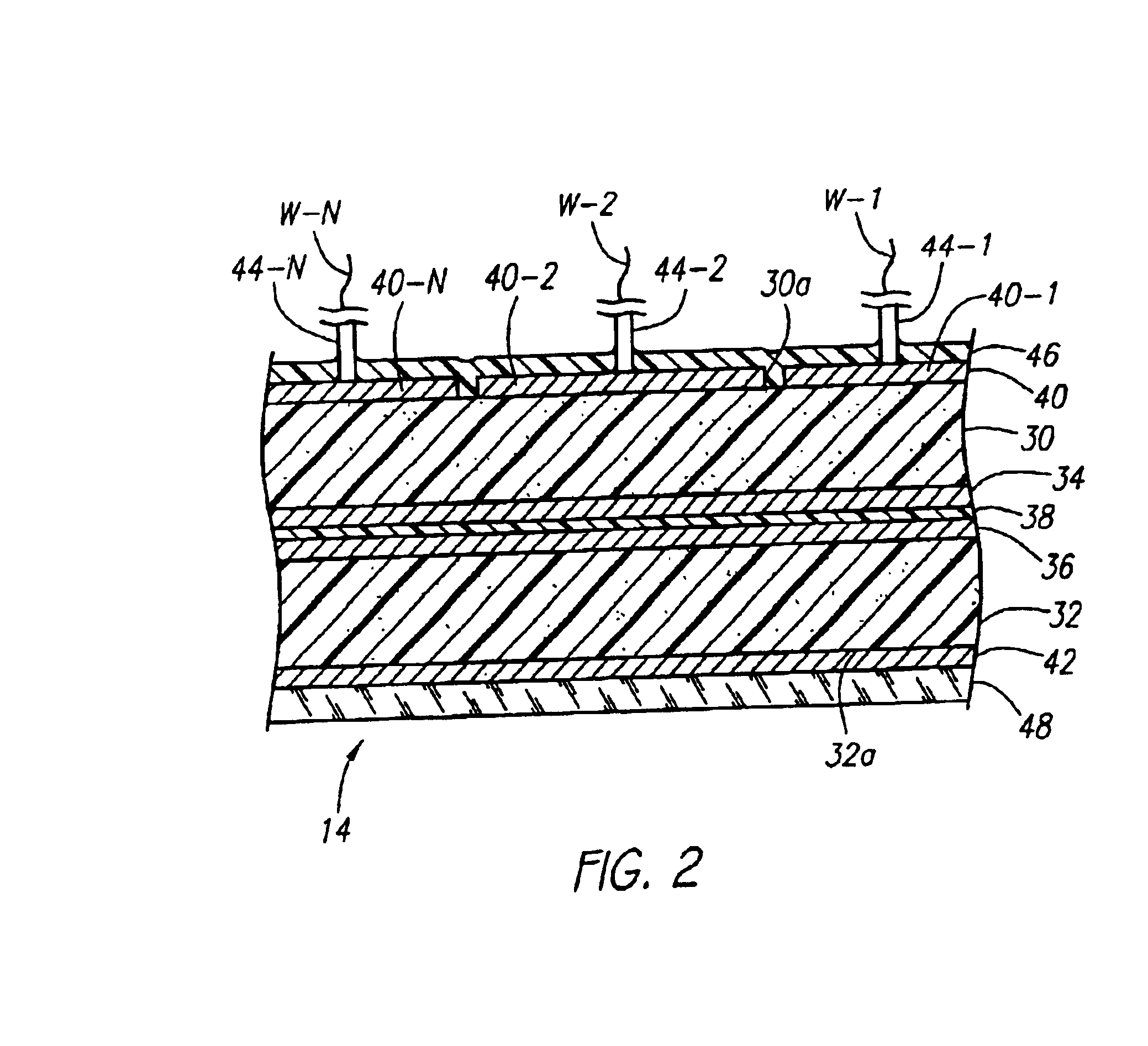
[0049]FIG. 8A illustrates the mirror embodiment 14 of FIG. 7F with equal electric field strengths across both plates 30 and 32. For example, gold layer 42 may be at ground, with no voltage applied to gold layer 34, and no voltage applied to electrode segment 40-1. This results, as shown in FIG. 8A, in a deformable mirror 14 that is not curved. In the previous example, each electro-restrictive plate has zero electric field across it. Alternately, equal nonzero electric fields across plates 30 and 32 may be applied. If the electric field strength across gold layers 42 and 34 is equal to the electric field strength between gold layer 34 and electrode 40-1, there is no curvature in the mirror. For example, assuming both plates 30 and 32 are of equal thickness, if 100 volts were applied to gold layer 34 and 200 volts applied to electrode 40-1, the voltage difference across both plates 30 and 32 would be 100 volts. This would result in equal field strengths across plates 30 and 32, and an...
PUM
 Login to View More
 Abstract
Description
Claims
Application Information
 Login to View More