
Mechanism for effectively handling livelocks in a simultaneous multithreading processor
a multi-threading processor and livelock technology, applied in the field of multi-threading processors, can solve the problem of too slow detection techniques of livelock conditions
- Summary
- Abstract
- Description
- Claims
- Application Information
AI Technical Summary
Benefits of technology
Problems solved by technology
Method used
Image

Examples
Embodiment Construction
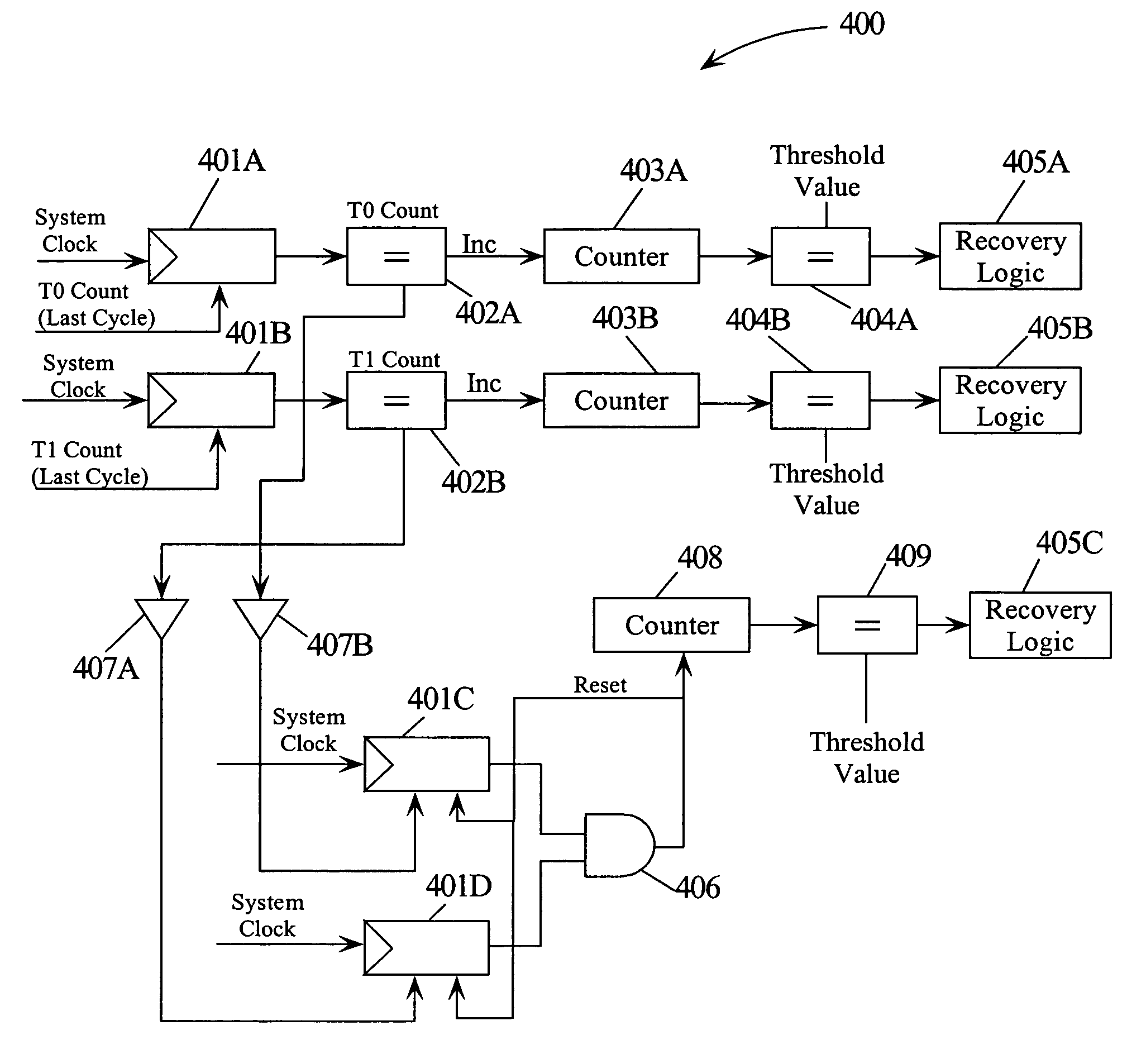
[0020]The present invention comprises a method and multithreaded processor for handling livelocks in a simultaneous multithreaded processor. In one embodiment of the present invention, a number of instructions for a thread in a queue may be counted. A counter in the queue may be incremented if the number of instructions for the thread in the queue in a previous clock cycle is equal to the number of instructions for the thread in the queue in the current clock cycle. If the value of the counter equals a threshold value, then a livelock condition may be detected. Further, if the value of the counter equals a threshold value, then a recovery action may be activated to handle the livelock condition detected. In another embodiment of the present invention, a number of instructions for a plurality of threads in a queue may be counted. A counter in the queue may be incremented if the number of instructions for each of the plurality of threads in the queue did not all change from a previous...
PUM
 Login to View More
 Abstract
Description
Claims
Application Information
 Login to View More