Device for a ball-and-socket joint type connection of two members

a technology of ball and socket joint and joint, which is applied in the direction of ligaments, prostheses, osteosynthesis devices, etc., can solve the problem that the connection mechanism must have a large overall height, and achieve the effect of small overall height of the connection mechanism

US7121755B2Inactive Publication Date: 2006-10-17SYNTHES USA
13 Cites 124 Cited by

Patent Information

Authority / Receiving Office
US · United States
Patent Type
Patents(United States)
Current Assignee / Owner
Publication Date
2006-10-17
Estimated Expiration
Not applicable · inactive patent

Smart Images

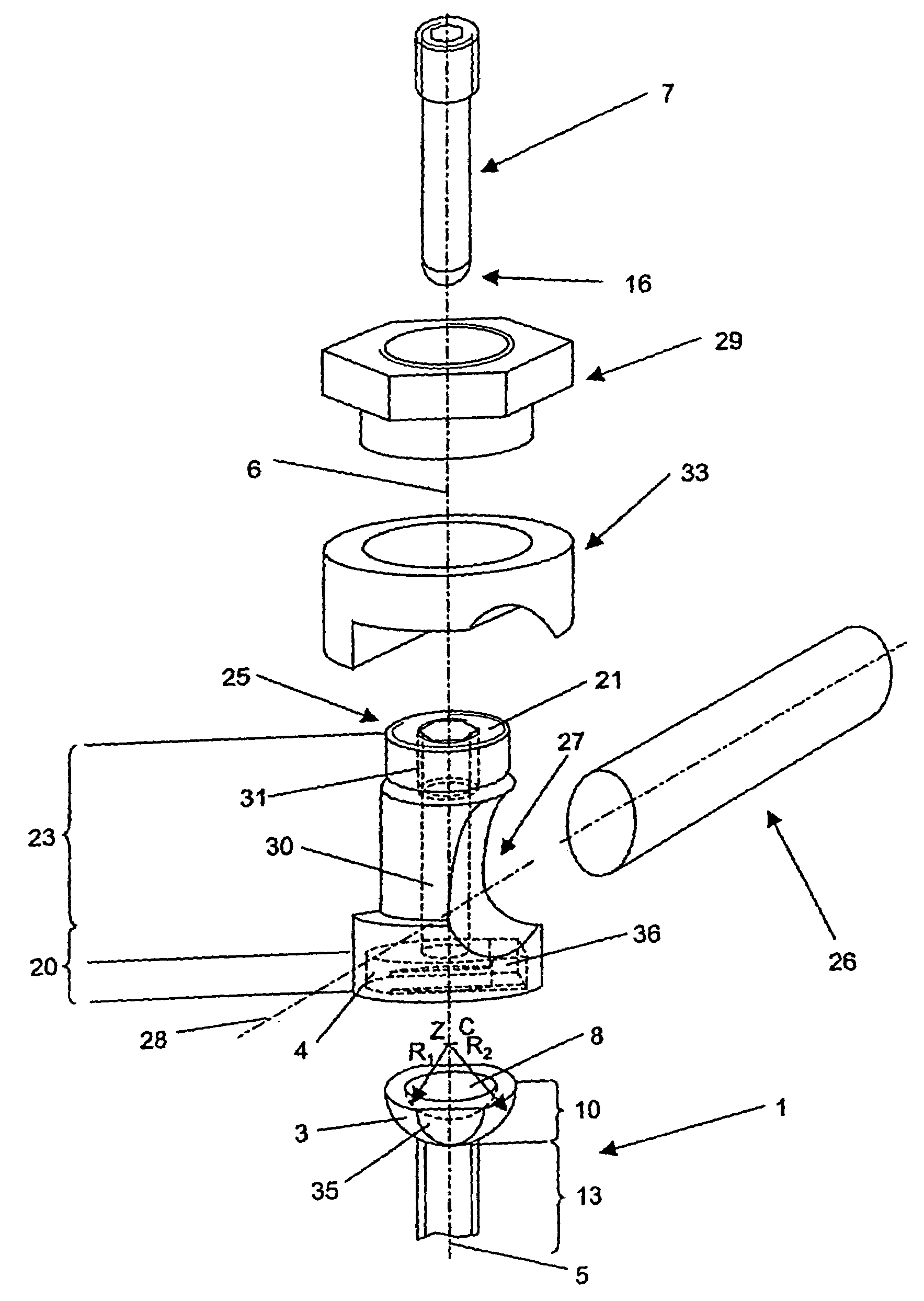
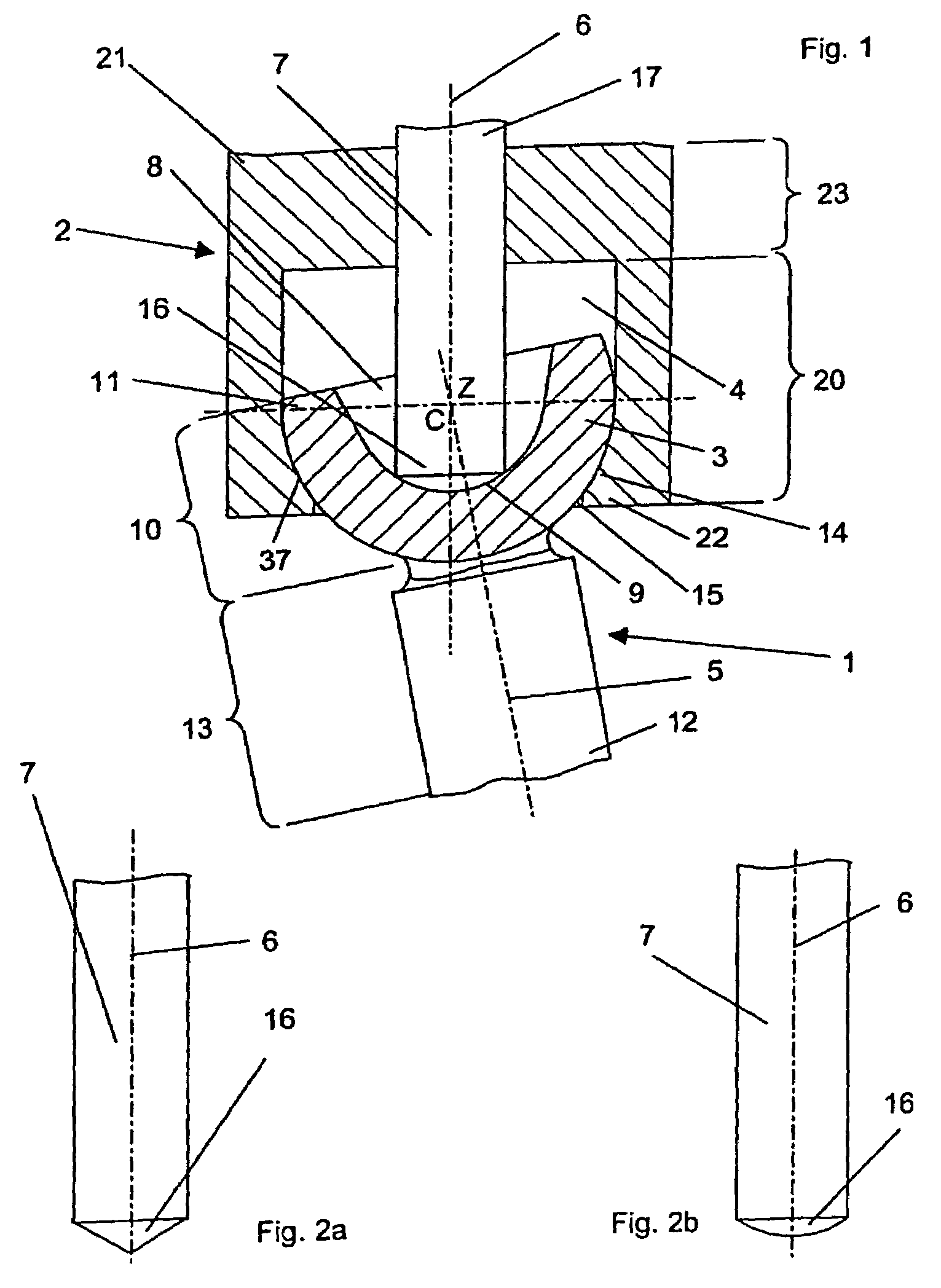
  • Figure 1
    Figure 1
  • Figure 2
    Figure 2
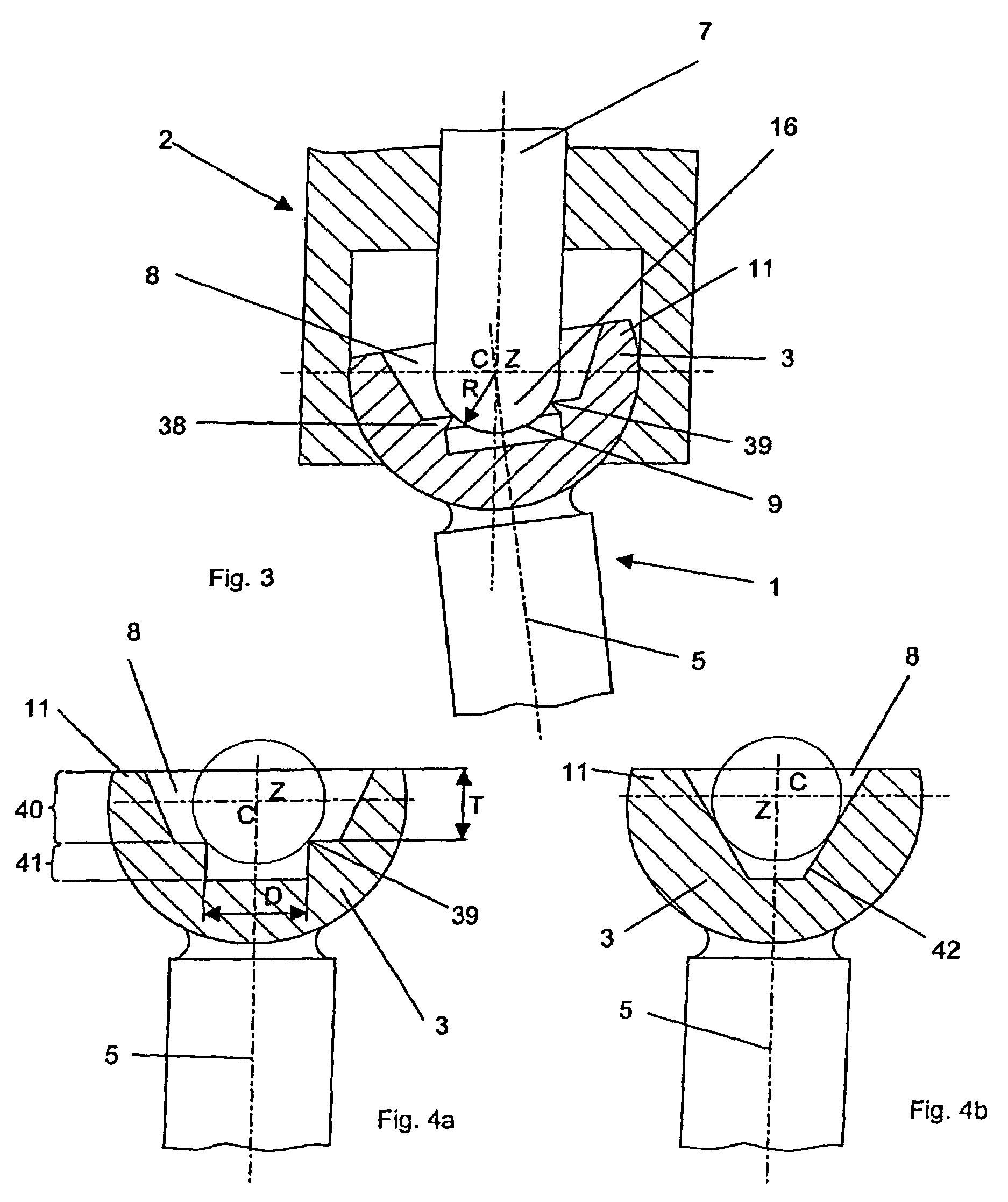
  • Figure 3
    Figure 3
Patent Text Reader

Abstract

A device for a ball-and-socket-type connection of two members includes a first member having a head and a second member having a cavity that receives the head. The cross-sectional surface of the cavity is tapered at the lower end of the second member as a result of a constriction. The head and / or cavity is configured spherically with a center of articulation (Z). The ball-and-socket-type connection between the two members can be detachably fixed by a clamping element that can be connected to the second member. The head has a recess in which the front end of the clamping element can rest. The recess and / or the front end has an at least partially spherical surface with a centre (C). In the clamped position of the device, the center of articulation (Z) and the centre (C) are identical.
Need to check novelty before this filing date? Find Prior Art

Description

[0001] This application is a continuation of pending application PCT / CH01 / 00744 filed Dec. 31, 2001.FIELD OF THE INVENTION

[0002] The invention relates to a device for the ball-and-socket joint type connection of two parts.BACKGROUND OF THE INVENTION

[0003] A stabilization device that interconnects the bone-fixation means, such as pedicle screws, with a longitudinal member, such as a longitudinal spinal rod, extending along at least a portion of a patient's spinal column, is used, for example, for the internal stabilization of the spinal column. In order to securely stabilize the spinal column, it should be possible to connect the bone-fixation means, on the one hand, firmly with the vertebrae and, on the other, with the longitudinal member. Preferably, the head of the bone fixation means and the longitudinal member are connected by a connecting mechanism, which permits the longitudinal member to be fixed with respect to the bone-fixation means at a variety of different angles. Moreover,...

Examples

Embodiment Construction

[0044]For the purposes of promoting an understanding of the principles of the invention, reference will now be made to an exemplary, non-limiting embodiment illustrated in the figures and specific language will be used to describe the same. It will nevertheless be understood that no limitation of the scope of the invention is hereby intended, such alterations and further modifications, and such further applications of the principles of the invention as illustrated herein being contemplated as would normally occur to one skilled in the art to which the invention relates.

[0045]As shown in FIG. 1, the device includes a first member 1 and a second member 2, wherein the second member 2 includes a cavity 4 and clamping means 7 while the first member 1 has a central axis 5, an upper end 11, and a lower end 12. The upper end 11 of the first member 1 may include a first joint segment 10, which may be constructed as a spherically shaped joint head 3, the center of which, preferably lies on th...