
System and method for multi-sampling primitives to reduce aliasing
a multi-sampling primitive and primitive technology, applied in the field of sampled imagery, can solve the problems of large amount of effort devoted to developing sophisticated graphics processing and rendering techniques, affecting the effect of viewers, and creating motion artifacts
- Summary
- Abstract
- Description
- Claims
- Application Information
AI Technical Summary
Benefits of technology
Problems solved by technology
Method used
Image

Examples
Embodiment Construction
[0015]Embodiments of the present invention render antialiased images by reducing artifacts in both static images and also in motion pictures or animation. The systems and methods described herein perform antialiased rendering through a process of taking multiple samples, or “over-sampling” at the primitive or primitive set level for calculating the colors or values of pixels forming a resulting computer graphics image. Certain details are set forth below to provide a sufficient understanding of the invention. However, it will be clear to one skilled in the art that the invention may be practiced without these particular details. In other instances, well-known circuits, control signals, timing protocols, and software operations have not been shown in detail in order to avoid unnecessarily obscuring the invention.
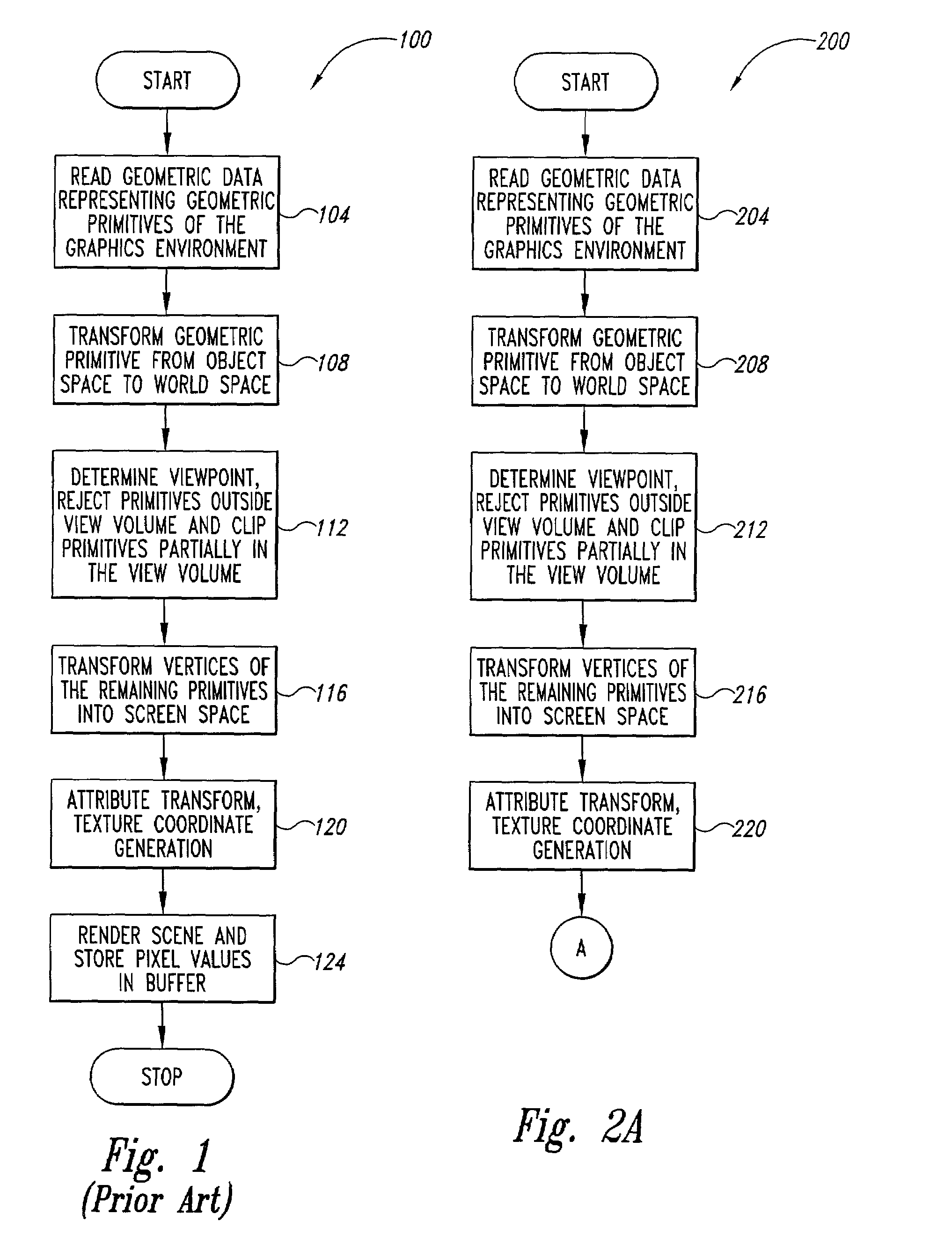
[0016]Illustrated in FIG. 1 is a process flow diagram 100 of a conventional 3D graphics pipeline process. It will be appreciated that FIG. 1 does not necessarily represent a ...
PUM
 Login to View More
 Abstract
Description
Claims
Application Information
 Login to View More