Unlock instant, AI-driven research and patent intelligence for your innovation.

Adaptive adjustment of backoff times in wireless network communications

a wireless network and backoff time technology, applied in the field of wireless computer networks, can solve the problems of reducing the effective data rate of the network, and improving the chances, so as to achieve the effect of maximizing the data throughpu

Active Publication Date: 2007-04-24
TEXAS INSTR INC
View PDF8 Cites 26 Cited by
  • Summary
  • Abstract
  • Description
  • Claims
  • Application Information

AI Technical Summary

Benefits of technology

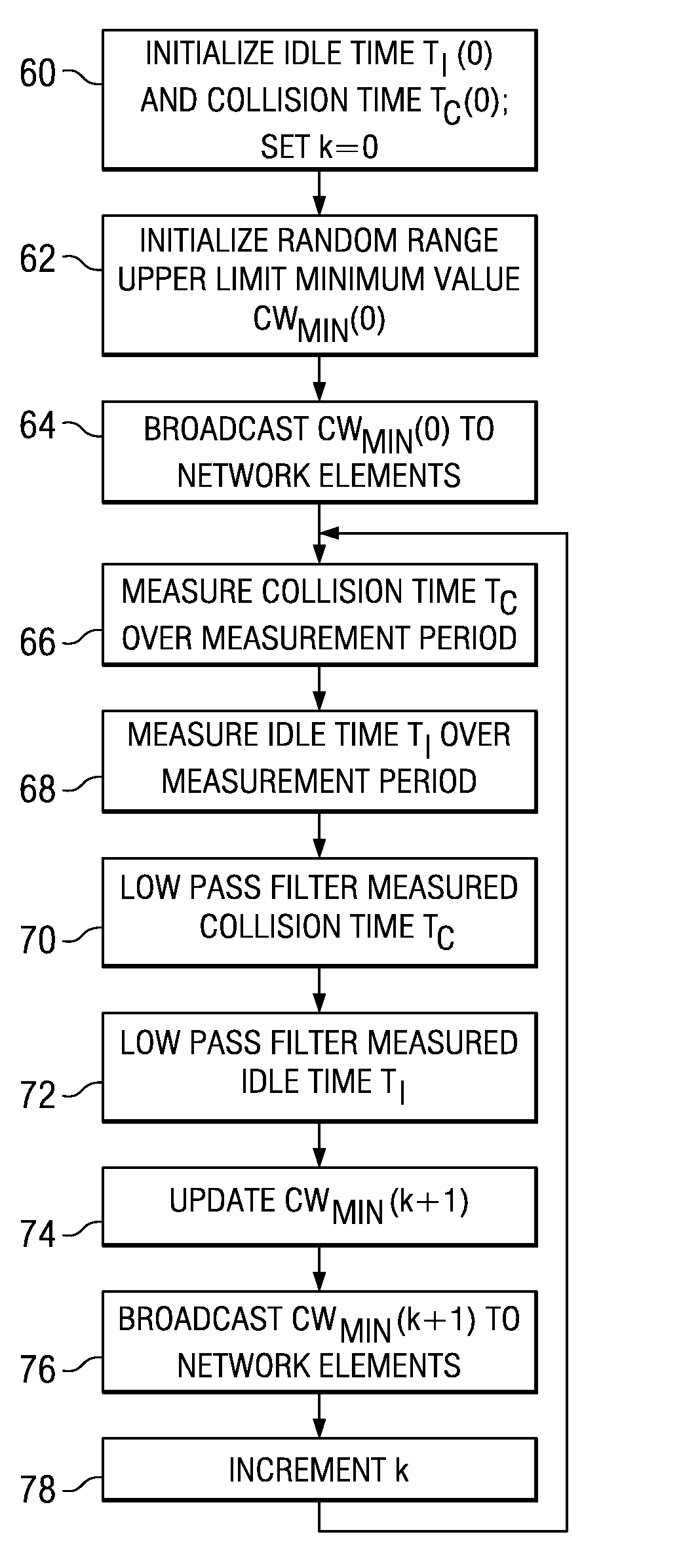
[0015]It is a further object of this invention to provide such a network, elements, and method, in which the data throughput over the network is maximized without expressly measuring the idle and collision times.

Problems solved by technology

As is well known in the wireless LAN art, one complication in the operation of a wireless network is the management of reliable communications among the various elements of the network within a finite bandwidth.
Collisions therefore reduce the effective data rate of the network.
Conversely, idle time spent by the network elements in order to avoid collisions also reduce the effective data rate of the network.
According to this conventional approach, if a collision occurs, the upper limit CW of the pseudo-random range is increased (typically doubled) at each station, improving the chances for a successful transmission, but at a cost of additional latency on the channel.

Method used

the structure of the environmentally friendly knitted fabric provided by the present invention; figure 2 Flow chart of the yarn wrapping machine for environmentally friendly knitted fabrics and storage devices; image 3 Is the parameter map of the yarn covering machine
View more

Image

Smart Image Click on the blue labels to locate them in the text.
Viewing Examples
Smart Image
  • Adaptive adjustment of backoff times in wireless network communications
  • Adaptive adjustment of backoff times in wireless network communications
  • Adaptive adjustment of backoff times in wireless network communications

Examples

Experimental program
Comparison scheme
Effect test

Embodiment Construction

[0026]This invention will be described in connection with its preferred embodiments in a context in which these preferred embodiments are particularly beneficial. More specifically, the preferred embodiments of this invention will be described in this specification in connection with a wireless computer network, in the context of a basic service set (BSS). It is of course contemplated that this invention may be implemented into other network applications, including extended service set (ESS) wireless networks, wireless networks according to standards other than the current and draft IEEE 802.11 specifications, and indeed in a wide range of other communications applications. Further, it is contemplated that those skilled in the art having reference to this specification will be readily able to implement this invention in these described embodiments and its variations and alternatives, all of which are contemplated to be within the true scope of this invention as claimed.

[0027]FIG. 1 ...

the structure of the environmentally friendly knitted fabric provided by the present invention; figure 2 Flow chart of the yarn wrapping machine for environmentally friendly knitted fabrics and storage devices; image 3 Is the parameter map of the yarn covering machine
Login to View More

PUM

No PUM Login to View More

Abstract

A wireless network, including a plurality of network elements such as a wireless access point (9), and computer stations (2, 4, 6), is disclosed. The wireless network operates so that each network element (2, 4, 6, 9) waits for a pseudo-randomly selected duration, after the end of a frame on the channel, before initiating transmission. One of the network elements, such as the wireless access point (9), measures the performance of the network over a measurement period (T), and adjusts a minimum value of the upper limit of the range from which the random duration is selected, according to the performance of the network over the measurement period. The times measured may be the successful transmission time (Ts), which is maximized in adjusting the minimum value, or the idle and collision times (T1, Tc), which are equated in the optimization of the minimum value.

Description

CROSS-REFERENCE TO RELATED APPLICATIONS[0001]Not applicable.STATEMENT REGARDING FEDERALLY SPONSORED RESEARCH OR DEVELOPMENT[0002]Not applicable.BACKGROUND OF THE INVENTION[0003]This invention is in the field of wireless computer networks, and is more specifically directed to the optimization of data transmissions in wireless networks.[0004]In recent years, the networking of multiple computers has become widespread, not only in business environments but also in the home. While many of these Local Area Networks (LANs) are “wired” networks, such as Ethernet networks, wireless networks have recently become quite popular, in large part because of recent reductions in the cost of wireless network equipment. An attractive benefit of wireless networks is the ease of installation, because cabling need not be run in order to set up a network. In addition, portable computing devices, such as laptop personal computers, become truly portable when communicating over wireless networks. Indeed, man...

Claims

the structure of the environmentally friendly knitted fabric provided by the present invention; figure 2 Flow chart of the yarn wrapping machine for environmentally friendly knitted fabrics and storage devices; image 3 Is the parameter map of the yarn covering machine
Login to View More

Application Information

Patent Timeline
no application Login to View More
IPC IPC(8): H04Q7/24H04B7/212H04J3/00H04L12/413H04L12/28H04L12/56H04W28/04H04W72/14H04W74/08H04W84/12
CPCH04W74/0833H04W74/085H04W74/006H04W84/12
Inventor LIU, YONGHESHOEMAKE, MATTHEW B.HO, JIN-MENG
Owner TEXAS INSTR INC