[0008]Accordingly it is one
advantage of the present invention to overcome some or all of the above limitations by providing an automated speed-adaptive and patient-
adaptive control scheme and system for a knee
prosthesis. The control scheme and system utilizes sensory information measured local to the
prosthesis to automatically adjust stance and swing phase knee resistances to a particular wearer under a wide variety of locomotory activities. Advantageously, no patient-specific
information needs to be pre-programmed into the
prosthetic knee by a prosthetist or the patient. The system is able to adapt to various types of disturbances once the patient leaves the prosthetist's facility because it is patient-adaptive and speed-adaptive.
[0009]In accordance with one preferred embodiment, a method is provided of adaptively controlling the
stance phase damping of a prosthetic knee worn by a patient. The method comprises the step of providing a memory in the prosthetic knee. The memory has stored therein correlations between sensory data and
stance phase damping established in clinical investigations of amputees of varying
body size. Instantaneous sensory information is measured using sensors local to the prosthetic knee as the patient stands, walks or runs. The instantaneous sensory information is used in conjunction with the correlations to automatically adjust
stance phase damping suitable for the patient without requiring
patient specific information to be pre-programmed in the prosthetic knee.
[0010]In accordance with another preferred embodiment, a method is provided of adaptively controlling the swing phase
damping torque of a prosthetic knee worn by a patient as the patient travels at various locomotory speeds. The
ground contact time of a prosthetic foot connected to the prosthetic knee by a prosthetic leg is indicative of the locomotory speed of the patient. The method comprises the step of continuously measuring the
contact time over periods of one
gait cycle as the patient ambulates at various locomotory speeds. The
contact time is stored within a memory of the prosthetic knee in time slots corresponding to the locomotory speed of the patient. The swing phase damping for
knee flexion is iteratively modulated to achieve a target peak
flexion angle range until the flexion damping converges within each time slot. The swing phase damping for
knee extension is iteratively modulated to control the
impact force of the extending prosthetic leg against an
artificial knee cap of the prosthetic knee until the extension damping converges within each time slot. The converged damping values are used to automatically control swing phase damping at all locomotory speeds.
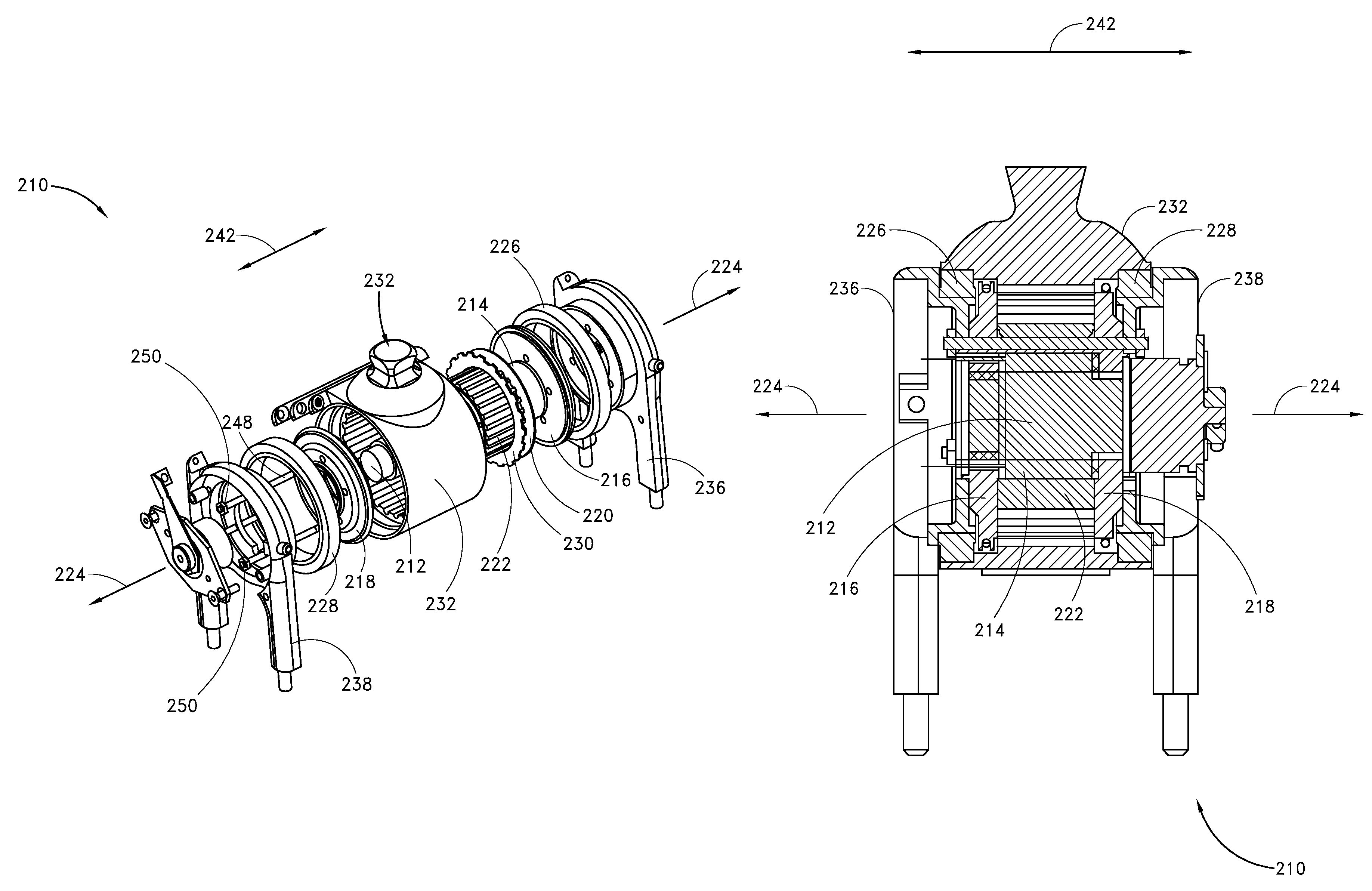
[0011]In accordance with one preferred embodiment, an adaptive prosthetic knee is provided for controlling the knee
damping torque during stance phase of an amputee. The prosthetic knee generally comprises a controllable knee
actuator, sensors and a controller. The knee
actuator provides a variable
damping torque in response to command signals. The sensors measure the force and moment applied to the prosthetic knee as the amputee moves over a supporting surface. The controller has a memory and is adapted to communicate command signals to the knee
actuator and receive input signals from the sensors. The memory has stored therein relationships between sensory data and stance phase damping established in prior clinical investigations of patients of varying
body size. The controller utilizes sensory data from the sensors in conjunction with the relationships to adaptively and automatically control the damping torque provided by the knee actuator during stance phase independent of any prior knowledge of the size of the amputee.
[0012]For purposes of summarizing the invention, certain aspects, advantages and novel features of the invention have been described herein above. Of course, it is to be understood that not necessarily all such advantages may be achieved in accordance with any particular embodiment of the invention. Thus, the invention may be embodied or carried out in a manner that achieves or optimizes one
advantage or group of advantages as taught herein without necessarily achieving other advantages as may be taught or suggested herein.
[0013]All of these embodiments are intended to be within the scope of the invention herein disclosed. These and other embodiments of the present invention will become readily apparent to those skilled in the art from the following detailed description of the preferred embodiments having reference to the attached figures, the invention not being limited to any particular preferred embodiment(s) disclosed.



 Login to View More
  Login to View More