Unlock instant, AI-driven research and patent intelligence for your innovation.

Light-emitting apparatus and method of manufacturing the same

Inactive Publication Date: 2007-11-27
SEMICON ENERGY LAB CO LTD
View PDF29 Cites 21 Cited by
  • Summary
  • Abstract
  • Description
  • Claims
  • Application Information

AI Technical Summary

Benefits of technology

[0016]Therefore, the present invention has been made with the foregoing in mind, and it is an object of the present invention to provide a light-emitting device composed of a light-emitting element using an organic compound with a prolonged life and enhanced reliability, and a method of manufacturing the same.
[0017]In order to solve the above-mentioned problem, the present invention relates to a light-emitting device which has an insulating layer provided between an organic compound layer and an electrode positioned below the organic compound layer, and the insulating layer allows a tunnel current or a Fowler-Nordheim current to flow therethrough to supply a current to the organic compound layer, and prevents moisture from diffusing to the organic compound layer. Such kind of insulating layer is formed of one kind or a plurality of kinds in combination selected from the group consisting of silicon oxide, silicon nitride, and silicon oxynitride, and has a thickness of 1 to 10 nm, and preferably a thickness of 2 to 3 nm.
[0020]The following structure is provided: a first electrode and an organic compound layer form a tunnel junction; a second insulating layer is formed to have a thickness that allows the first electrode and the organic compound layer to form a tunnel junction; or the second insulating layer is formed to have a thickness that allows a tunnel current to flow therethrough. More specifically, by forming the second insulating layer to have a thickness of 1 to 10 nm, preferably 2 to 3 nm, a tunnel current is allowed to flow between the first electrode and the organic compound layer. By providing the second insulating layer, minute unevenness on the surface of the first electrode (anode) is flattened, and the organic compound layer can be formed uniformly. Even if unevenness and foreign matters with several tens of to several hundreds of nm are present on the first interlayer insulating film or the second interlayer insulating film, a dark spot and a defect (non-lighting of a light-emitting element due to a short-circuit between the first and second electrodes) can be prevented by forming the second insulating layer.
[0022]By using an inorganic material such as silicon oxide, silicon nitride, and silicon oxynitride for the second insulating layer, oxygen and moisture contained in the interlayer insulating film formed of an organic resin can be prevented from entering the organic compound layer, thereby avoiding degradation of the organic compound layer. Furthermore, the second insulating layer using the above-mentioned inorganic material can prevent an alkali metal or alkaline-earth metal material that degrades the characteristics of a TFT, such as Li and Mg contained in the second electrode of the light-emitting element, from entering an active layer of the TFT.

Problems solved by technology

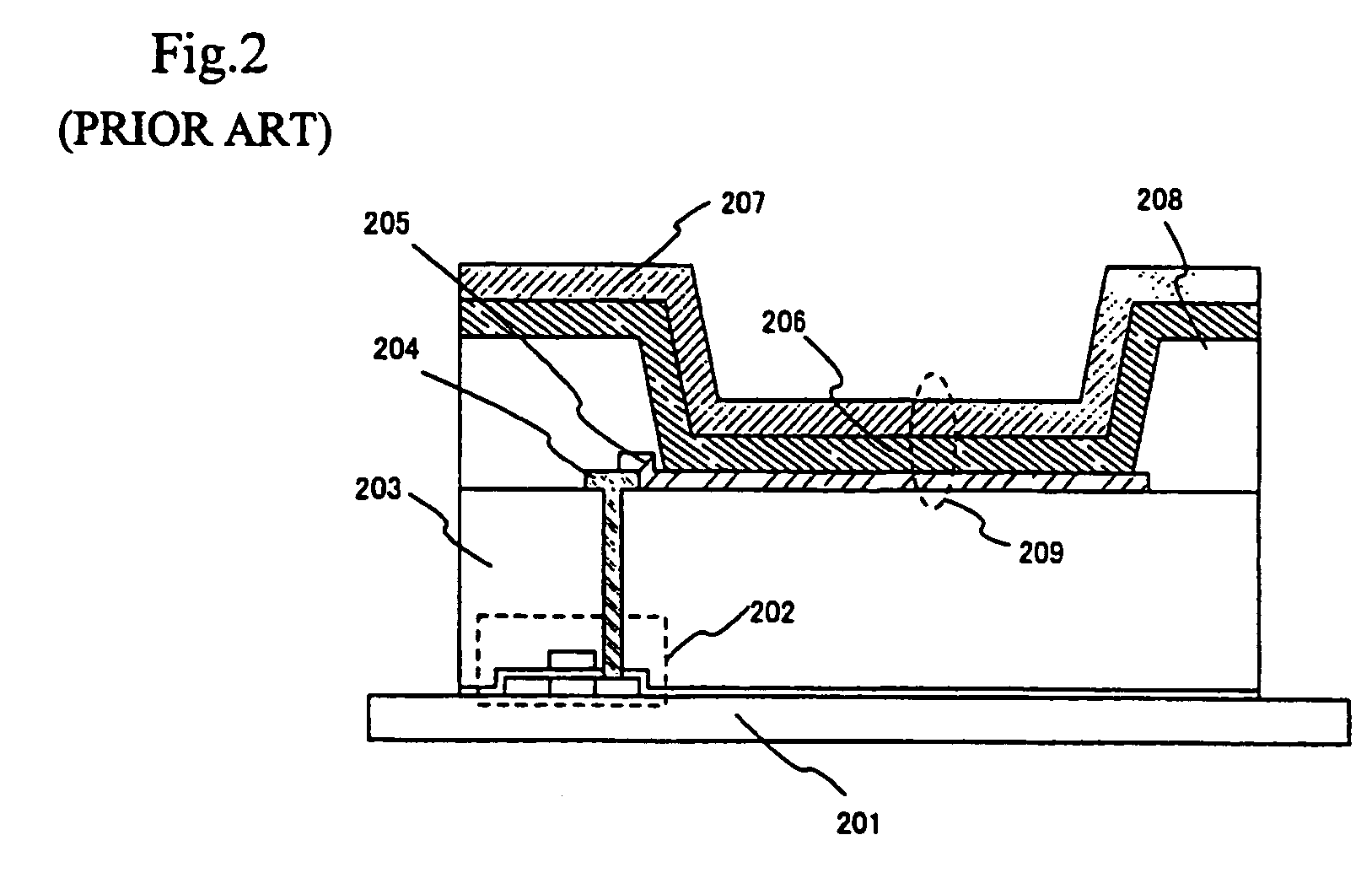
Furthermore, when the insulating surface under the first electrode is not flat and has foreign matters and unevenness with a thickness almost equal to or larger than that of the first electrode, the first electrode is not formed uniformly, and has a surface reflecting the unevenness.
Because of this, the organic compound layer is not formed uniformly, either.
Furthermore, a short-circuit is caused vertically between the first and second electrodes.

Method used

the structure of the environmentally friendly knitted fabric provided by the present invention; figure 2 Flow chart of the yarn wrapping machine for environmentally friendly knitted fabrics and storage devices; image 3 Is the parameter map of the yarn covering machine
View more

Image

Smart Image Click on the blue labels to locate them in the text.
Viewing Examples
Smart Image
  • Light-emitting apparatus and method of manufacturing the same
  • Light-emitting apparatus and method of manufacturing the same
  • Light-emitting apparatus and method of manufacturing the same

Examples

Experimental program
Comparison scheme
Effect test

embodiment 1

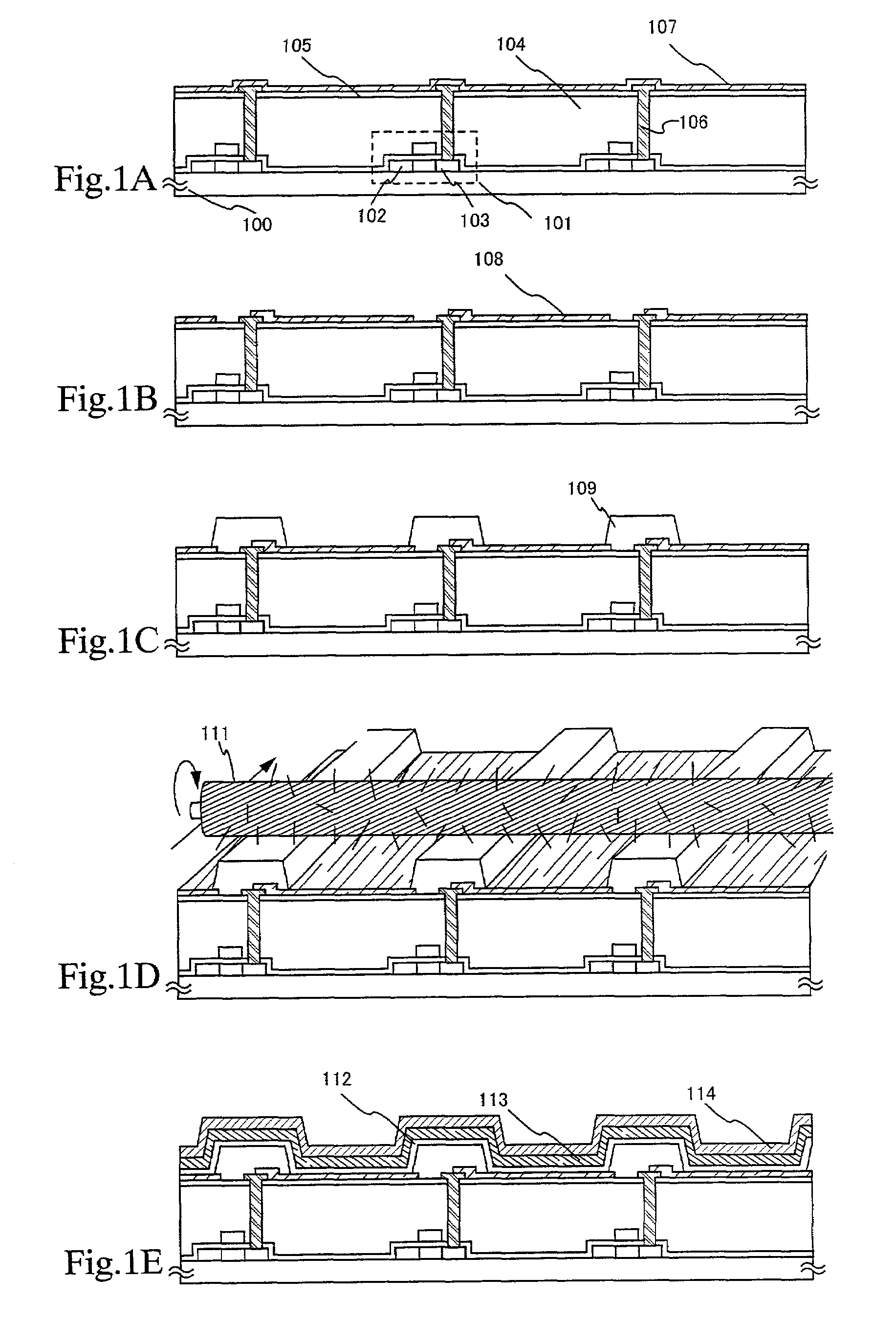
[0068]In this embodiment, the light-emitting element formed by using the present invention is explained. Described next is an example of a method of manufacturing, at the same time on the same substrate, TFTs for a pixel portion having a light-emitting element of the present invention and TFTs (an n-channel TFT and a p-channel TFT) for a driving circuit that is provided in the periphery of the pixel portion. The description will be given with reference to FIGS. 3A to 6C.

[0069]First, as shown in FIG. 3A, this embodiment uses a substrate 900 made of barium borosilicate glass, typically Corning #7059 glass and #1737 glass (products of Corning Incorporated), or alumino borosilicate glass. No limitation is put to the material of the substrate 900 as long as it is light-transmissive, and a quartz substrate may be used. A plastic substrate may also be used if it can withstand heat at the process temperature of this embodiment.

[0070]Next, a base film 901 is formed on the substrate 900 from ...

embodiment 2

[0117]In Embodiment 1, the first electrode is formed of Mg—Ag, an Al—Li alloy film, or a film formed by co-deposition of an element belonging to Group I or II of the periodic table and aluminum, and the second electrode is formed of a transparent conductive film material, whereby a light-emitting device emitting light to the opposite side of the substrate 100 can be produced.

embodiment 3

[0118]The processes are conducted in the same way as in Embodiment 1 until the second interlayer insulating film 935 is formed. Then, the second interlayer insulating film 935 is subjected to a plasma treatment, in place of forming the insulating film 936 in Embodiment 1, whereby the surface of the second interlayer insulating film 935 is modified. This method will be described with reference to FIG. 7.

[0119]The second interlayer insulating film 935 is subjected to a plasma treatment in one kind or a plurality of kinds of gases selected from the group consisting of hydrogen, nitrogen, hydrocarbon, halocarbon, hydrogen fluoride, and noble gas (Ar, He, Ne, etc.), whereby a new coating film is formed on the surface of the second interlayer insulating film 953, or the kind of a functional group present on the surface is changed. As a result, the surface of the second interlayer insulating film 935 can be modified. On the surface of the second interlayer insulating film 935, a densified ...

the structure of the environmentally friendly knitted fabric provided by the present invention; figure 2 Flow chart of the yarn wrapping machine for environmentally friendly knitted fabrics and storage devices; image 3 Is the parameter map of the yarn covering machine
Login to View More

PUM

No PUM Login to View More

Abstract

A light-emitting apparatus of the present invention includes: a first electrode formed on an insulating surface; a first insulating layer covering an end portion of the first electrode and having a tapered edge; a second insulating layer formed on the first electrode and the first insulating layer and formed of one kind or a plurality of kinds selected from the group consisting of silicon oxide, silicon nitride, and silicon oxynitride; an organic compound layer formed on the second insulating layer; and a second electrode formed on the organic compound layer.

Description

BACKGROUND OF THE INVENTION[0001]1. Field of the Invention[0002]The present invention relates to a light-emitting device using a light-emitting element which has a film (hereinafter, referred to as an “organic compound layer”) containing an organic compound that emits light through fluorescence and phosphorescence by applying an electric field, and a method of manufacturing the same.[0003]2. Description of the Related Art[0004]A light-emitting element using an organic compound as an illuminant has characteristics such as thinness and light-weight, high response, and driving at a D.C. current and a low voltage. Thus, such light-emitting element is expected to be applied to a next-generation flat panel display. In particular, a display device with light-emitting elements arranged in matrix is considered to have the advantages of a wide viewing angle and excellent visibility, compared with a conventional liquid crystal display device.[0005]According to a light-emitting mechanism of a l...

Claims

the structure of the environmentally friendly knitted fabric provided by the present invention; figure 2 Flow chart of the yarn wrapping machine for environmentally friendly knitted fabrics and storage devices; image 3 Is the parameter map of the yarn covering machine
Login to View More

Application Information

Patent Timeline
no application Login to View More
IPC IPC(8): H01L51/52H01L27/32
CPCH01L27/1214H01L51/5253H01L51/5206H01L27/3246H01L29/4908H01L29/42384H01L27/1259H10K59/122H10K50/81H10K50/844H10K59/1201
Inventor SAKAKURA, MASAYUKIYAMAZAKI, SHUNPEI
Owner SEMICON ENERGY LAB CO LTD