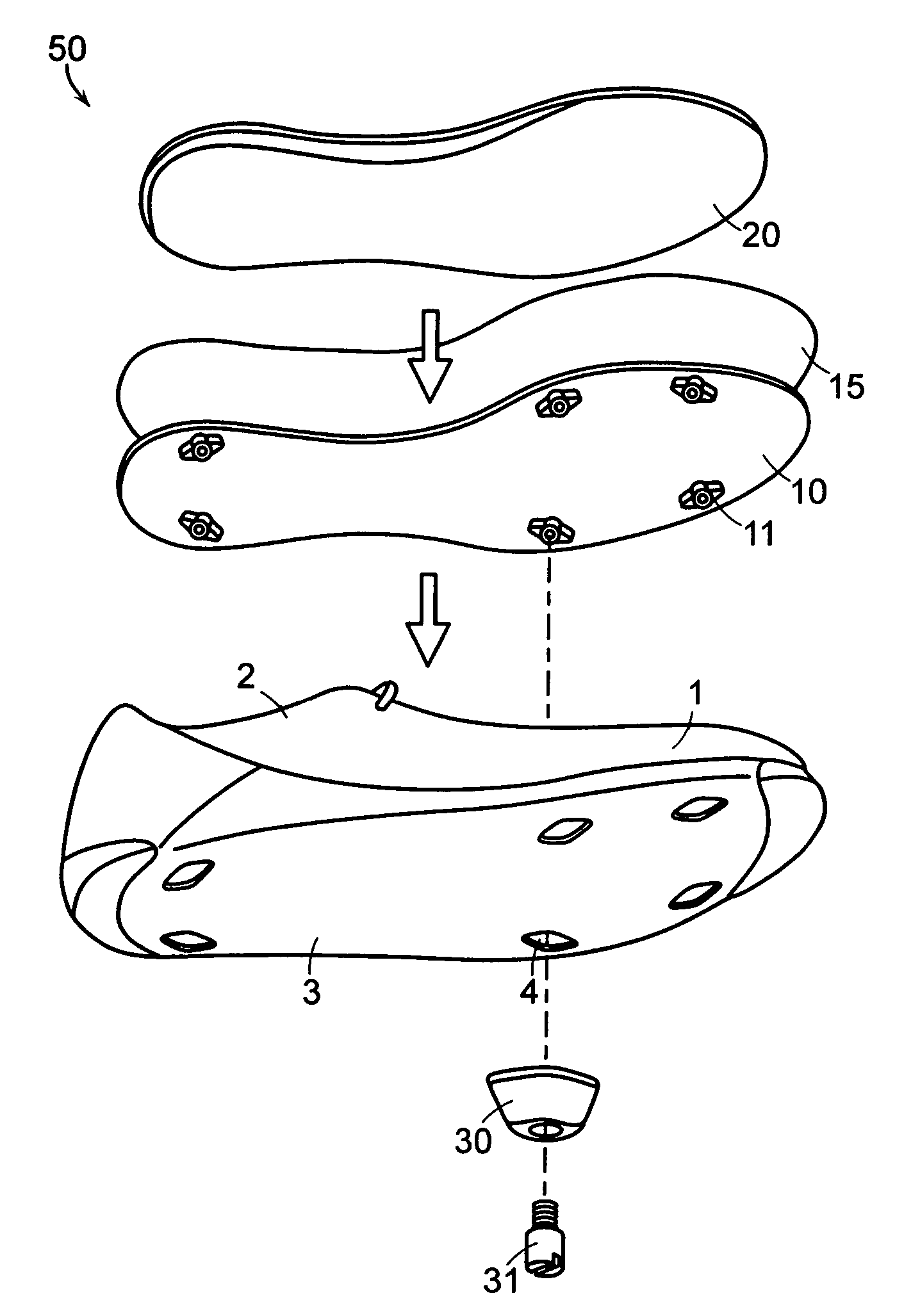
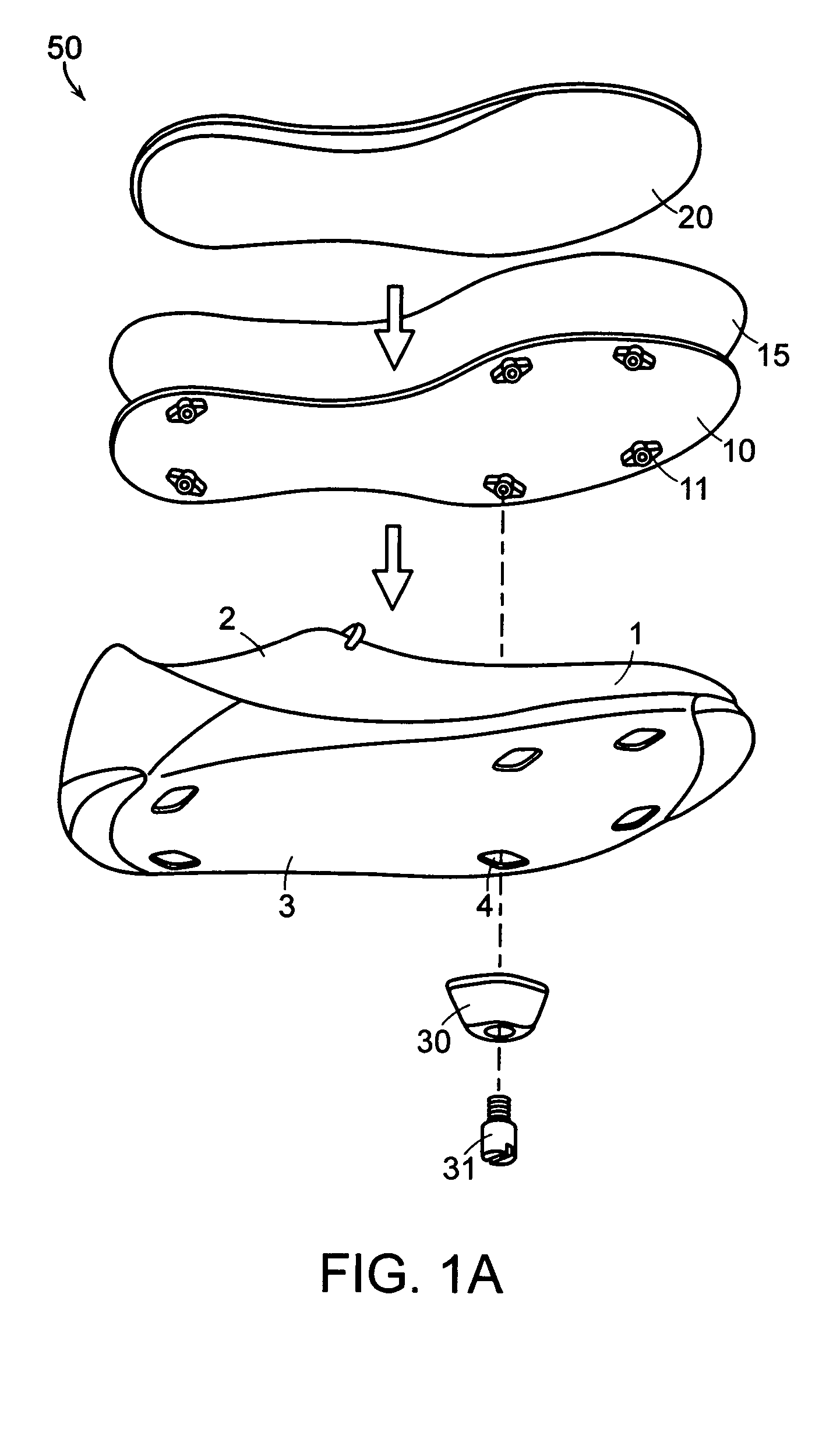
[0008]The described modular construction of a studded shoe leads to a great number of advantages for both the manufacturer and the athlete. The unlimited combinations of various embodiments of the three releasably combined modules (i.e., the upper, the chassis, and the studs) allow the manufacturer or the athlete or both to modify the design and the technical properties of the studded shoe over a wide range of possible characteristics. For example, the replacement of the sock-like upper allows the use of uppers with different colors and patterns, as well as the use of thicker or thinner embodiments depending on the season. Even a complete individualization is possible by imprinting the upper with a pattern or lettering unique to the individual athlete, for example a signature. It is also possible to use different materials for the upper, which lead to different properties during ball contact with the instep.
[0009]The releasable chassis generally determines the mechanical properties of the studded shoe. For example, it is possible to use, depending on the ground conditions, a chassis of a different hardness. Furthermore, the thickness and contour of the chassis can influence the positioning of the foot inside the shoe. In another embodiment of the invention, the shape of the upper side of the chassis can be custom made in accordance with the wearer's foot, for example, as determined by a three-dimensional scan. Also, the material properties of the chassis may be customized to take the individual needs of a wearer into account, for example to provide pronation control or increased cushioning.
[0011]From the viewpoint of the manufacturer, the described modular design facilitates the production of the studded shoe. Instead of a complete shoe, only three modules are produced, which are later selected and assembled by the customer. Gluing, welding, or sewing the components of the shoe is no longer necessary, which reduces the number of production steps. Furthermore, there are no toxic solvent vapors involved in the manufacture of the shoe, which are typically a problem with respect to the environment.
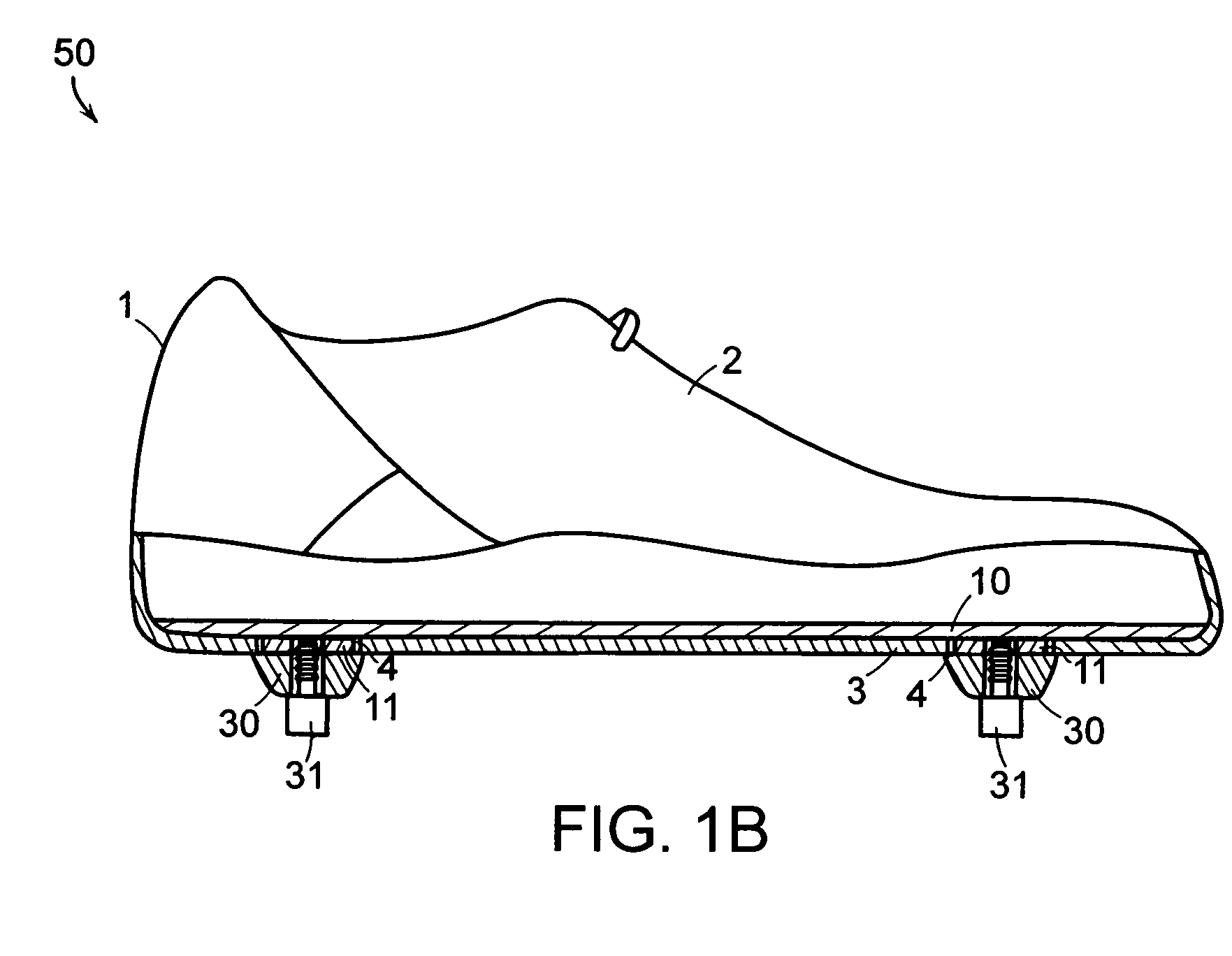
[0013]In various embodiments, the upper optionally includes a reinforcement element disposed on at least one of a heel part or a toe part. This avoids premature abrasion of the upper in these parts, which are subjected to greater wear. The lower side of the upper can include a coating for resisting adhesion of dirt. Such coatings are today well-known from many fields of technology. In one embodiment, the article of footwear includes a seal at least partially disposed between the studs and the lower side of the upper for preventing penetration of dirt into the interior of the upper through the apertures formed in the lower side. The seal can be disposed along an upper rim of each of the plurality of studs. Thus, the opening in the lower side of the upper through which one or more studs are releasably attached to the chassis is effectively sealed against moisture or dirt particles on the playing field. Known stud systems, wherein the mounting mechanism is arranged outside of the interior of the upper, generally do not include such a sealing arrangement.
[0018]In another aspect, the invention relates to an upper for an article of footwear for releasably interconnecting a chassis and a plurality of studs. The upper includes a lower side adapted to at least partially extend below a wearer's foot and a plurality of apertures formed through the lower side for receiving a plurality of corresponding projections of the chassis. The shape of the apertures can be polygonal, arcuate, or combinations thereof. In various embodiments, the upper optionally includes a reinforcement element disposed on at least one of a heel part or a toe part. The lower side can include a coating to reduce adhesion of dirt to the lower side of the upper.



 Login to View More
  Login to View More