Module evaluation method and system
a module and evaluation method technology, applied in the field of module evaluation methods and systems, can solve the problems of not being performed, unable to quickly determine whether the use of the modular construction method is proper, and cannot be performed in an automatic manner, so as to quickly determine the overall effectiveness of the modular construction method. the effect of determining the overall effectiveness of the modular construction method
- Summary
- Abstract
- Description
- Claims
- Application Information
AI Technical Summary
Benefits of technology
Problems solved by technology
Method used
Image



Examples
first embodiment
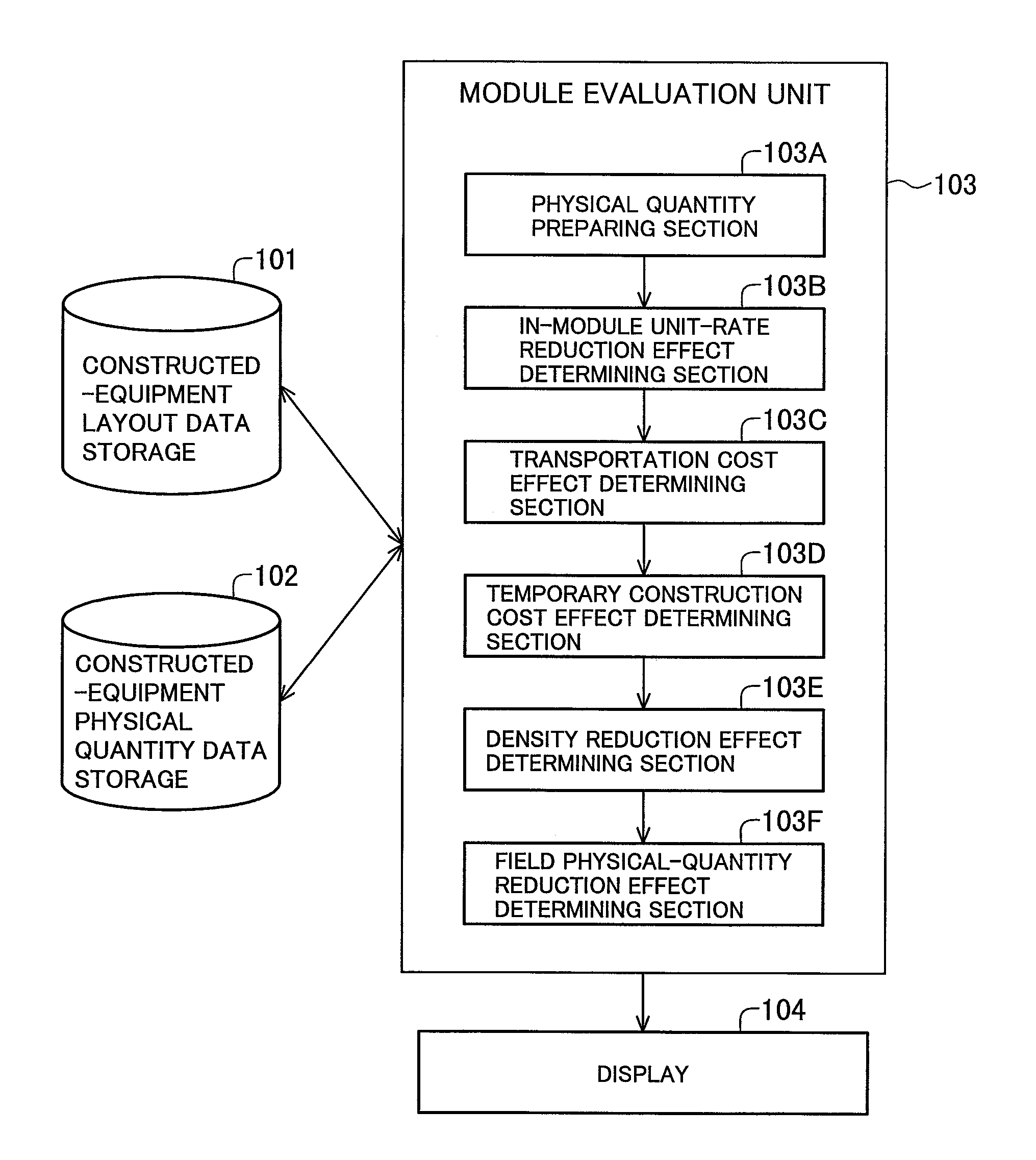
[0032]FIG. 1 is a block diagram of a module evaluation system to which is applied the present invention.
[0033]Referring to FIG. 1, the module evaluation system comprises a storage 101 for storing constructed-equipment layout data (including constructed-equipment arrangement schedule data for a region where arrangement of constructed equipment is scheduled, constructed-equipment modularization work data, and arrangement data for transportation of the modularized constructed-equipment to the arrangement scheduled region), a storage 102 for storing constructed-equipment physical quantity data (representing the number, sizes and weights of individual parts of the constructed equipment), a module evaluation unit 103, and a display 104.
[0034]The module evaluation unit 103 comprises a physical quantity data preparing section 103A, an in-module unit-rate reduction effect determining section 103B, a transportation cost effect determining section 103C, a temporary construction cost effect det...
second embodiment
[0083]the present invention will be described below.
[0084]The second embodiment of the present invention is intended to, when information for definition of a module is not included in the constructed-equipment layout data, make determination on effectiveness of the range of a designated imaginary module, or automatic determination on the effective range of modularization.
[0085]The basic configuration of the module evaluation system according to the second embodiment is the same as that of the first embodiment shown in FIG. 1, and therefore a detailed description of the system configuration is omitted here.
[0086]FIG. 13 is a flowchart of processing for determination of the modularization effectiveness in the second embodiment.
[0087]First, the range of a module frame is set in step 1201 of FIG. 13. Herein, the term “module frame” means an imaginary rectangular parallelepiped surrounding the constructed equipment, which is inputted by the user or set by the system and which is defined ...
third embodiment
[0100]FIG. 15 is a flowchart of processing for determination of the modularization effectiveness in the present invention, and FIG. 16 shows one example of a user display / operating screen.
[0101]As shown in FIG. 15, first, a target area is divided in the height direction as per upper limit size during the module transportation, and the target area is divided at constant intervals in a horizontal plane to form division frames in a grid pattern (step 1501, see FIG. 16). The smaller the division interval in the horizontal plane, the higher is the accuracy of the evaluation. A value of the division interval can be optionally set by the user.
[0102]Then, in step 1502, the man-hour density in each division frame is determined. The man-hour density is obtained by determining all the constructed equipment parts existing within each frame from the coordinate values of the constructed equipment parts, which are stored in the constructed-equipment arrangement data, and by summing up man-hour val...
PUM
 Login to View More
 Abstract
Description
Claims
Application Information
 Login to View More