
Liquid crystal device and electronic apparatus
a liquid crystal device and electronic equipment technology, applied in non-linear optics, instruments, optics, etc., can solve the problems of degrading the display quality at the time of reflective display, which is performed by using light reflected by the reflective display region, and unable to perform vivid display, etc., to achieve vivid display, high-quality display, and high-quality display
- Summary
- Abstract
- Description
- Claims
- Application Information
AI Technical Summary
Benefits of technology
Problems solved by technology
Method used
Image

Examples
first embodiment
of Liquid Crystal Device
[0042]Hereinafter, a liquid crystal device according to the invention will be described by way of an embodiment. Moreover, it is needless to say that the invention is not limited to the embodiment. Further, in the following description, various structures are exemplified by use of the drawings, but it is necessary to take notice that the structures shown in the drawings have been shown to have different scales from the actual structures such that characteristic portions are easy to understand.
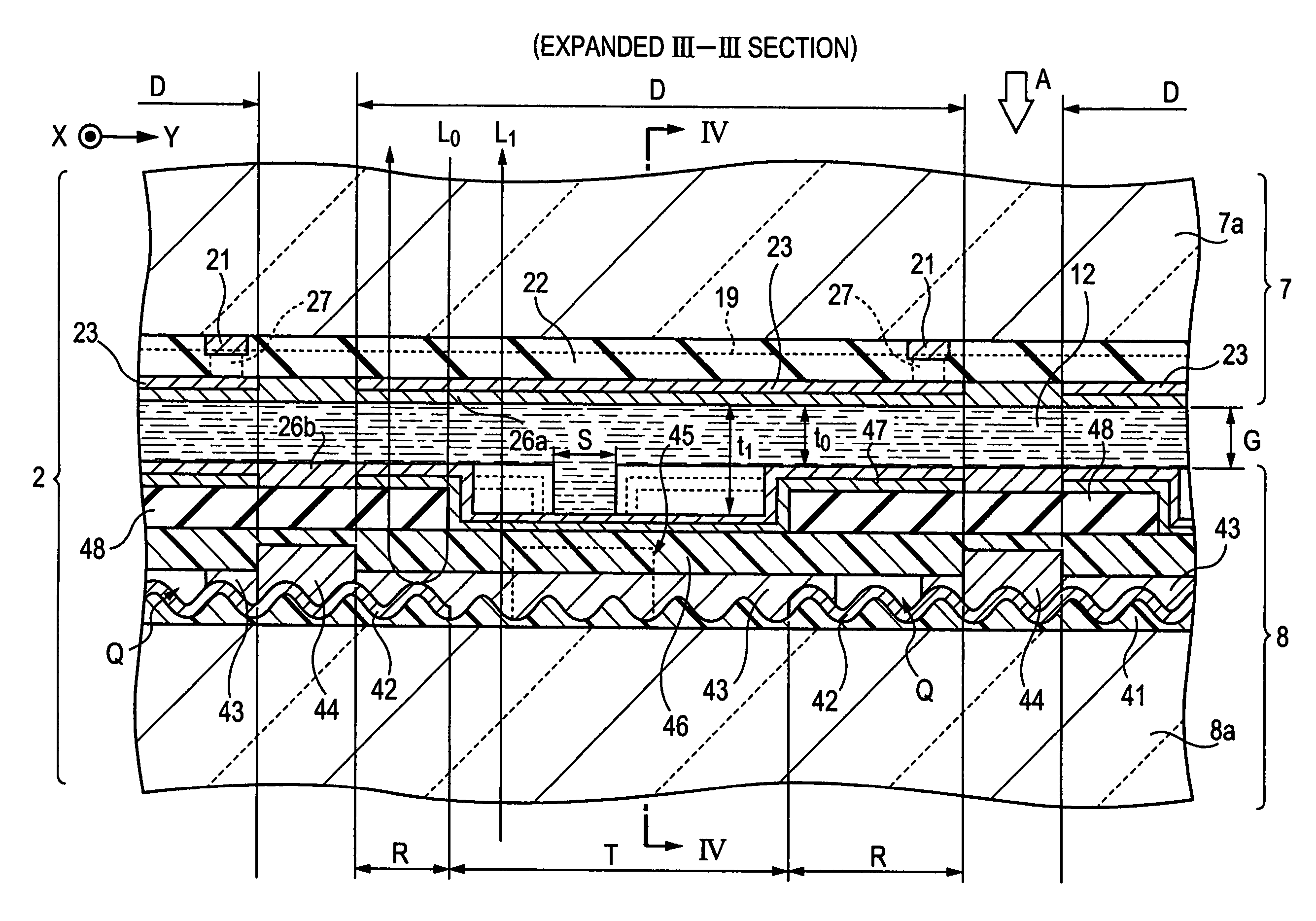
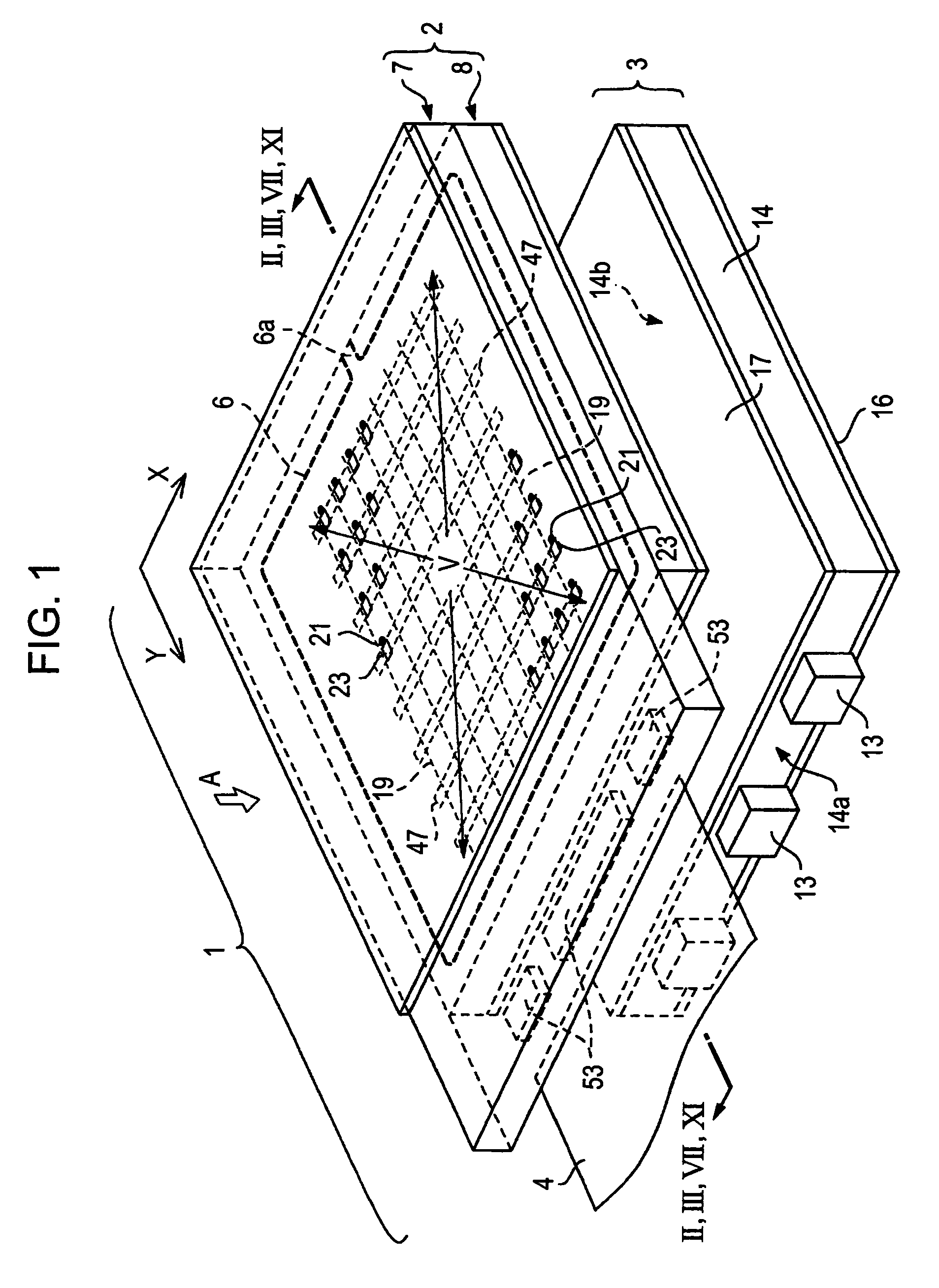
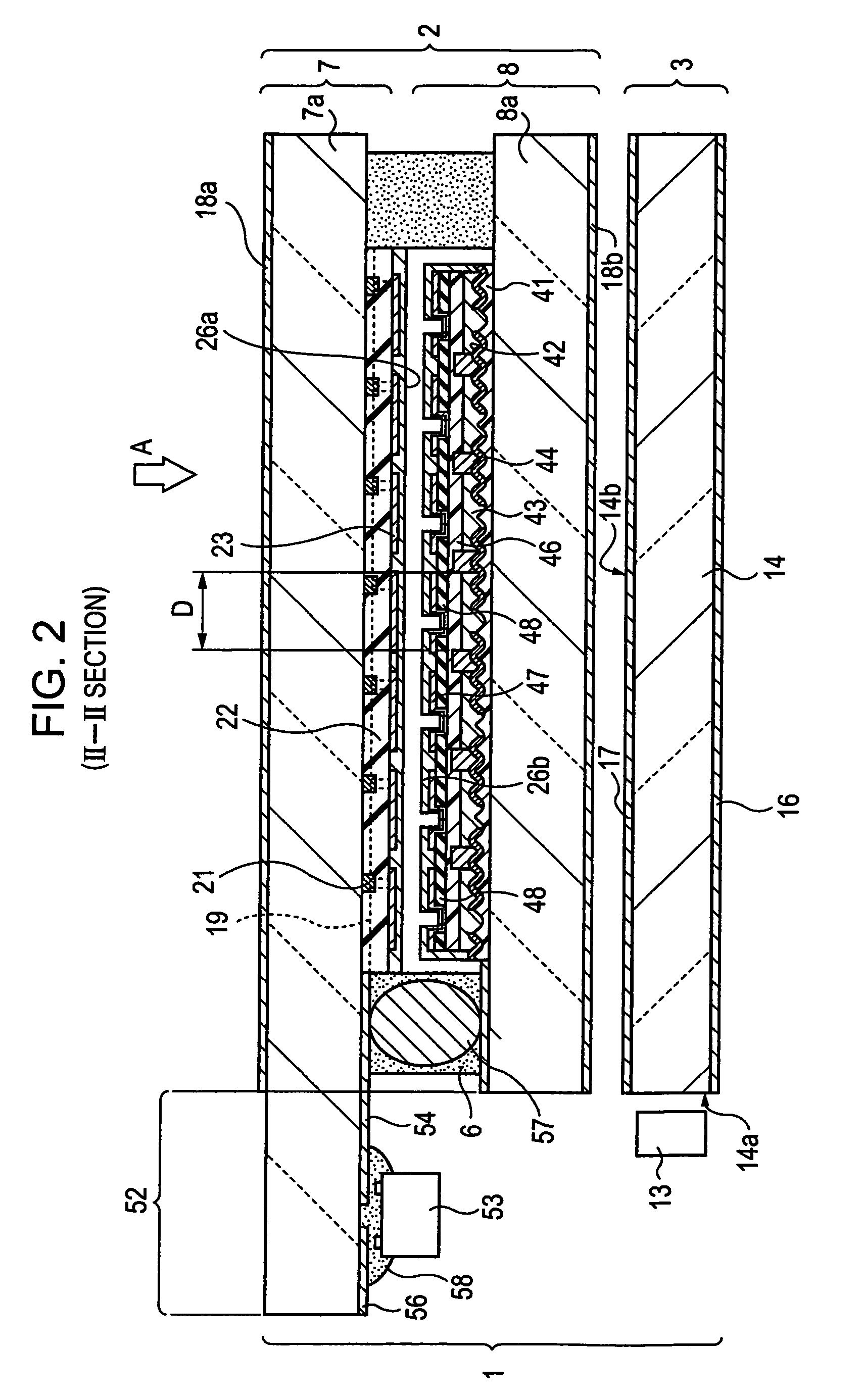
[0043]FIG. 1 shows an embodiment of a liquid crystal device according to the invention. FIG. 2 is a side cross-sectional view taken along the line II-II of FIG. 1. FIG. 3 is a cross-sectional view showing a pixel portion in FIG. 2 on a magnified scale. FIG. 4 is a cross-sectional view taken along the line IV-IV of FIG. 3. FIG. 5 is a plan cross-sectional view taken along the line V-V of FIG. 4. In the present embodiment, the invention is applied to an active matrix-type ...
second embodiment
of Liquid Crystal Device
[0081]FIGS. 7 to 10 show essential parts of another embodiment of a liquid crystal device according to the invention. The overall configuration of the present embodiment can be configured to have the same structure as shown in FIGS. 1 and 2. FIG. 7 is a cross-sectional view showing a pixel portion in FIG. 2 on a magnified scale, like FIG. 3 in the above-described embodiment. Further, FIG. 8 is a cross-sectional view taken along the line VIII-VIII of FIG. 7, like FIG. 4 in the above-described embodiment. Further, FIG. 9 is a plan cross-sectional view taken along the line IX-IX of FIG. 8, like FIG. 5 in the above-described embodiment. Further, FIG. 10 is a diagram showing a laminated state of individual parts on a color filter substrate in exploded view for ease of understanding, like FIG. 6 in the above-described embodiment.
[0082]Hereinafter, the present embodiment will be described, laying emphasis on different parts from those in the first embodiment. In the...
third embodiment
of Liquid Crystal Device
[0087]FIGS. 11 to 14 show essential parts of still another embodiment of a liquid crystal device according to the invention. The present embodiment relates to an active matrix-type liquid crystal device using a TFT (Thin Film Transistor) element, which is a three-terminal-type active element, as a switching element. Moreover, as the TFT element, various kinds of TFTs, such as an amorphous silicon TFT, a low-temperature polysilicon TFT, a high-temperature polysilicon TFT, or the like, may be used. In the present embodiment, it is assumed that the amorphous silicon TFT is used. Of course, the invention can be applied to a liquid crystal device which uses other kinds of TFTs.
[0088]The overall configuration of the present embodiment can be configured to have the same structure as shown in FIG. 1 or 2. FIG. 11 is a cross-sectional view showing a pixel portion in FIG. 2 on a magnified scale, like FIG. 3 in the above-described embodiment. Further, FIG. 12 is a cross...
PUM
| Property | Measurement | Unit |
|---|---|---|
| thickness | aaaaa | aaaaa |
| width | aaaaa | aaaaa |
| thickness t2 | aaaaa | aaaaa |
Abstract
Description
Claims
Application Information
 Login to View More