

Network traffic monitoring for search popularity analysis
a network traffic and popularity analysis technology, applied in the field of search technology, can solve the problems of difficulty in finding documents or content related to a particular subject, and conventional search engines are not capable of monitoring how many, so as to improve the rank of web pages retrieved
- Summary
- Abstract
- Description
- Claims
- Application Information
AI Technical Summary
Benefits of technology
Problems solved by technology
Method used
Image

Examples
Embodiment Construction
[0024]The embodiments of the present invention will be described below with reference to the accompanying drawings. Where possible, like reference numerals are used for like elements in the accompanying drawings.
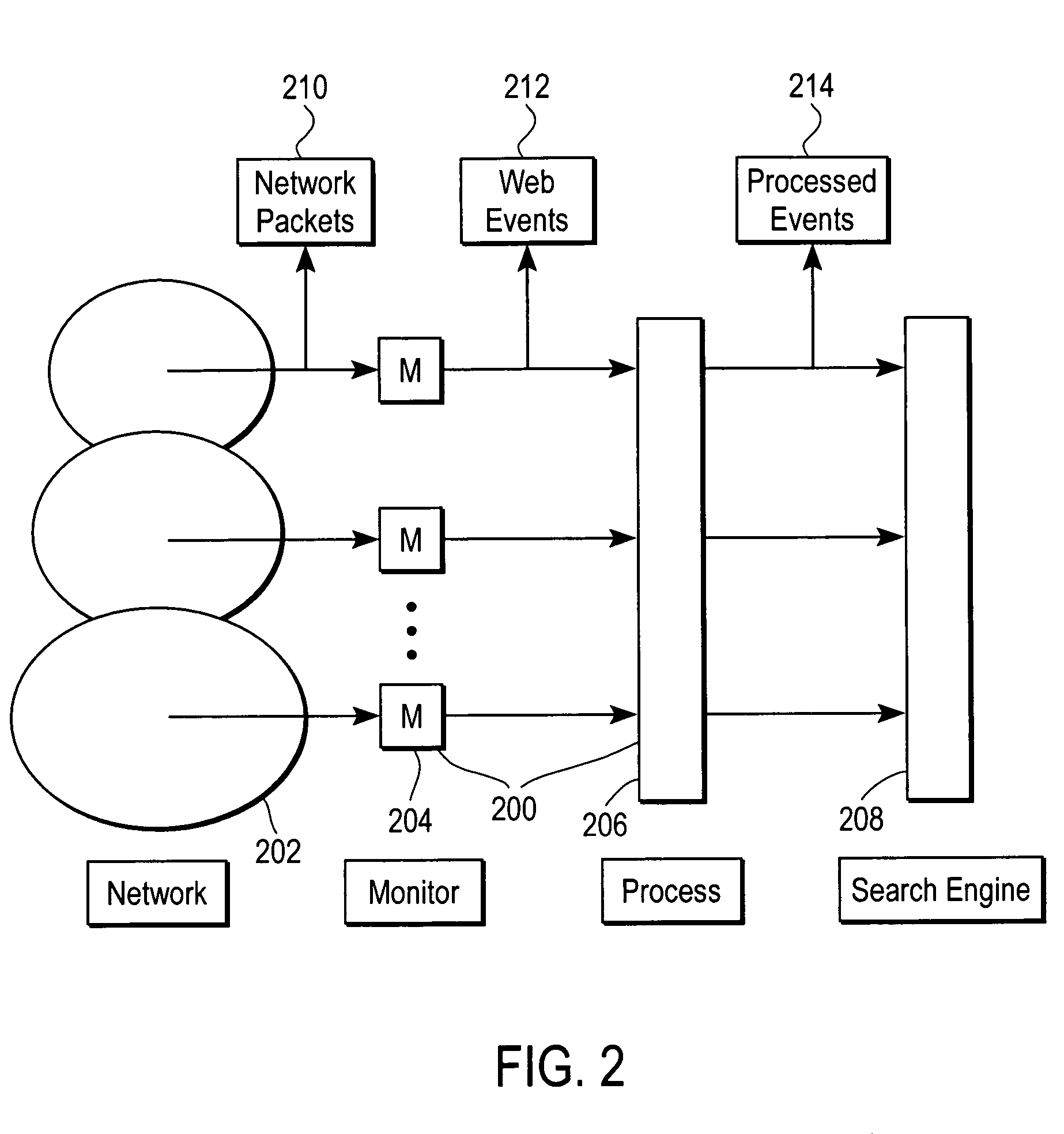
[0025]FIG. 2 is a diagram illustrating the architecture of the system 200 for monitoring the actual popularity of web pages, according to one embodiment of the present invention. The system 200 includes a plurality of monitoring devices 204 and a processing module 206. Although FIG. 2 shows one processing module 206, there could be a plurality of processing modules 206 depending upon the physical deployment of the monitoring devices 204. The monitoring devices 204 are physically embedded in strategic locations within a data communication network 202, such as the Internet. The monitoring devices 204 are transparent and impartial monitoring devices that monitor the data traffic in the network 202 and examine data packets that traverse the network 202. The monitoring devices ex...
PUM
 Login to View More
 Abstract
Description
Claims
Application Information
 Login to View More