[0009]Either of the foregoing two characteristics of the preferred embodiment of the invention may be used independently of the other, and each is considered to be novel. However, there is a
synergy from the use of both of these aspects of the invention working together. The structured communication aspect facilitates care in creation of a document and in the response to be made to a submitted document. The fact that the history of the communication exchange will be permanently of
record in the archives of the authenticator tends to reinforce human willingness that care and attention will be paid to the content of the submitted document and the response to be made to it. The archived history itself is rendered more orderly and
usable (both currently by the parties and later if the archives are used as evidence of the exchange of communications) by reason of the structure imposed on the exchange of communications.
[0013]3. The communications invariably pass through the authenticator's own communication channels or a
communication channel selected or approved by the authenticator (with, of course, the option available to the parties to communicate with one another outside the ‘official’ communication channels established by the authenticator). This characteristic has two important consequences, viz: (i) The parties are aware that their exchange of messages is being recorded and preserved; this tends to reinforce care and discipline in the communication process; and (ii) all such communications are readily captured by the authenticator; the communications exchange occurs within the authenticator'
s system so that each passing message can readily be captured and stored by the authenticator.
[0015]5. Because the system can be completely automated except for
data entry by the parties, the authenticator's expense to operate the system, once up and running, can be low, and the cost of the service to the parties using it can be kept within manageable bounds.
[0016]6.
Connectivity to useful associated systems, such as internet or
intranet networks or
peripheral apparatus, can be readily accomplished, since the stored data is conveniently stored in accessible databases and can be copied to or retrieved by any other facility having authorized access to the authenticator'
s system.
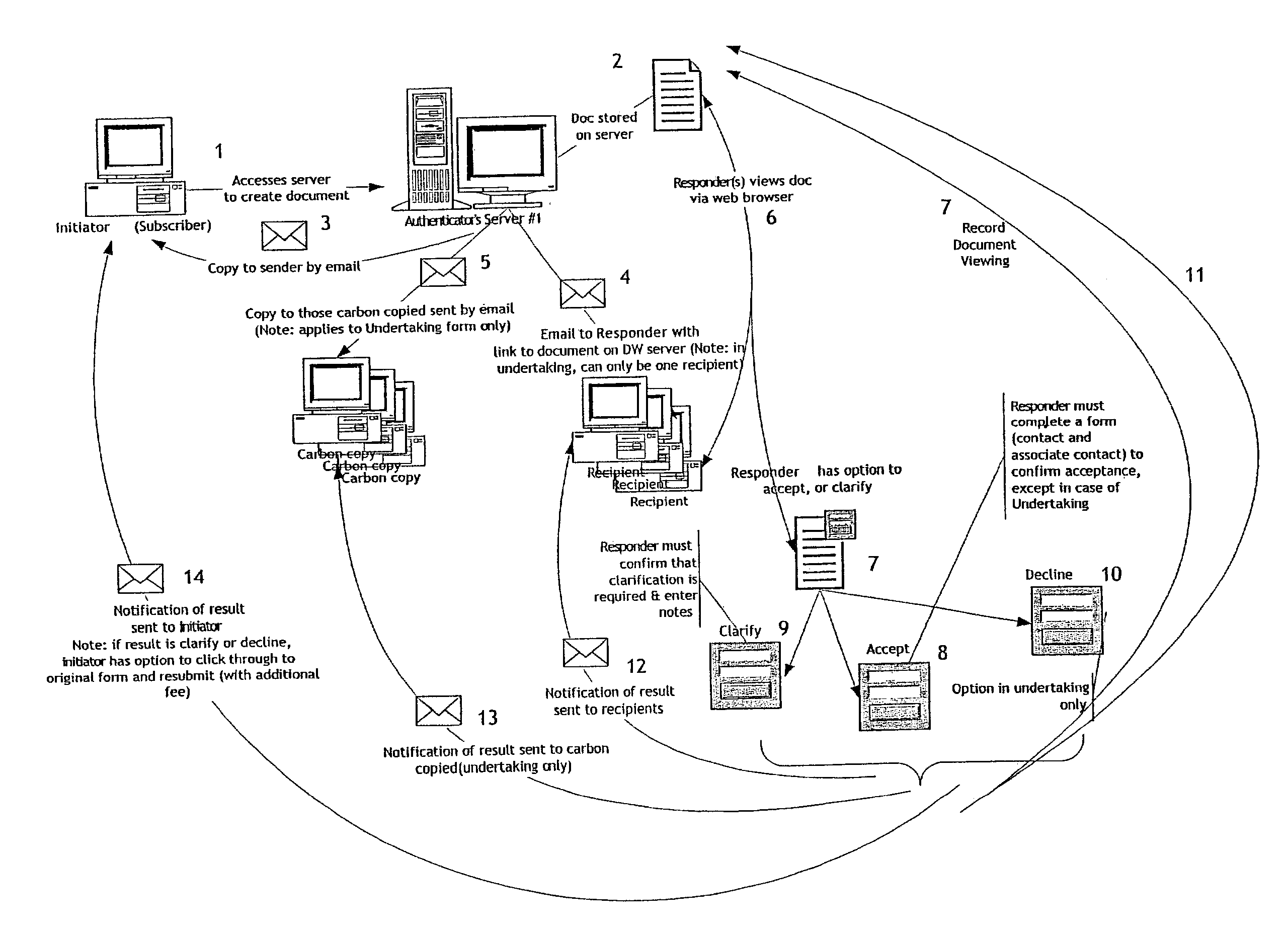
[0022]The system according to the invention may be used to facilitate negotiations intended to lead to a concluded contract or the like. At each stage of the exchange, the acceptance or non-acceptance of the content of the immediately preceding message and all earlier messages can be reviewed, and the fact of viewing of a message by the recipient can also be reviewed, along with stored particulars relating to each such act. In one embodiment of the invention, such review may be limited to review by the initiator, who has paid the authenticator a subscriber fee and / or message fee for the authenticator's service, unless the responder is also a subscriber to the authenticator's service, in which case the responder would have equal viewing rights. Equally, if the responder is not a subscriber, the responder will not be able to avail itself of the capability to invoke the authenticator's message formatting to compel or induce the initiator to elect one of a limited number of responses to the responder's message. The fact that the messages and the nature of the response to messages and other pertinent particulars are stored with an independent authenticator may help constrain the parties to productive message exchanges that facilitate an orderly progress of negotiations.
[0024]In some preferred embodiments of the inventive system, the authenticator is provided with party
authentication means, at least vis-a-vis prospective message initiators, to ensure upon log-in, that at least the initiating party using the system is who it claims to be. In some embodiments, the authenticator is provided with
connectivity to one or more other verifiers to enable those other verifiers to authenticate one or more parties to the communication. For example, if members of a professional body such as an organization of lawyers are subscribers to an Internet-based lawyer
authentication system such as the Juricert system operating in Canada,
connectivity between that system and the authenticator may enable the authenticator to verify the identity of a lawyer designated as the initiator of a message or responder thereto, without having the lawyer as a direct subscriber to the authenticator's service.


 Login to View More
  Login to View More