
Tool for design of multiple single-input-single-output control loops
a control loop and single input technology, applied in adaptive control, computer control, instruments, etc., can solve the problems of complex world applications, complex simulation models of plants and controllers, and complex world applications
- Summary
- Abstract
- Description
- Claims
- Application Information
AI Technical Summary
Benefits of technology
Problems solved by technology
Method used
Image

Examples
Embodiment Construction
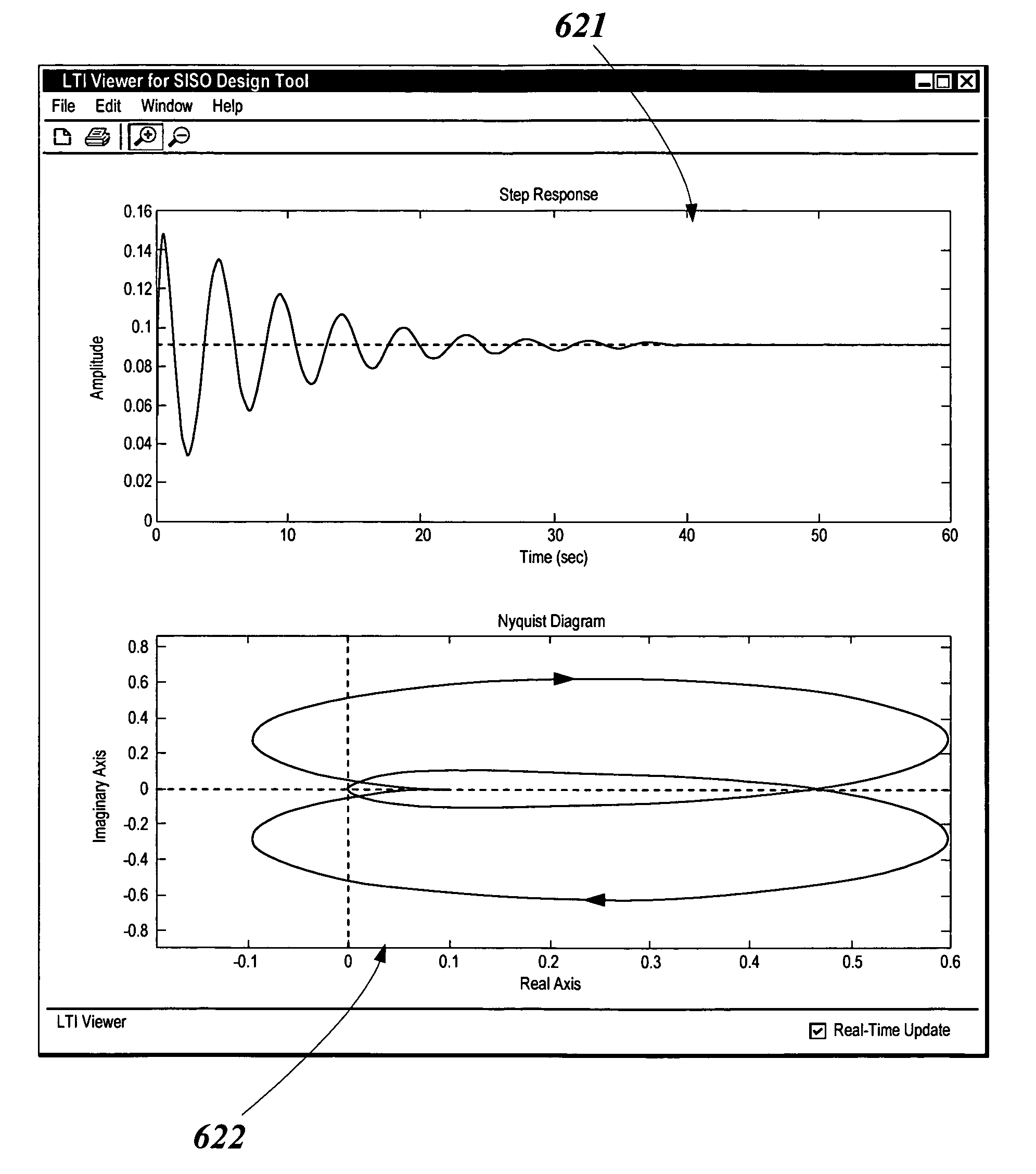
[0041]An illustrative embodiment of the present invention relates to a general framework for representing and manipulating linear time-invariant (LTI) control systems having a plurality of SISO feedback loops or, more generally, SISO “compensators” to be designed or tuned. The term compensator refers to any gain or dynamic system whose parameters are manipulated to enhance the performance of a control system. Systems having a plurality of SISO compensators are characterized as “Distributed SISO Control Systems” (DSCS). The present invention provides a graphical user interface (GUI) for interactively tuning design parameters and viewing resulting actions of the tuning actions across the larger DSCS. The GUI can include graphical interfaces, such as editors, which users can utilize to modify such variables as gain and other dynamics of each SISO compensator. Changes made to one SISO compensator generate different outputs, which are automatically translated to the other SISO compensato...
PUM
 Login to View More
 Abstract
Description
Claims
Application Information
 Login to View More