Stacked generalization learning for document annotation

a generalization learning and document annotation technology, applied in the field of annotation of semistructured documents, can solve problems such as slow methods

a generalization learning and document annotation technology, applied in the field of annotation of semistructured documents, can solve problems such as slow methods

US7890438B2Inactive Publication Date: 2011-02-15XEROX CORP

Image

Smart Image Click on the blue labels to locate them in the text.
Viewing Examples
Smart Image
  • Stacked generalization learning for document annotation
  • Stacked generalization learning for document annotation
  • Stacked generalization learning for document annotation

Examples

Experimental program
Comparison scheme
Effect test

example

[0111]In this Example, the method employing stacked RDNs (referred to herein as Stacking) is compared to other methods. The lower bound in the evaluation may be considered to be the Basic or “Independent” method (also referred to as the Intrinsic method) given by Crf++: “Yet another CRF toolkit”, available at http: / crfpp.sourceforge.net / (hereinafter CRF++) where the dynamic features are ignored and the prediction models are trained using the static features only. As the upper bound for the stacking approximation, the “Exact” solution according to Berger (1996) may be considered. However, when the learning or inference of exact solutions is intractable because of the large size of input documents and / or complexity of dependency graphs, another upper bound may be considered for the stacking algorithms (“Upper” method). Here, the upper bound solution is one where an oracle is assumed to correctly predict the neighbor classes. In the exemplary embodiment, the oracle-based models are bu...

the structure of the environmentally friendly knitted fabric provided by the present invention; figure 2 Flow chart of the yarn wrapping machine for environmentally friendly knitted fabrics and storage devices; image 3 Is the parameter map of the yarn covering machine
Login to View More

PUM

No PUM Login to View More

Abstract

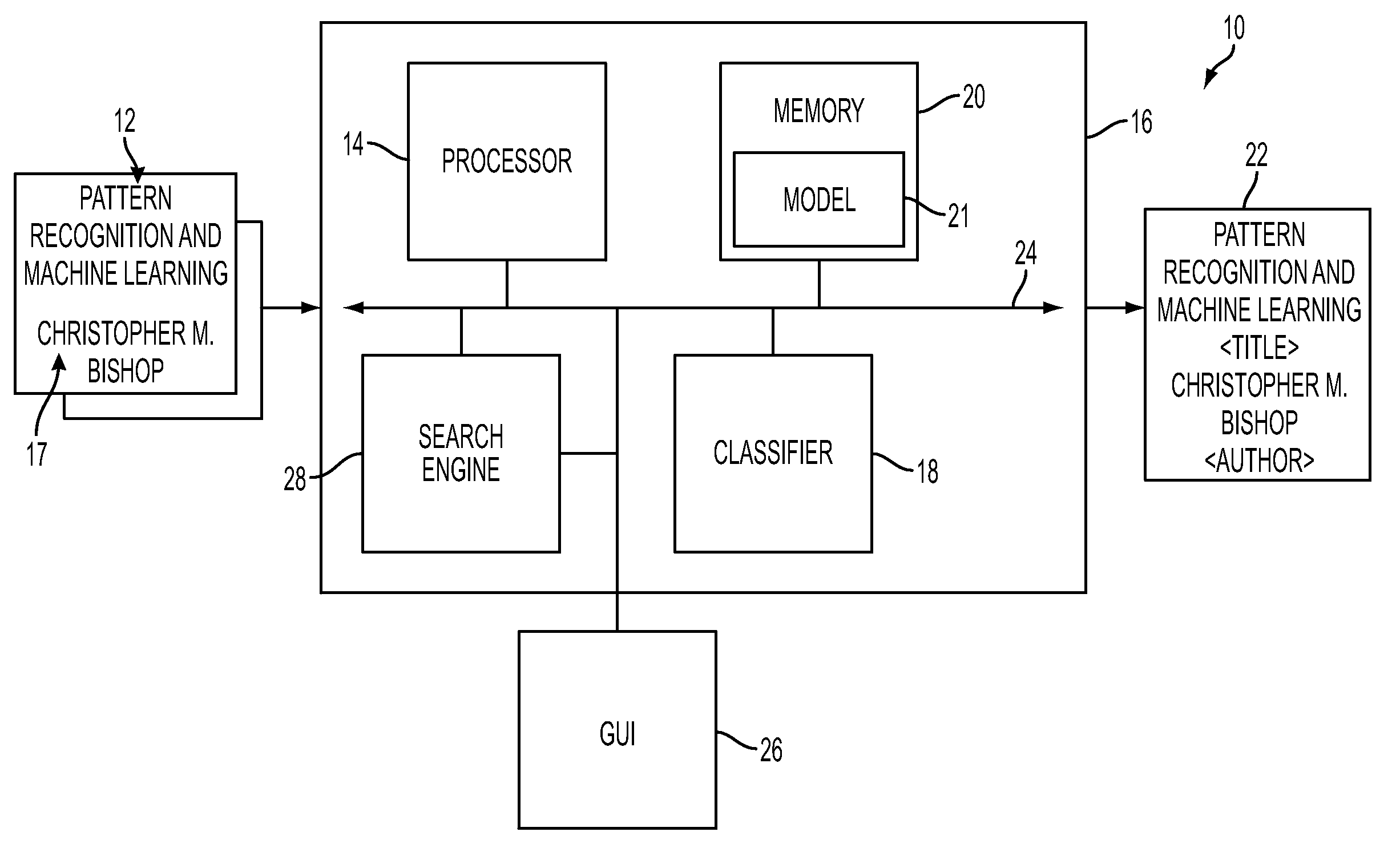
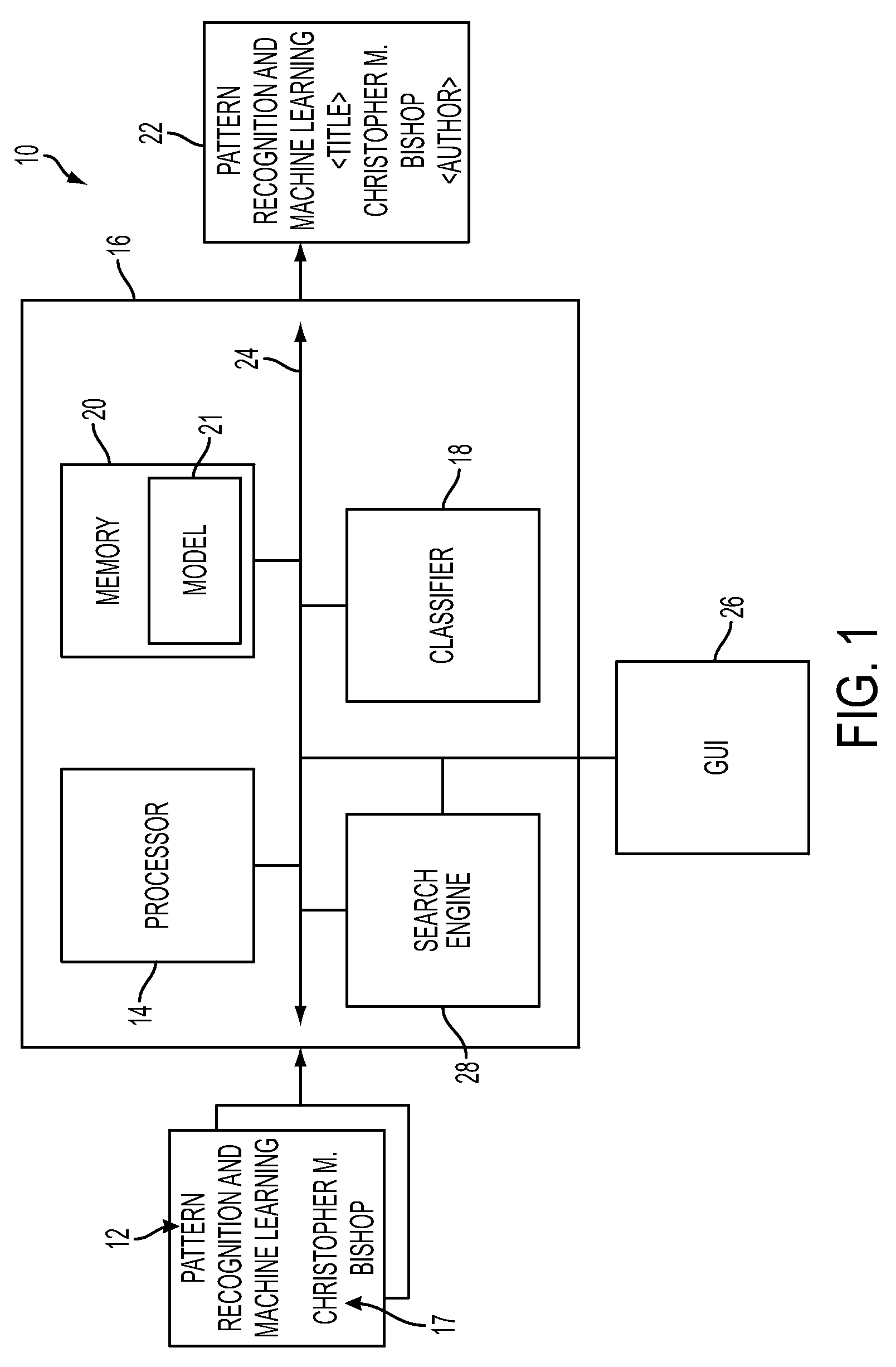
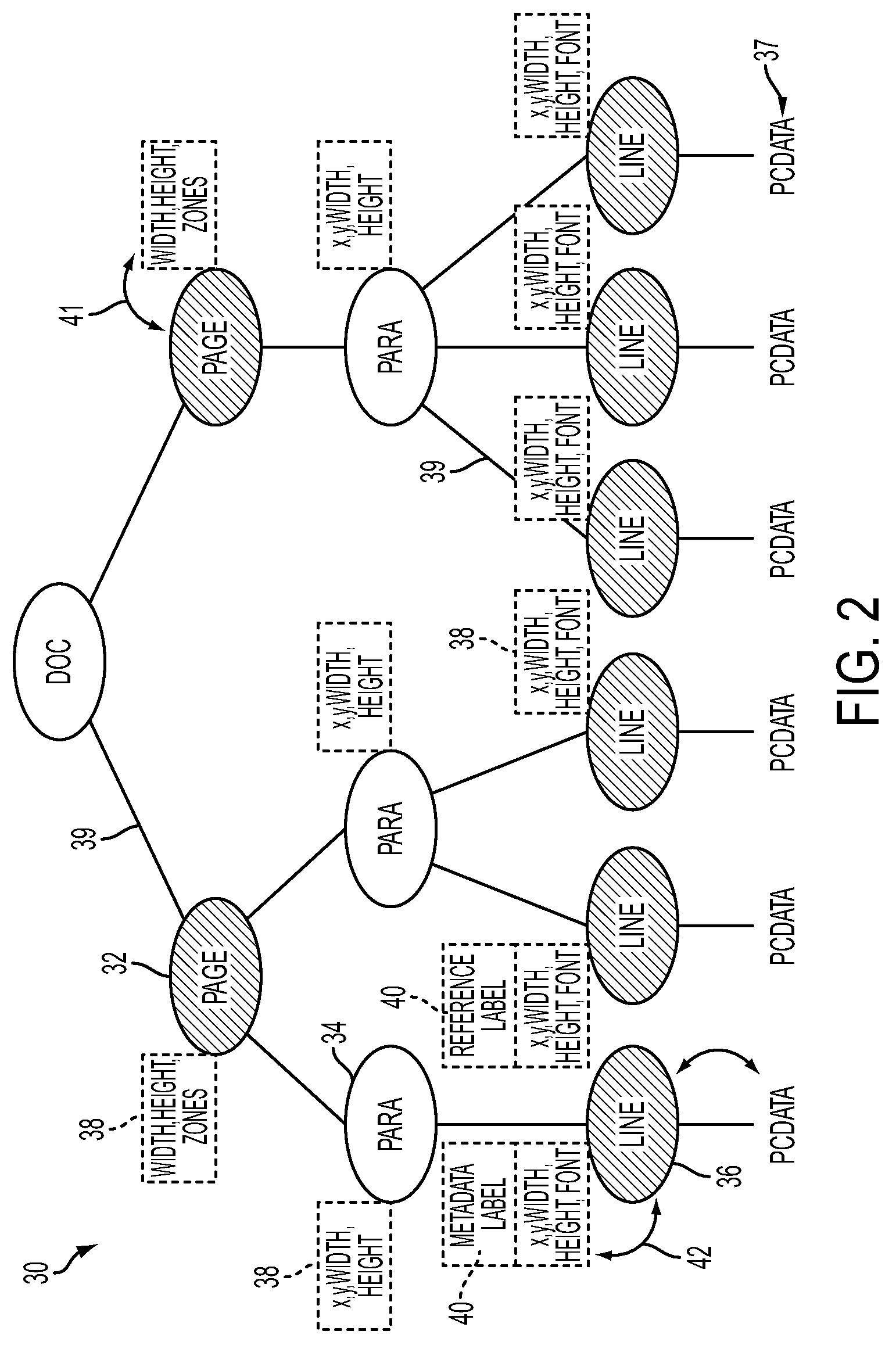
A document annotation method includes modeling data elements of an input document and dependencies between the data elements as a dependency network. Static features of at least some of the data elements are defined, each expressing a relationship between a characteristic of the data element and its label. Dynamic features are defined which define links between an element and labels of the element and of a second element. Parameters of a collective probabilistic model for the document are learned, each expressing a conditional probability that a first data element should be labeled with information derived from a label of a neighbor data element linked to the first data element by a dynamic feature. The learning includes decomposing a globally trained model into a set of local learning models. The local learning models each employ static features to generate estimations of the neighbor element labels for at least one of the data elements.

Description

BACKGROUND[0001]The exemplary embodiment relates to the annotation of semi-structured documents, such as HTML or layout-oriented documents. It finds application in a variety of applications, including natural language processing, legacy document conversion, Web page classification, and other automated and semi-automated document annotation applications.[0002]In many document processing applications, it is desirable to annotate data elements of documents, such as pages, paragraphs, lines, etc., with information which describes the structure of the document as well as semantic information about the elements, such as whether a particular element relates to a document title, a reference, the name of the author, or the like. Documents created originally for human use often have little or no semantic annotation.[0003]Automated techniques for semantic annotation of unstructured and semi-structured documents require classification methods that take into account different elements of the doc...

Claims

the structure of the environmentally friendly knitted fabric provided by the present invention; figure 2 Flow chart of the yarn wrapping machine for environmentally friendly knitted fabrics and storage devices; image 3 Is the parameter map of the yarn covering machine
Login to View More

Application Information

Patent Timeline
15 Feb 2011
Publication
US7890438B2
IPC
G06F15/18; G06N7/00; G06N20/00
CPC
G06N99/005; G06N20/00
Inventors
CHIDLOVSKII, BORIS