Supercharge Your Innovation With Domain-Expert AI Agents!

Back closure

a back closure and closure technology, applied in the field of closure, can solve the problems of poor locking connection, loose connection, difficult to turn for the user of the frame, etc., and achieve the effect of preventing the frame from disengagement, convenient and easy to use for the consumer

Inactive Publication Date: 2013-02-19
CRAFT INC
View PDF26 Cites 1 Cited by
  • Summary
  • Abstract
  • Description
  • Claims
  • Application Information

AI Technical Summary

Benefits of technology

The solution ensures repetitive, reliable, and predictable securing of the frame back, preventing disengagement and requiring additional force to dislodge the tab, thus enhancing user convenience and frame back retention.

Problems solved by technology

For example, a tightly secured rivet connection will result in a tight turn button making it very difficult to turn for the user of the frame.
A less tightly secured rivet connection makes it easier to manipulate the turn button but the connection will also be loose making a poor locking connection and / or making it possible for the turn button to fall off of the frame back or multi-use frame completely.
Sometimes, the turn button may fail to reliably and predictably secure the frame back to the frame for a variety of reasons.
On occasion, the frame back is made of material, such as soft cardboard, lacking sufficient strength to properly retain the turn button therein.
Upon installation, the rivet may be improperly flared allowing the turn button to disengage.
Also, a consumer may not properly place the turn button in the correct position to secure the frame back to the frame.

Method used

the structure of the environmentally friendly knitted fabric provided by the present invention; figure 2 Flow chart of the yarn wrapping machine for environmentally friendly knitted fabrics and storage devices; image 3 Is the parameter map of the yarn covering machine
View more

Image

Smart Image Click on the blue labels to locate them in the text.
Viewing Examples
Smart Image
  • Back closure
  • Back closure
  • Back closure

Examples

Experimental program
Comparison scheme
Effect test

Embodiment Construction

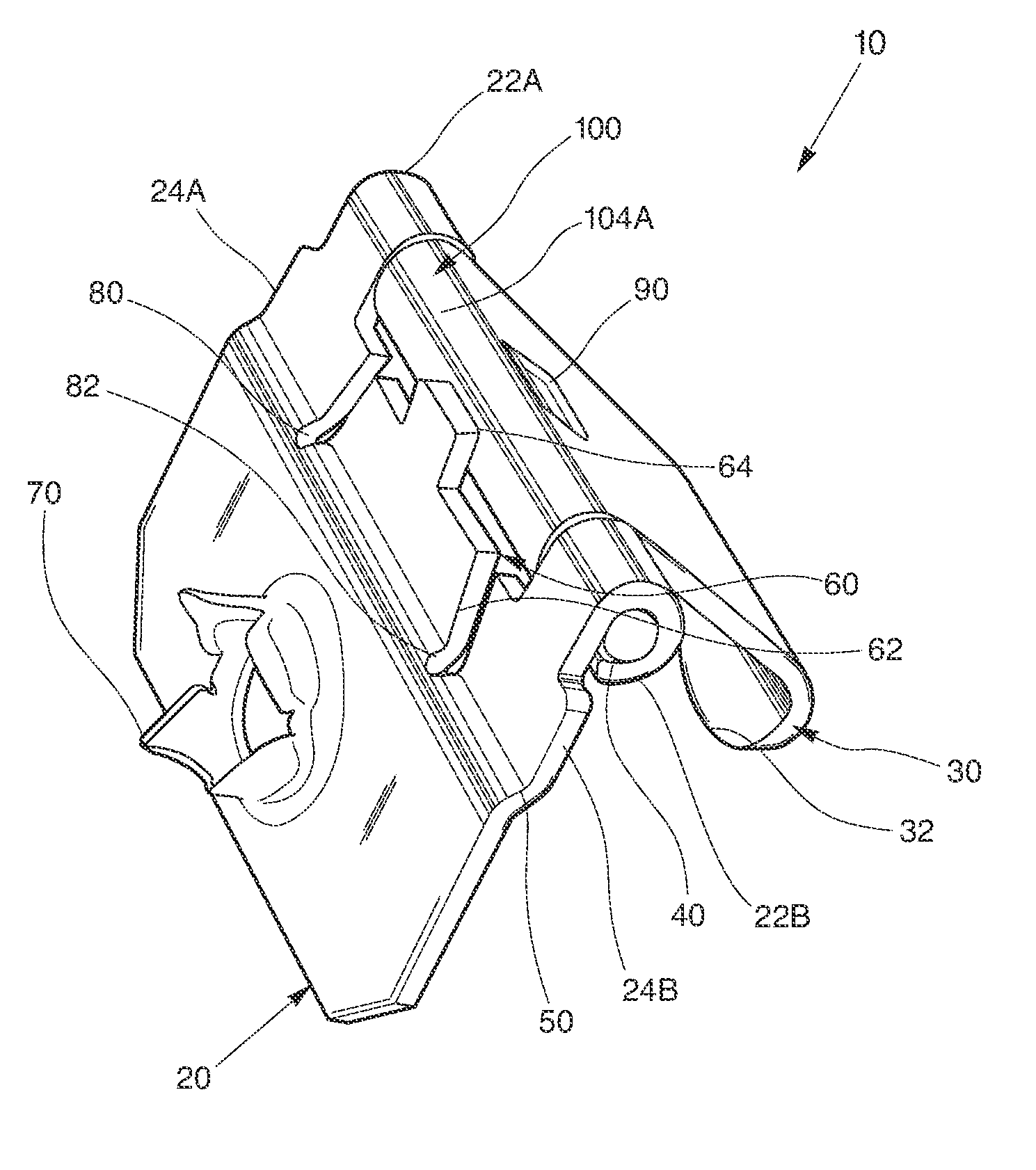
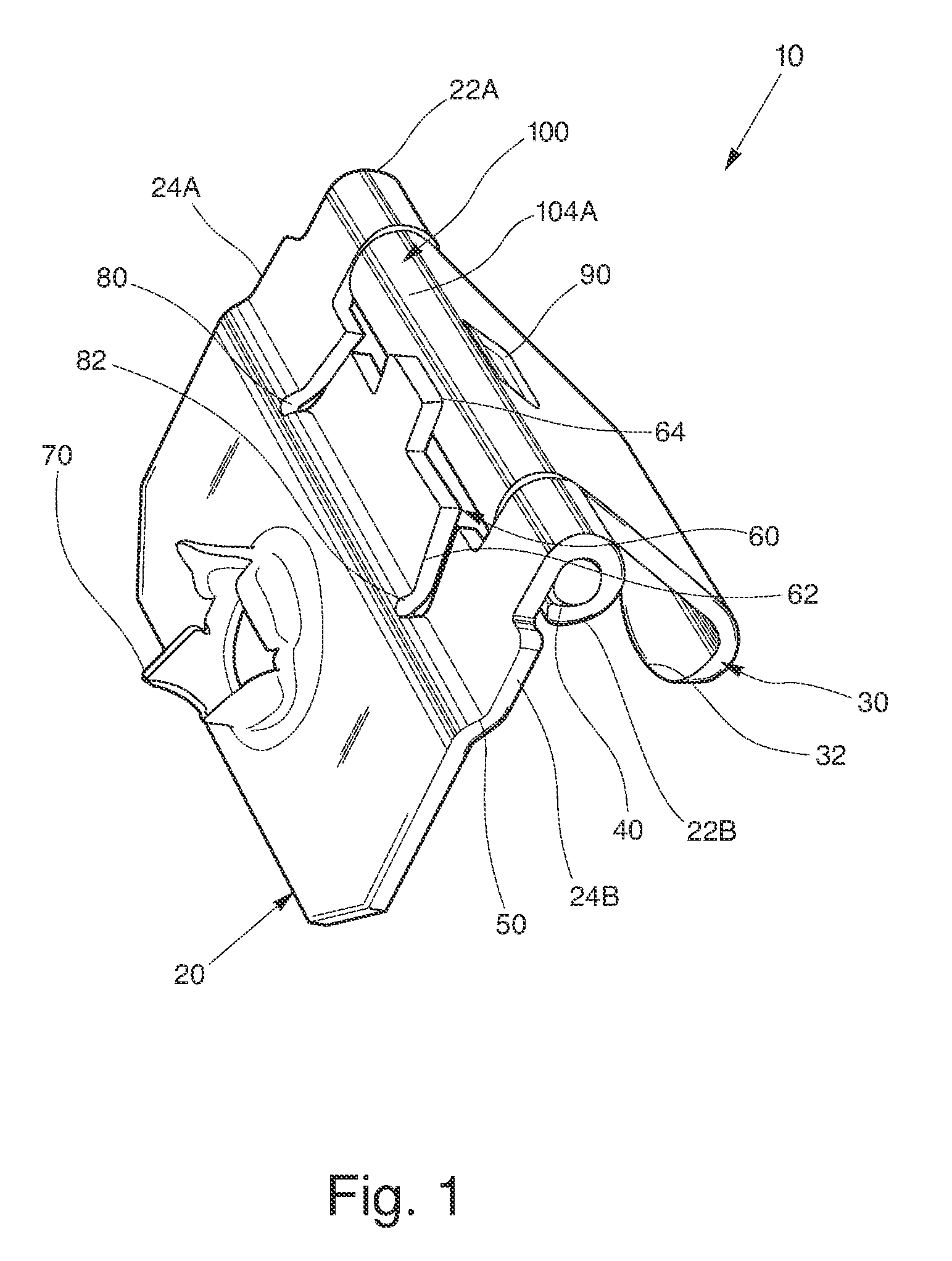
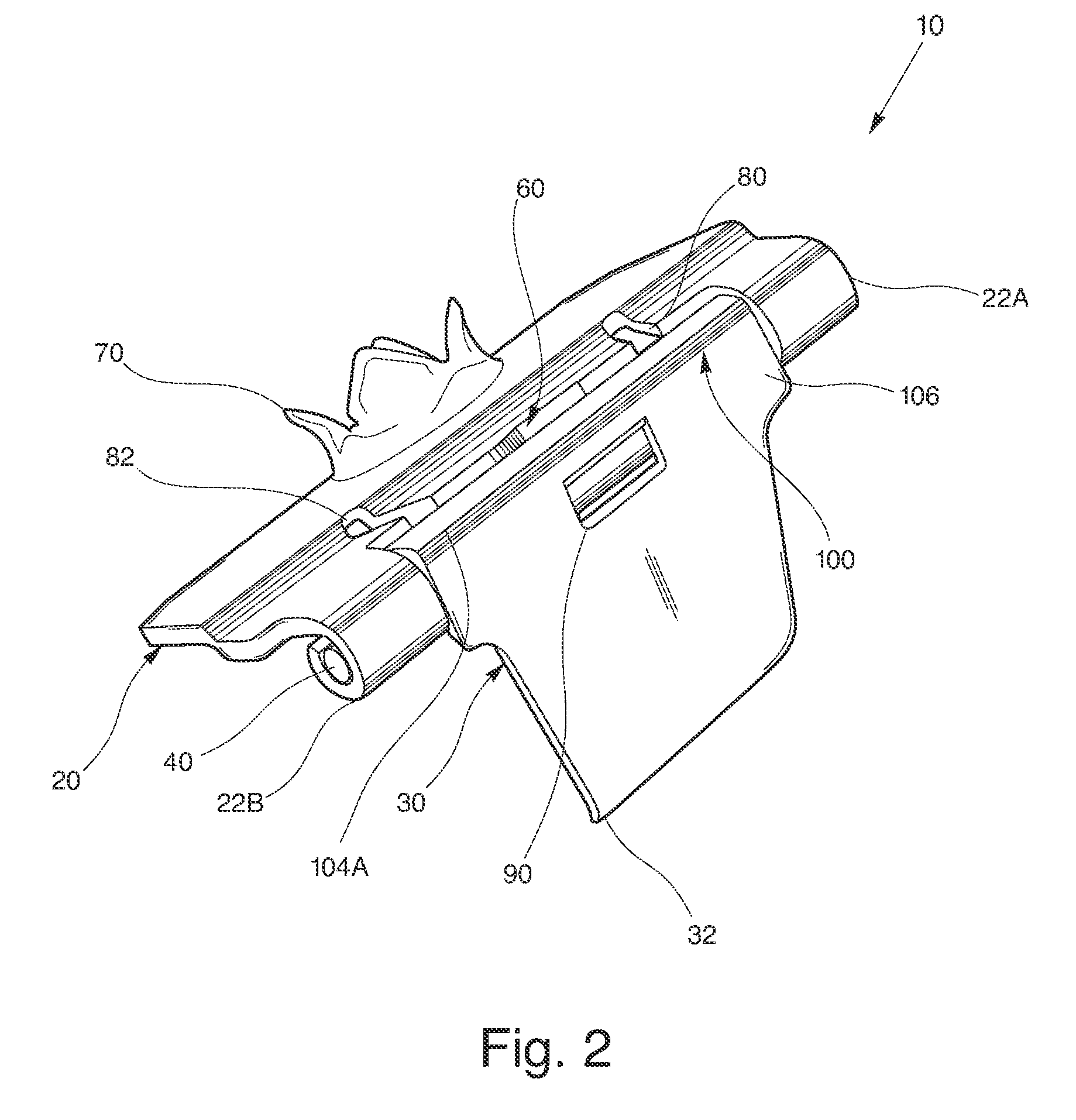
[0035]Referring now to FIGS. 1-14, the back closure 10 of the instant invention is illustrated. Generally, the present invention provides an improved back closure 10 having spring-bias and snap action that provides a repetitive, reliable, and predictable way of securing a frame back 700 to a multi-use frame 800 to prevent disengagement of the frame back 700 from the multi-use frame 800. In addition, the back closure 10 secures the frame back 700 to the multi-use frame 800 which is convenient and easy to use for a consumer. Referring to FIG. 11, the closure 10 is attached to an outer peripheral edge of a rear portion of the multi-use frame 800. The closure 10 is in an open position which allows the frame back 700 to be moved away from the rear of the multi-use frame 800. Referring to FIG. 14, the closure 10 snaps or engages the frame back 700 to releasably secure the frame back 700 to the multi-use frame 800.

[0036]As illustrated in FIGS. 1-7, the closure 10 of the present invention i...

the structure of the environmentally friendly knitted fabric provided by the present invention; figure 2 Flow chart of the yarn wrapping machine for environmentally friendly knitted fabrics and storage devices; image 3 Is the parameter map of the yarn covering machine
Login to View More

PUM

No PUM Login to View More

Abstract

A back closure for a multi-use frame includes a base plate and a lever. The base plate has a first and second knuckle. A tab is defined within the base plate between the first and second knuckle. The tab has spring-bias. A lever is connected to the base plate for movement relative to the base plate. The lever and the base plate have a common axis for movement relative to one another. The lever includes a center knuckle which is positioned between the first and second knuckle of the base plate. The center knuckle defining a slot for receipt of the tab to provide snap action. In operation, a user moves the lever relative to the base plate about a common axis. The tab of the base plate engages the slot defined within the lever to prevent further travel of the lever.

Description

CROSS REFERENCE TO RELATED APPLICATIONS[0001]This non-provisional patent application is related to and claims priority from earlier filed, U.S. Provisional Patent Application No. 61 / 105,193 filed Oct. 14, 2008, all of which is incorporated herein by reference.BACKGROUND OF THE INVENTION[0002]This invention relates generally to a closure and more particularly to a back closure having spring-bias and snap action for repetitive, predictable, and simple securing of a frame back to a multi-use frame.[0003]Presently, there are many methods and devices for securing a frame back, which may or may not be hingedly connected to a multi-use frame, such as a turn button. For example, a turn button is used to maintain a frame back within a multi-use frame with media, such as a photograph or artwork, sandwiched therebetween. Prior art turn buttons are typically tab-like structures that are attached to a multi-use frame back or a multi-use frame. The tabs are pivotally attached to the multi-use fra...

Claims

the structure of the environmentally friendly knitted fabric provided by the present invention; figure 2 Flow chart of the yarn wrapping machine for environmentally friendly knitted fabrics and storage devices; image 3 Is the parameter map of the yarn covering machine
Login to View More

Application Information

Patent Timeline
no application Login to View More
Patent Type & Authority Patents(United States)
IPC IPC(8): E05D11/06
CPCE05D11/1014Y10T16/559Y10T16/522Y10T16/529Y10T16/551
Inventor ROY, ARMAND E
Owner CRAFT INC
Features
  • R&D
  • Intellectual Property
  • Life Sciences
  • Materials
  • Tech Scout
Why Patsnap Eureka
  • Unparalleled Data Quality
  • Higher Quality Content
  • 60% Fewer Hallucinations
Social media
Patsnap Eureka Blog
Learn More