Check patentability & draft patents in minutes with Patsnap Eureka AI!

Method for solving control problems

a control problem and problem solving technology, applied in the field of model predictive control, can solve the problems of reducing processing time, requiring long computation time to solve optimization problems, and usually restricted, and achieve the effect of achieving speed advantages

Inactive Publication Date: 2013-10-08
MITSUBISHI ELECTRIC RES LAB INC
View PDF14 Cites 2 Cited by
  • Summary
  • Abstract
  • Description
  • Claims
  • Application Information

AI Technical Summary

Benefits of technology

The invention uses a method called PQP that can be easily parallelized for different data structures and can make the best use of multiple processors, including tri-cores, SIMD machines, and GPUs. It is also very fast to update and can be implemented on serial computers.

Problems solved by technology

One of the main drawbacks of MPC is that it requires long computation times to solve the optimization problem at each sampling time instant.
Therefore, it is usually restricted to systems with slow dynamics and large sampling time intervals, such as chemical processes.
Although the above methods can reduce processing time, many of the methods are heuristics without any guarantees on convergence to a global minimum.

Method used

the structure of the environmentally friendly knitted fabric provided by the present invention; figure 2 Flow chart of the yarn wrapping machine for environmentally friendly knitted fabrics and storage devices; image 3 Is the parameter map of the yarn covering machine
View more

Image

Smart Image Click on the blue labels to locate them in the text.
Viewing Examples
Smart Image
  • Method for solving control problems
  • Method for solving control problems
  • Method for solving control problems

Examples

Experimental program
Comparison scheme
Effect test

Embodiment Construction

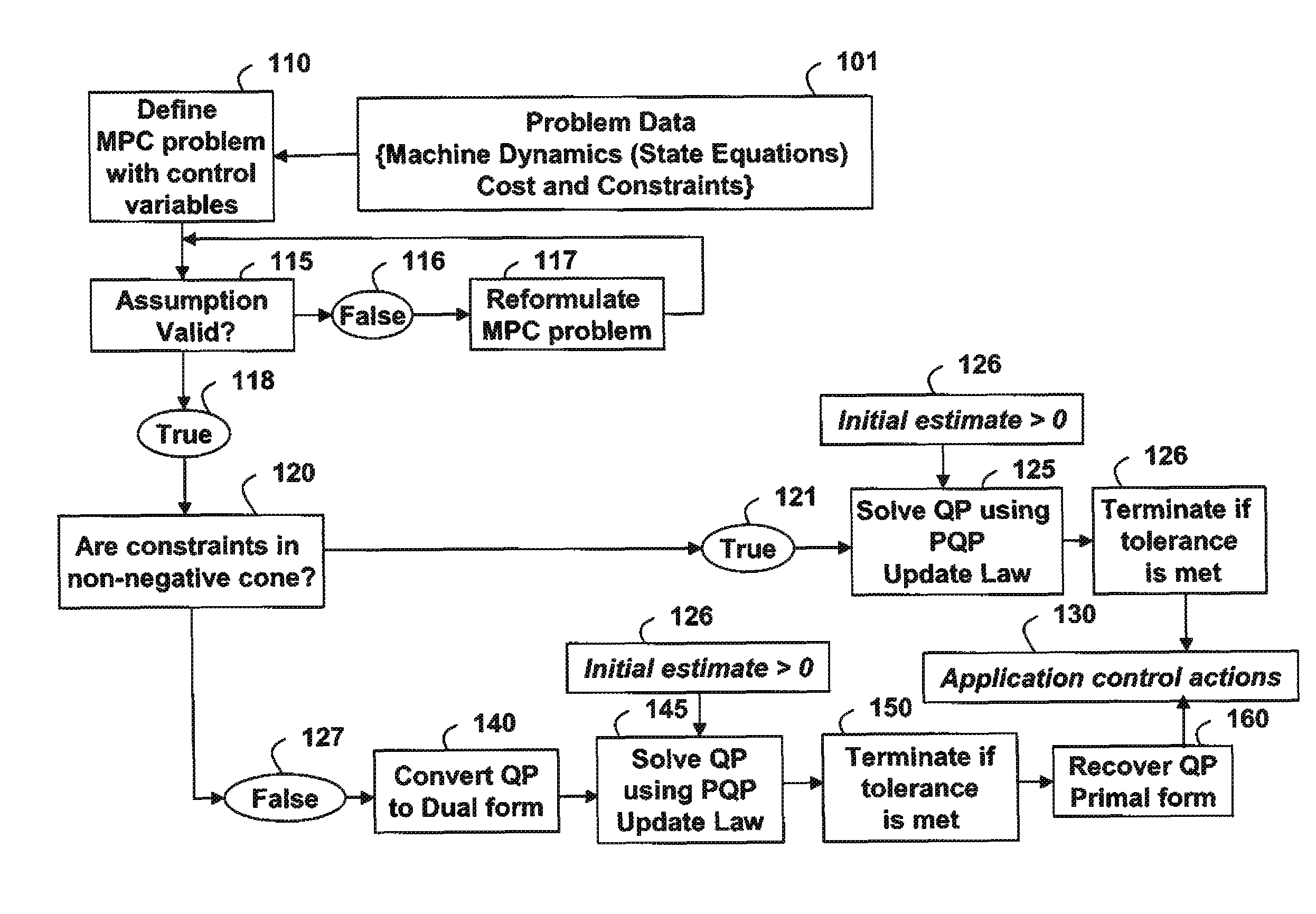
[0013]FIG. 1 shows a method for solving an optimization-based control problem according to embodiments of the invention.

[0014]Input 101 to the method includes control parameters and variables, dynamic state equations, costs, and constraints. The parameters can include machine parameters such as masses, lengths and material parameters. The constraints can include maximum velocity, range of travel, and maximum torque. It is understood that the input can be any arbitrary parameters and constraints found in typical automation applications, including processing plants, machine tools, vehicles etc., as used herein “application,”

[0015]A model predictive control (MPC) problem is defined 110 for the application using dynamic models and the input. As known by those of ordinary skill in the art, the model can be obtained from physics-based models or black-box models.

[0016]The MPC problem is an optimization problem solved for each finite time interval of a set of N samples. A cost function is p...

the structure of the environmentally friendly knitted fabric provided by the present invention; figure 2 Flow chart of the yarn wrapping machine for environmentally friendly knitted fabrics and storage devices; image 3 Is the parameter map of the yarn covering machine
Login to View More

PUM

No PUM Login to View More

Abstract

A method solves a quadratic programming (QP) problem in real-time implementations of model predictive control for automation applications. The method can be implemented for fine-grained parallel solutions. Due to the extreme simplicity of the method, even serial implementations offer considerable speed advantages. The method solves the problem by formulating, over a predetermined time interval, an optimization problem with a quadratic cost function, and linear state and control constraints as a quadratic program for the application. Then, the quadratic program is solved by applying a parallel quadratic programming update law starting from a positive initial estimate to obtain control actions for the application.

Description

FIELD OF THE INVENTION[0001]This invention is related generally to factory automation, and more particularly to model predictive control for optimizing control commands for machine tools.BACKGROUND OF THE INVENTION[0002]Model predictive control (MPC) is an optimization-based control strategy, which has been successfully applied in a wide range of applications, such as chemical process control, servo motion control, automotive cruise control, and multi-agent control in transportation networks, see e.g., U.S. Pat. Nos. 7,826,909, “Dynamic model predictive control,” 7,418,372, “Model predictive control apparatus,” and 5,519,605, “Model predictive control apparatus and method.”[0003]An MPC formulation is as follows. At each sampling time instant, an optimization problem is solved to minimize user-specified costs over a finite horizon in forward time, and a sequence of controls is obtained. This optimization is performed online, also referred to as in real-time. From the sequence of cont...

Claims

the structure of the environmentally friendly knitted fabric provided by the present invention; figure 2 Flow chart of the yarn wrapping machine for environmentally friendly knitted fabrics and storage devices; image 3 Is the parameter map of the yarn covering machine
Login to View More

Application Information

Patent Timeline
no application Login to View More
Patent Type & Authority Patents(United States)
IPC IPC(8): G05B13/02
CPCG05B13/048
Inventor BRAND, MATTHEWSHILPIEKANDULA, VIJAYBORTOFF, SCOTT A
Owner MITSUBISHI ELECTRIC RES LAB INC
Features
  • R&D
  • Intellectual Property
  • Life Sciences
  • Materials
  • Tech Scout
Why Patsnap Eureka
  • Unparalleled Data Quality
  • Higher Quality Content
  • 60% Fewer Hallucinations
Social media
Patsnap Eureka Blog
Learn More