
Rubber composition
a technology of composition and rubber, applied in the field of rubber composition, can solve the problems of affecting the adhesive property, affecting the appearance of vulcanized rubber, and exerting adverse effects on the physical properties of vulcanized rubber, so as to reduce the generation of rubber burning, and reduce the effect of delay
- Summary
- Abstract
- Description
- Claims
- Application Information
AI Technical Summary
Benefits of technology
Problems solved by technology
Method used
Image

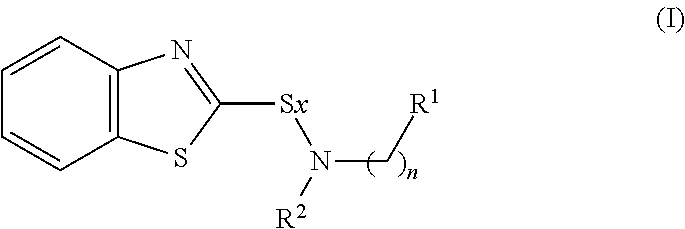
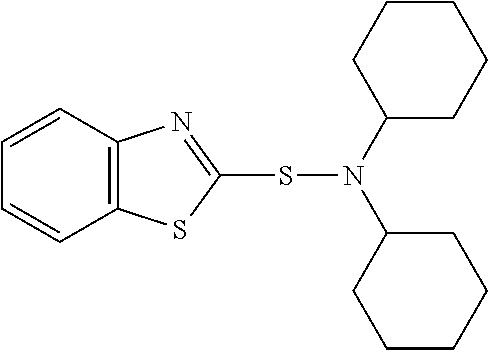
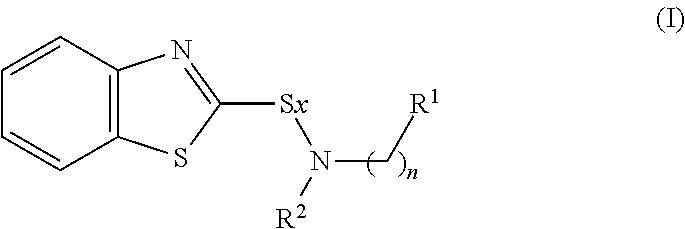
Examples
production example 1
Synthesis of N-ethyl-N-t-butylbenzothiazole-2-sulfeneamide (BEBS)
[0075]A 12% sodium hypochlorite aqueous solution 148 g was dropwise added to N-t-butylethylamine 16.4 g (0.162 mol) at 0° C. or lower and stirred for 2 hours, and the oil layer was separated. Bis(benzothiazole-2-yl)disulfide 39.8 g (0.120 mol), N-t-butylethylamine 24.3 g (0.240 mol) and the above oil layer were suspended in 120 ml of methanol and stirred under refluxing for 2 hours. After cooling, the solution was neutralized by sodium hydroxide 6.6 g (0.166 mol), filtered, washed with water and concentrated under reduced pressure, and then the concentrate was recrystallized, whereby 41.9 g (yield: 66%) of targeted BEBS was obtained in the form of white solid (melting point: 60 to 61° C.).
[0076]The spectral data of BEBS thus obtained is shown below.
[0077]1H-NMR (400 MHz, CDCl3) δ=1.29 (t, 3H, J=7.1 Hz, CH3 (ethyl)), 1.34 (s, 9H, CH3 (t-butyl)), 2.9 to 3.4 (br-d, CH2), 7.23 (1H, m), 7.37 (1H, m), 7.75 (1H, m), 7.78 (1H,...
production example 2
Synthesis of N-methyl-N-t-butylbenzothiazole-2-sulfeneamide
[0081]The same procedure as in Production Example 1 was carried out, except that N-t-butylmethylamine 14.1 g (0.162 mol) and 20.9 g (0.240 mol) were used in place of N-t-butylethylamine, whereby 46.8 g (yield: 82%) of BMBS was obtained in the form of white solid (melting point: 56 to 58° C.).
[0082]1H-NMR (400 MHz, CDCl3) δ=1.32 (9H, s, CH3 (t-butyl)), 3.02 (3H, s, CH3 (methyl)), 7.24 (1H, m), 7.38 (1H, m), 7.77 (1H, m), 7.79 (1H, m).
[0083]13C-NMR (100 MHz, CDCl3) δ=27.3, 41.9, 59.2, 120.9, 121.4, 123.3, 125.7, 135.0, 155.5, 180.8.
[0084]mass spectrometry (EI, 70 eV): m / z; 252 (M+), 237 (M+-CH3), 223 (M+-C2H6), 195 (M+-C4H9), 167 (M+-C5H12N), 86 (M+-C7H4NS2).
production example 3
Synthesis of N-n-propyl-N-t-butylbenzothiazole-2-sulfeneamide
[0085]The same procedure as in Production Example 1 was carried out, except that N-n-propyl-t-butylamine 18.7 g (0.162 mol) and 27.7 g (0.240 mol) were used in place of N-t-butylethylamine, whereby N-n-propyl-N-t-butylbenzothiazole-2-sulfeneamide was obtained in the form of white solid (melting point: 50 to 52° C.).
[0086]1H-NMR (400 MHz, CDCl3) δ: 0.92 (t, J=7.3 Hz, 3H), 1.34 (s, 9H), 1.75 (br, 2H), 3.03 (brd, 2H), 7.24 (t, J=7.0 Hz, 1H), 7.38 (t, J=7.0 Hz, 1H), 7.77 (d, J=7.5 Hz, 1H), 7.79 (d, J=7.5 Hz, 1H).
[0087]13C-NMR (100 MHz, CDCl3) δ: 11.7, 23.0, 28.1, 55.3, 60.4, 120.7, 121.3, 123.3, 125.7, 134.7, 154.8, 181.3.
PUM
| Property | Measurement | Unit |
|---|---|---|
| melting point | aaaaa | aaaaa |
| melting point | aaaaa | aaaaa |
| melting point | aaaaa | aaaaa |
Abstract
Description
Claims
Application Information
 Login to View More