[0004]The object of the present invention is to specify a tool head of the type initially mentioned, which has as few components as possible, is simple to manufacture and allows an especially precise fine adjustment of the radial widening. Furthermore, the adjusting device provided for this purpose in the tool head should require as little installation space as possible, so that the tool head can, as required, have a highly compact design.
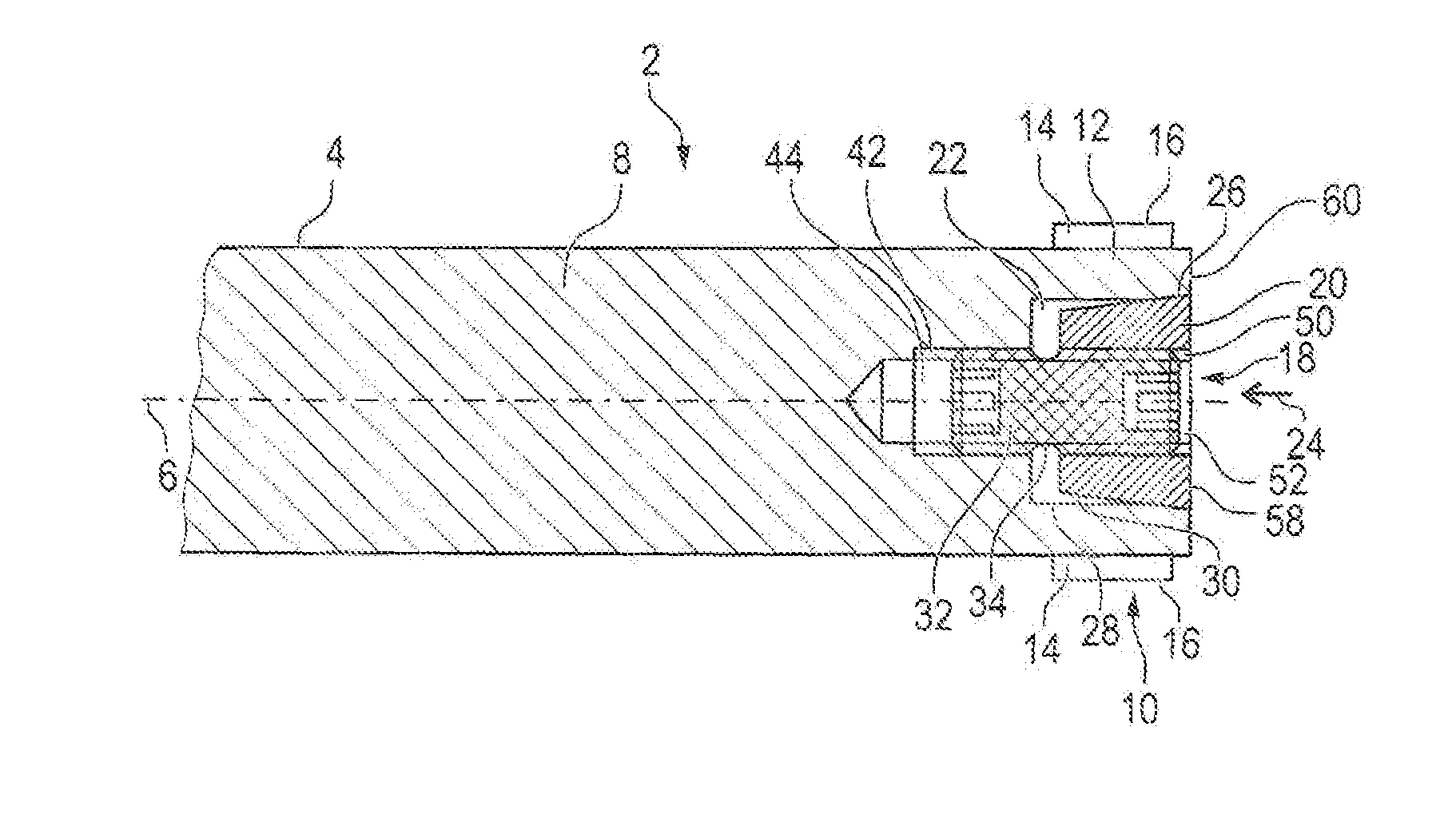
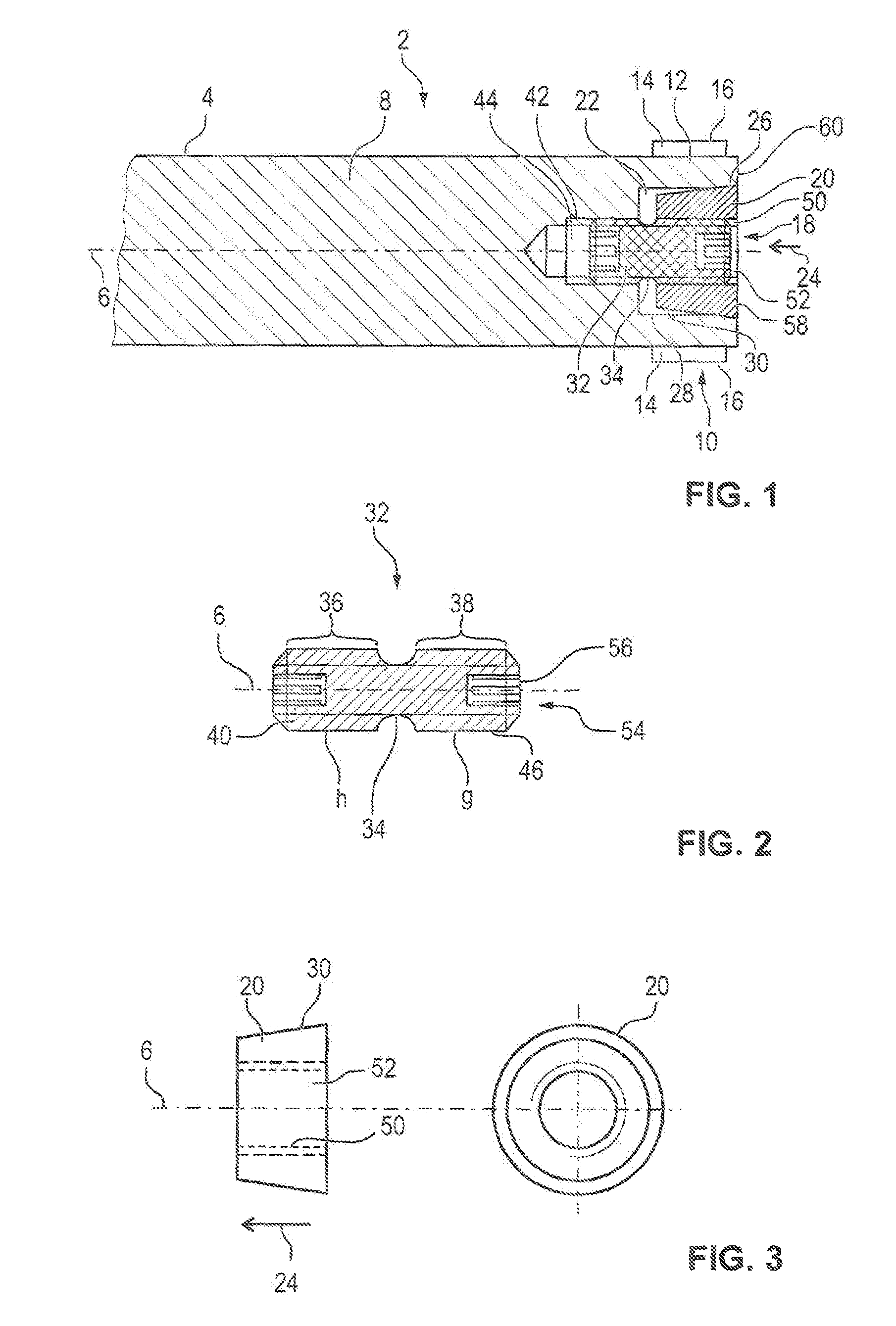
[0009]According to the fundamental operating principle of a differential screw of this kind, a differential mechanism, as it is known, is therefore implemented, in which the resulting axial stroke of the adjusting sleeve is always lower than the axial stroke of the adjusting screw when the latter is screwed into the threaded bore of the basic body. Since the resulting axial stroke of the adjusting sleeve depends on the difference between the leads of the two thread regions, in the extreme case of a very small lead difference, the stroke of the adjusting sleeve brought about during a rotation of the adjusting screw can be kept very low. Owing to the thread step-up, an especially precise fine adjustment of the axial position of the adjusting sleeve becomes possible independently of the conical geometry of the outer face of the adjusting sleeve, thus giving rise in a way known per se to the desired spreading or expansion of the tool head in the radial direction as a result of the wedge effect of the adjusting sleeve. In other words, in the present invention, in addition to the known wedge-type mechanism a further mechanism which extends and improves the setting possibilities is also implemented by the differential screw.
[0010]In a second variant, the two threaded portions of the adjusting screw have different flight directions. That is to say, one threaded portion is left-handed and the other right-handed. The associated internal threads of the receptacle in the basic body of the tool and in the adjusting sleeve are, of course, adapted to this configuration. Since, in this variant, the effective stroke travel of the adjusting sleeve in the axial direction depends on the sum of the leads of the two thread regions, a correspondingly high step-up can be provided, so that, by means of relatively small rotational movements on the adjusting screw, a relatively high force component can be introduced into the annular portion of the tool head via the adjusting sleeve acting as a spreading cone.
[0011]In both instances, the differential screw also makes it possible to release the adjusting device easily. Indeed, when the annular portion is being spread open, the actuating sleeve is usually braced markedly in the receptacle, that is to say in the annular portion, due to the high force introduced. However, when the differential screw is rotated counter to the tensioning direction, it is easily released from this state of tension, since, as a result of the step-up ratio, it then also moves the adjusting sleeve out of the receptacle again.
[0014]In an especially advantageous refinement, the adjusting screw and the adjusting sleeve are arranged, countersunk completely, in the cavity surrounded by the annular portion of the basic body, that is to say do not project with respect to the annular portion in the region of the end face of the tool head. Blind holes and steps in a workpiece can consequently be machined without difficulty.
[0021]The advantages achieved by means of the invention are, in particular, that the use of a differential screw as part of an adjusting device with a conical adjusting sleeve allows an especially precise fine adjustment of the radial expansion of an expandable tool head. By the adjusting sleeve being used, no frictional forces are transmitted to the annular portion of the tool head during bracing. To be precise, as soon as the adjusting sleeve comes to bear, flush, in the surrounding receptacle, that is to say in the annular portion, and has been braced, said adjusting sleeve does not rotate any further, but, instead, when the adjusting screw penetrates further, is displaced only in the axial direction and at the same time, as a result of its conical outer contour, expands the tool head. As compared with solutions known hitherto, the tool head according to the invention manages with fewer parts and can be mounted more easily.



 Login to View More