

Enabling a non-core domain to control memory bandwidth in a processor
a non-core domain and memory bandwidth technology, applied in the field of semiconductors, can solve the problems of inability to ensure the operation of the unit at an appropriate frequency, different circuitry can have differing needs, and the unit cannot meet the requirements of the unit,
- Summary
- Abstract
- Description
- Claims
- Application Information
AI Technical Summary
Benefits of technology
Problems solved by technology
Method used
Image

Examples
Embodiment Construction
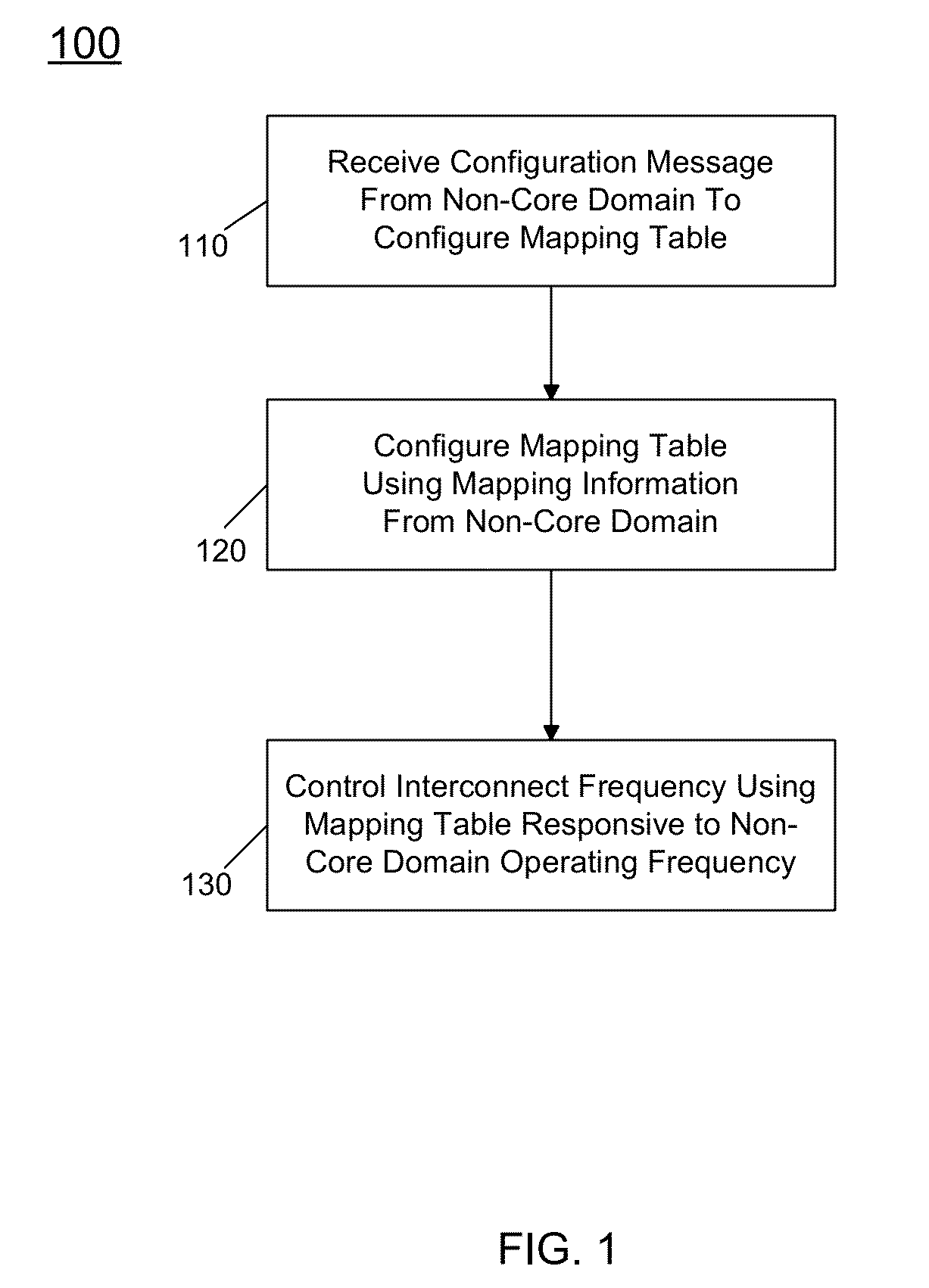
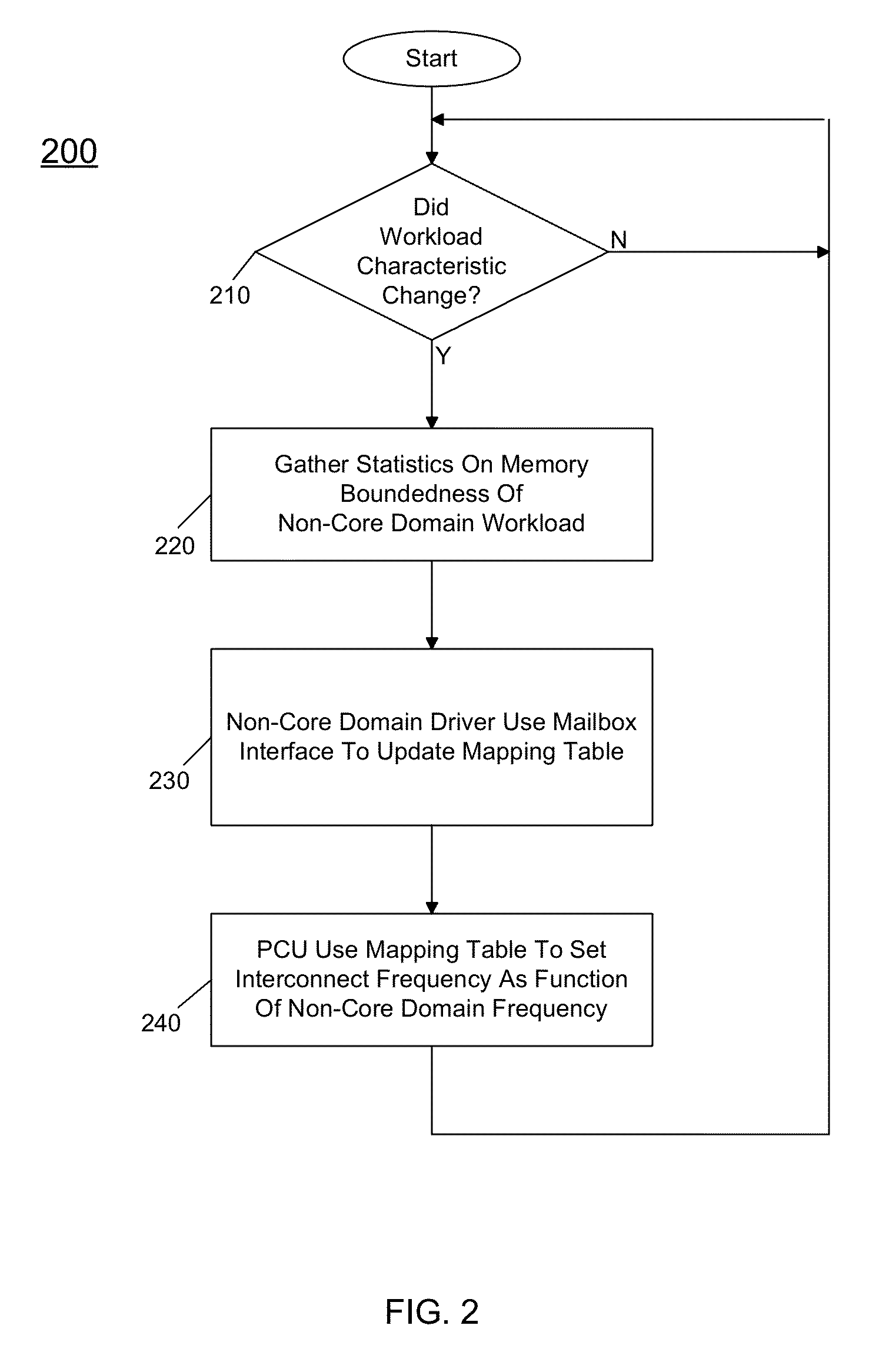
[0008]A multi-domain processor including multiple domains such as a core domain, a non-core domain and a system agent domain can enable the non-core domain to control memory bandwidth available to it. As will be described herein, in various embodiments this memory bandwidth can be realized by an interconnect structure, namely a ring interconnect that is part of the core domain. However, although described herein as being part of the core domain, understand that in other implementations a multi-domain processor can include an independent interconnect domain. By allowing a non-core domain to have control over an interconnect frequency and thus bandwidth, memory bandwidth used by non-core domain can be more efficient.
[0009]As will be discussed further below, in a multi-domain processor, a non-core domain can be coupled to a shared memory such as a last level cache and system main memory via an interconnect structure. By default, the interconnect frequency can be at the maximum frequenc...
PUM
 Login to View More
 Abstract
Description
Claims
Application Information
 Login to View More