

Solid oxide fuel cell
a fuel cell and solid oxide technology, applied in the field of solid oxide fuel cells, can solve the problems of slow gas g velocity, difficult reaction, and inability to generate electricity, and achieve the effect of simple structure and stably increasing power generation outpu
Patent Information
- Authority / Receiving Office
- US · United States
- Patent Type
- Patents(United States)
- Current Assignee / Owner
- Publication Date
- 2015-05-12
- Estimated Expiration
- Not applicable · inactive patent
Smart Images
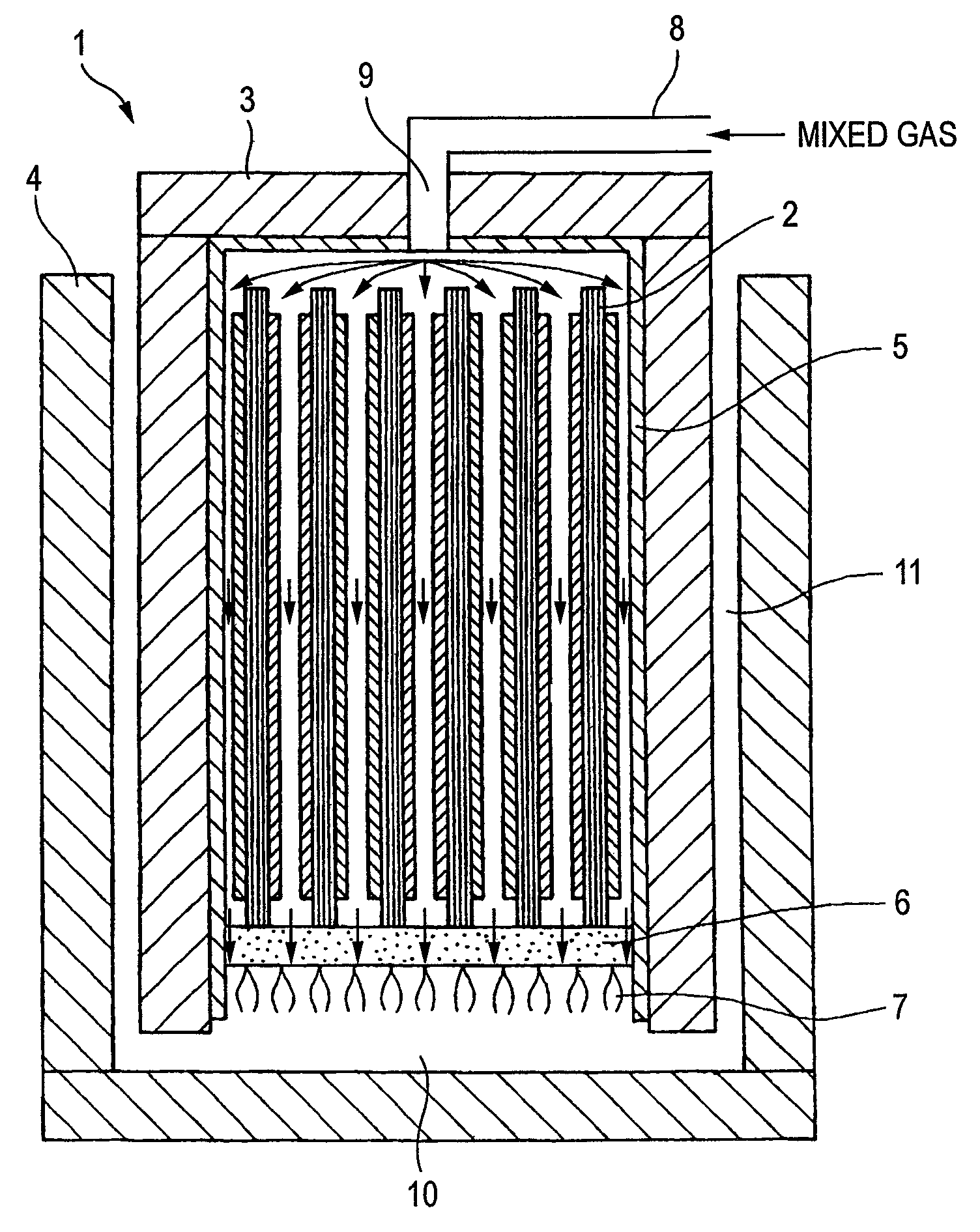
Figure 1 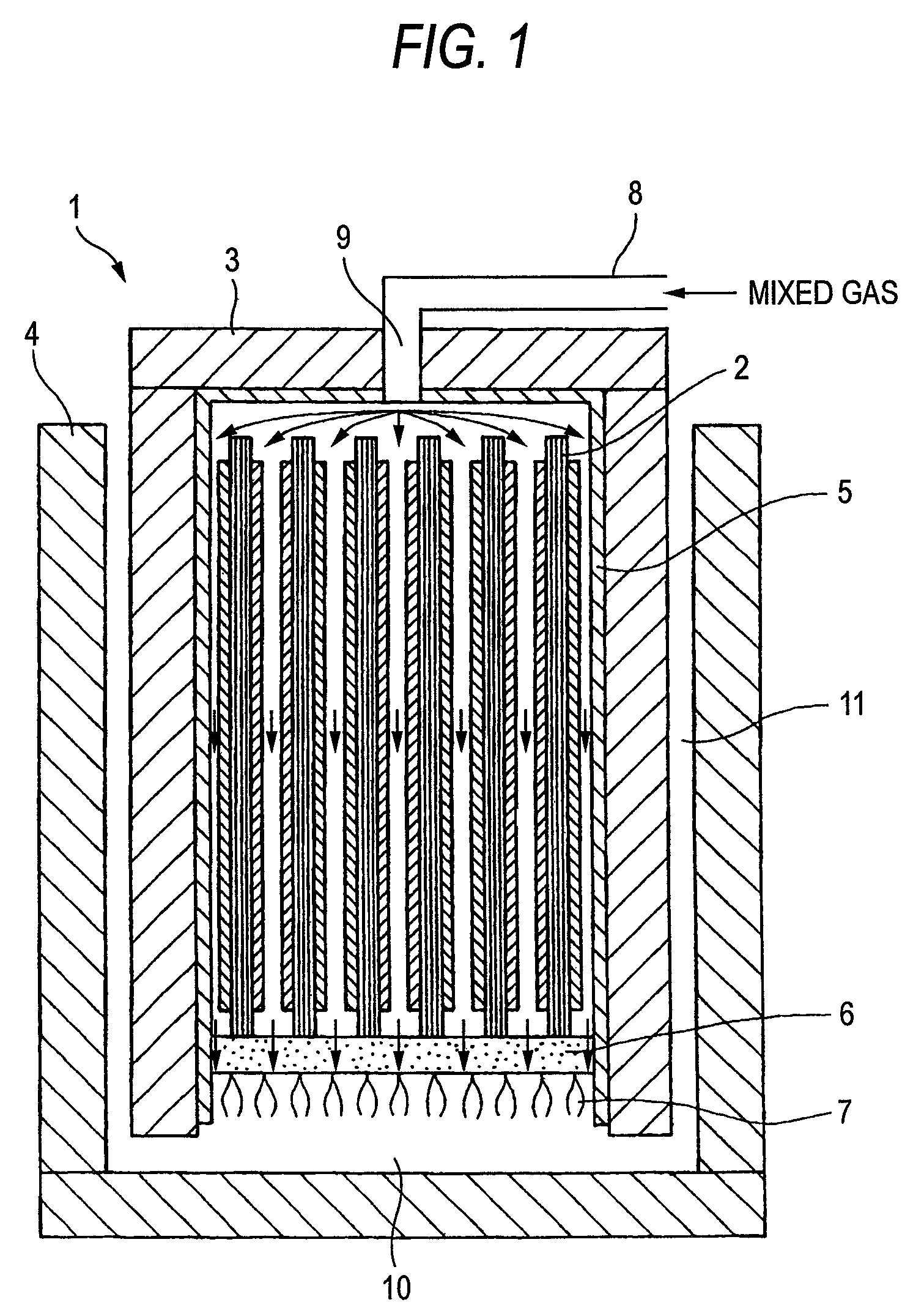
Figure 2 
Figure 3
Abstract
Description
BACKGROUND OF THE INVENTION
[0001] The invention relates to a solid oxide fuel cell, in particular, a solid oxide fuel cell that is simple in a structure, can generate electricity at a high density, and is easy to handle.
[0002] As big problems of the modern world, an energy problem and an environmental problem can be cited. As one of technologies that contribute to overcome the problems, a fuel cell technology is expected and various studies are in progress to achieve higher efficiency and low cost thereof.
[0003] The fuel cells are categorized in four types depending on kinds of electrolytes that constitute a battery. That is, 1) a solid polymer type where an electrolyte is a polymer exchange membrane, 2) a phosphoric acid type where an electrolyte is phosphoric acid, 3) a molten carbonate type where an electrolyte is carbonate and 4) a solid oxide type where an electrolyte is a solid oxide can be cited.
[0004] The invention relates to the fourth type thereof, that is, a solid oxide fuel ...
Examples
Embodiment Construction
[0077]In what follows, examples of the invention will be described.
[0078]FIG. 1 is a sectional view of a solid oxide fuel cell of the invention. In the drawing, reference numerals 1 through 11, respectively, express a solid oxide fuel cell, a battery cell, an internal vessel, an external vessel, a highly conductive material layer, a porous body, a flame, an introduction pipe of a mixture gas of fuel and air, an inlet port, a bottom space formed by the porous body 6 and the external vessel 4 and a space between side surfaces formed from the internal vessel 3 and the external vessel 4.
[0079]In FIG. 1, the external vessel 4 and the internal vessel 3 of the fuel cell 1 is made of a heat-insulating material and between both the space 11 therefrom burnt exhaust gas is exhausted is disposed. Inside of the internal vessel 3, a plurality of oblong planar cells 2 is disposed and the porous body 6 that supports bottom portions of the plurality of cells 2 and allows a mixture gas G described be...