Check patentability & draft patents in minutes with Patsnap Eureka AI!

Monitoring computer process resource usage

Active Publication Date: 2015-08-04
ZIFTEN TECH
View PDF150 Cites 119 Cited by
  • Summary
  • Abstract
  • Description
  • Claims
  • Application Information

AI Technical Summary

Benefits of technology

The patent describes techniques for identifying, classifying, and prioritizing processes running on a computer system. These techniques help assess the importance of processes and reconcile their resource usage with business goals. The system can also evaluate processes based on their application genre, user type, or network session activity. The results of the evaluation can trigger corrective actions. The main technical effects of this patent are improved process management and resource optimization, as well as improved user experience through relevant process evaluation and improved decision-making based on resource usage policies.

Problems solved by technology

A potential problem with having multiple processes is that they may be inefficient in sharing system resources.
In many instances, processes are completely unnecessary to system operation, yet contend with high-value processes for limited system resources.
Developers of software that corresponds to these processes generally have little motivation to address this issue, because they are more often concerned with providing a maximal feature set to users.
These processes typically consume a large amount of resources, without regard for the needs of other processes on the system.
This disregard often results in a “tragedy of the commons,” in which processes are ultimately starved or severely impaired.
Operating system designers also have not addressed this issue.
The problem of resource usage is further magnified as the size of the computing environment increases.
At a given time in such an environment, millions of processes may be running, all of which are competing for limited resources.
The execution of these processes may correspond to a significant investment in cost and resources on the part of the enterprise.
These approaches have certain limitations, however.
For example, these approaches do not enable entities to gain insight into (and informed control over) what non-malicious or benign processes are running on end-user systems at a given time.
(Non-malicious processes include those processes not flagged or classified by security software as harmful and those processes not intended to harm a computer system; examples of malicious processes include viruses, worms, keyloggers, adware, etc.) Because the vast majority of processes in an enterprise are benign, this lack of insight is a huge blind spot that creates cost inefficiencies and security problems, and prevents entities from being able to appropriately prioritize and direct their computing resources.

Method used

the structure of the environmentally friendly knitted fabric provided by the present invention; figure 2 Flow chart of the yarn wrapping machine for environmentally friendly knitted fabrics and storage devices; image 3 Is the parameter map of the yarn covering machine
View more

Image

Smart Image Click on the blue labels to locate them in the text.
Viewing Examples
Smart Image
  • Monitoring computer process resource usage
  • Monitoring computer process resource usage
  • Monitoring computer process resource usage

Examples

Experimental program
Comparison scheme
Effect test

embodiment 2

3. The method of embodiment 2, wherein the plurality of processes includes one or more non-malicious processes, and wherein the controlling prioritizes processes with a relatively higher importance score.

4. The method of embodiment 2, wherein the controlling is performed according to a resource consumption of the plurality of processes.

5. A method, comprising:

[0128]automatically controlling resource usage of a plurality of processes operating on a computer system of an entity according to a non-best-efforts paradigm that prioritizes processes according to a resource usage policy of the entity.

6. A method, comprising:

[0129]a computer system of an entity categorizing a plurality of processes executing on the computer system;

[0130]the computer system terminating those ones of the plurality of processes categorized as being extraneous to the entity;

[0131]the computer system boosting performance of non-extraneous ones of the plurality of processes categorized as satisfying a resource usa...

embodiment 6

7. The method of embodiment 6, further comprising:

[0133]automatically optimizing settings and parameters relating to an operating system of the computer system.

[0134]The embodiments described above may be combined in any suitable manner including being combined with embodiments described in other sections. Furthermore, non-transitory computer readable media that include program instructions executable to implement any of the methods described in this section are also contemplated. Additionally, computer systems or computing devices that are configured to implement any of the disclosed methods are also contemplated. Such methods, computer-readable media, and systems may be implemented at a client level or a server level (either within an entity or external to multiple entities, as with a regulatory body).

Extraneous Process Analysis

[0135]Turning now to FIG. 7, one embodiment of an extraneous process analysis module 710 is depicted. As discussed above, an “extraneous” process is a proc...

embodiment 1

2. The method of embodiment 1, wherein the determining includes computing a first score indicative of a process being extraneous and a different second score indicative of a process being non-extraneous.

3. The method of embodiment 1, wherein the determining includes reading a file that stores directory information.

4. The method of embodiment 1, wherein the determining includes collecting information by making one or more application programming interface (API) calls to an operating system.

5. The method of embodiment 1, wherein the determining includes accessing an enterprise server database storing information on attributes of processes executing on a plurality of client systems.

6. The method of embodiment 1, wherein the determining includes determining a manner in which a process was initiated.

7. The method of embodiment 6, wherein the manner includes being initiated by another process, being manually initiated by a user, or being initiated by an operating system during a startup s...

the structure of the environmentally friendly knitted fabric provided by the present invention; figure 2 Flow chart of the yarn wrapping machine for environmentally friendly knitted fabrics and storage devices; image 3 Is the parameter map of the yarn covering machine
Login to View More

PUM

No PUM Login to View More

Abstract

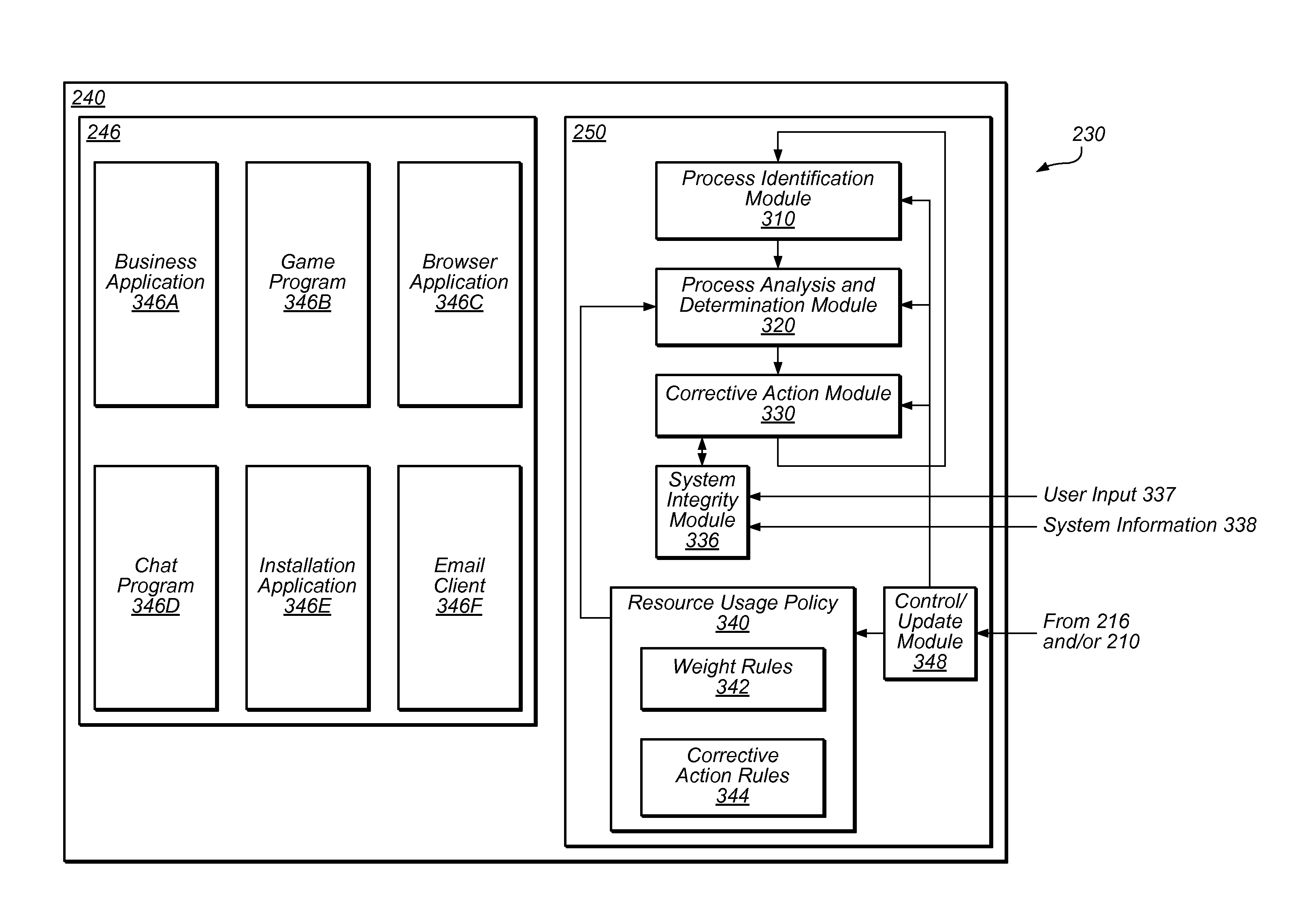
Techniques are disclosed relating to improving resource usage on a computer system. In one embodiment, a computer system identifies a plurality of processes running on the computer system and determines an importance value and a resource consumption value. In such an embodiment, the importance value is indicative of an importance of an identified process, and the resource consumption value is indicative of a resource consumption of the identified process. The computer system evaluates the importance value and the resource consumption value relative to a usage policy, and takes a corrective action with respect to the identified process based on the evaluating to reconcile resource consumption with process importance value.

Description

RELATED APPLICATION[0001]The present application claims the benefit of U.S. Provisional Application No. 61 / 332,629, filed May 7, 2010, the disclosure of which is incorporated by reference herein in its entirety.BACKGROUND[0002]1. Technical Field[0003]This disclosure relates generally to improving resource usage on a computer system, and, in some embodiments, to classifying processes and taking corrective actions in response thereto.[0004]2. Description of the Related Art[0005]Computer systems typically have numerous processes that share system resources (one or more processors, memory space, network bandwidth, etc.). A potential problem with having multiple processes is that they may be inefficient in sharing system resources. In many instances, processes are completely unnecessary to system operation, yet contend with high-value processes for limited system resources.[0006]Developers of software that corresponds to these processes generally have little motivation to address this is...

Claims

the structure of the environmentally friendly knitted fabric provided by the present invention; figure 2 Flow chart of the yarn wrapping machine for environmentally friendly knitted fabrics and storage devices; image 3 Is the parameter map of the yarn covering machine
Login to View More

Application Information

Patent Timeline
no application Login to View More
IPC IPC(8): G06F9/46G06F9/50
CPCG06F9/50G06F11/3003G06F11/3051G06F11/3409G06F11/3442G06F11/3452G06F11/3466G06F2201/865G06F21/554G06F21/566G06F2221/034G06F2221/2135Y02D10/00H04L43/0876H04L47/783
Inventor OBRECHT, MARK E.MYERS, ROBERT P.HARTMANN, ALFRED C.ALAGNA, NICK F.PYLE, KEVIN N.SULLIVAN, SCOTT D.LITTLE, MICHAEL W.
Owner ZIFTEN TECH
Features
  • R&D
  • Intellectual Property
  • Life Sciences
  • Materials
  • Tech Scout
Why Patsnap Eureka
  • Unparalleled Data Quality
  • Higher Quality Content
  • 60% Fewer Hallucinations
Social media
Patsnap Eureka Blog
Learn More