
Planar sensor and its manufacturing method
a sensor and planar technology, applied in the field of planar sensors, can solve the problems of time-consuming and complex separation of sensor and flooring, complex contact arrangement between sensor conductors and connection cables, etc., and achieve the effect of facilitating the manufacturing process
- Summary
- Abstract
- Description
- Claims
- Application Information
AI Technical Summary
Benefits of technology
Problems solved by technology
Method used
Image

Examples
Embodiment Construction
[0029]The present invention is based on an idea to integrate a planar sensor and a flooring into a unitary floor sensor structure and to manufacture this unitary structure in a continuous manufacturing process. The planar sensor is thin and has a thickness 10-100 μm whereby the flooring is essentially thicker and has a thickness 1-10 mm. Further, the flooring layer is provided with peeling areas or peeling stripes.
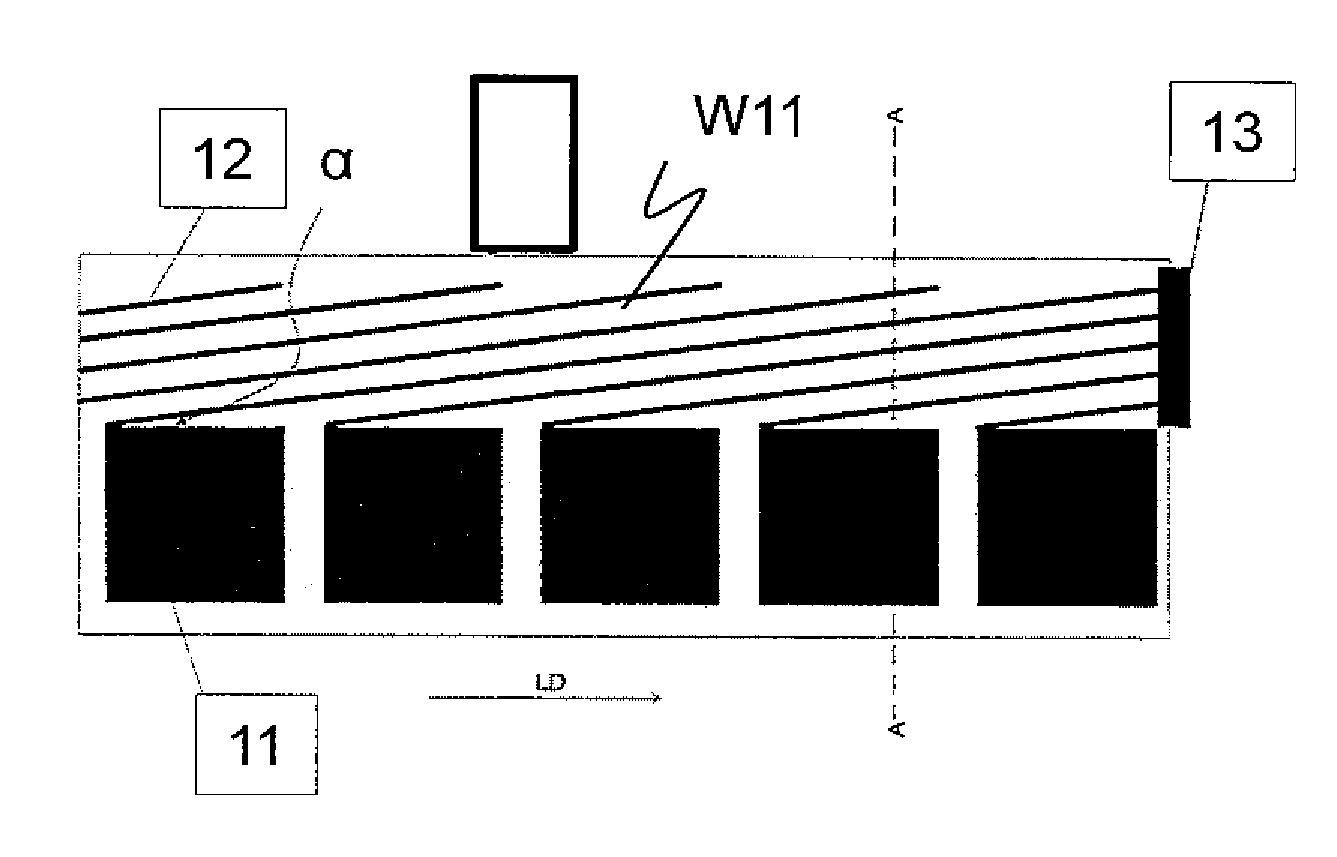
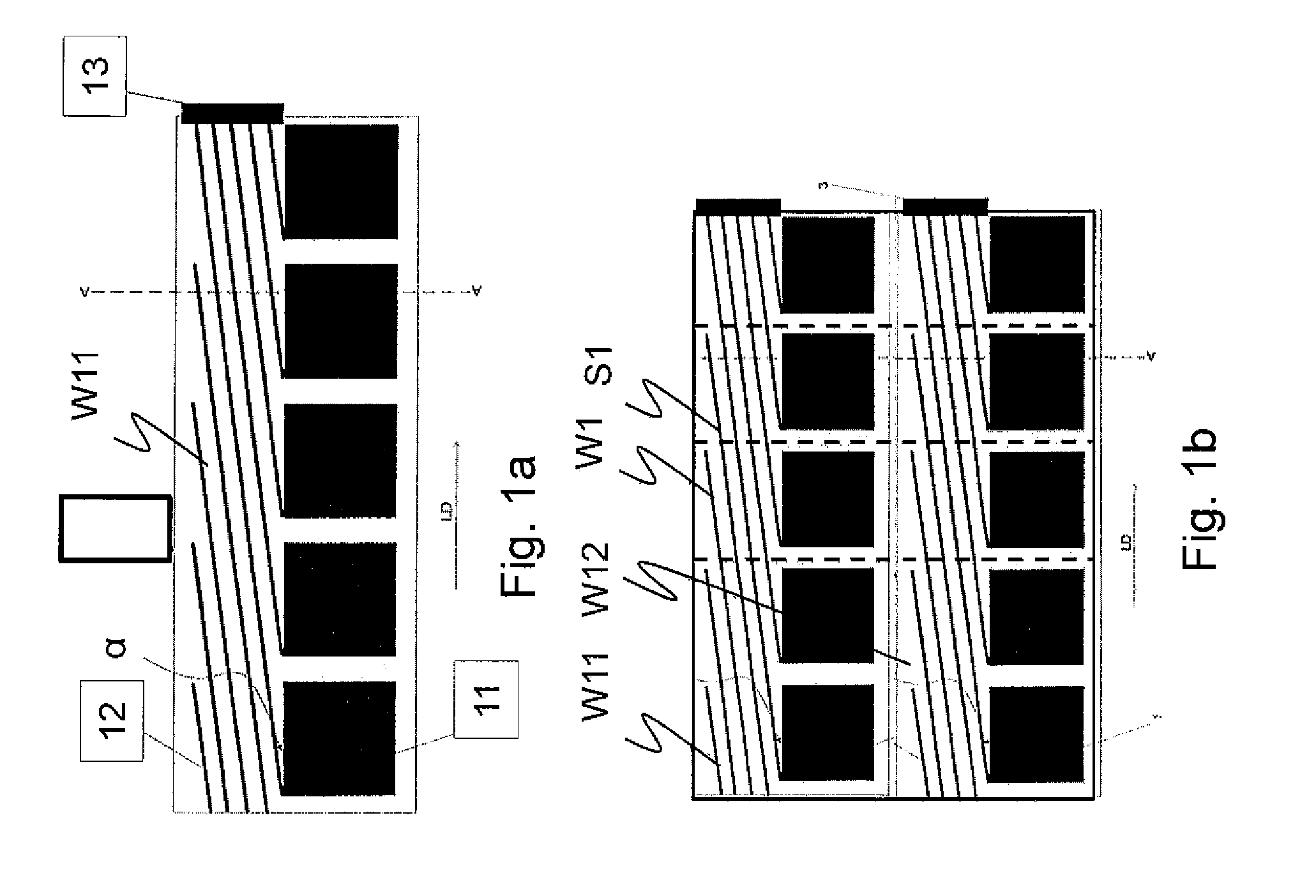
[0030]FIG. 1b illustrates a floor sensor W1 for monitoring electrically conductive objects, for example the movement and location of a human on a floor. The sensor web W1 comprises several, in FIG. 1b two, identical parallel sensor web units W11, W12 having successive electrically conductive areas 11 according to FIG. 1a. A conductor 12 connects the electrically conductive area 11 to an output 13. The output 13 is provided with a connector. The parallel conductors 12 extend linearly and form an angle α to the longitudinal direction LD of the web.
[0031]The sensor web W1 is ...
PUM
| Property | Measurement | Unit |
|---|---|---|
| thickness | aaaaa | aaaaa |
| thickness | aaaaa | aaaaa |
| thickness | aaaaa | aaaaa |
Abstract
Description
Claims
Application Information
 Login to View More