
Manufacturing method for a glass roll and manufacturing apparatus for a glass roll
a manufacturing method and glass roll technology, applied in the direction of glass tempering apparatus, furnaces, charge manipulation, etc., can solve the problems of unrolled glass film accumulating distortion, unrolled glass film proportions that cannot be brought into close contact with each other, and unable to achieve weaving, etc., to achieve easy and stably manufacture glass rolls, and appropriate tensile for
- Summary
- Abstract
- Description
- Claims
- Application Information
AI Technical Summary
Benefits of technology
Problems solved by technology
Method used
Image

Examples
example
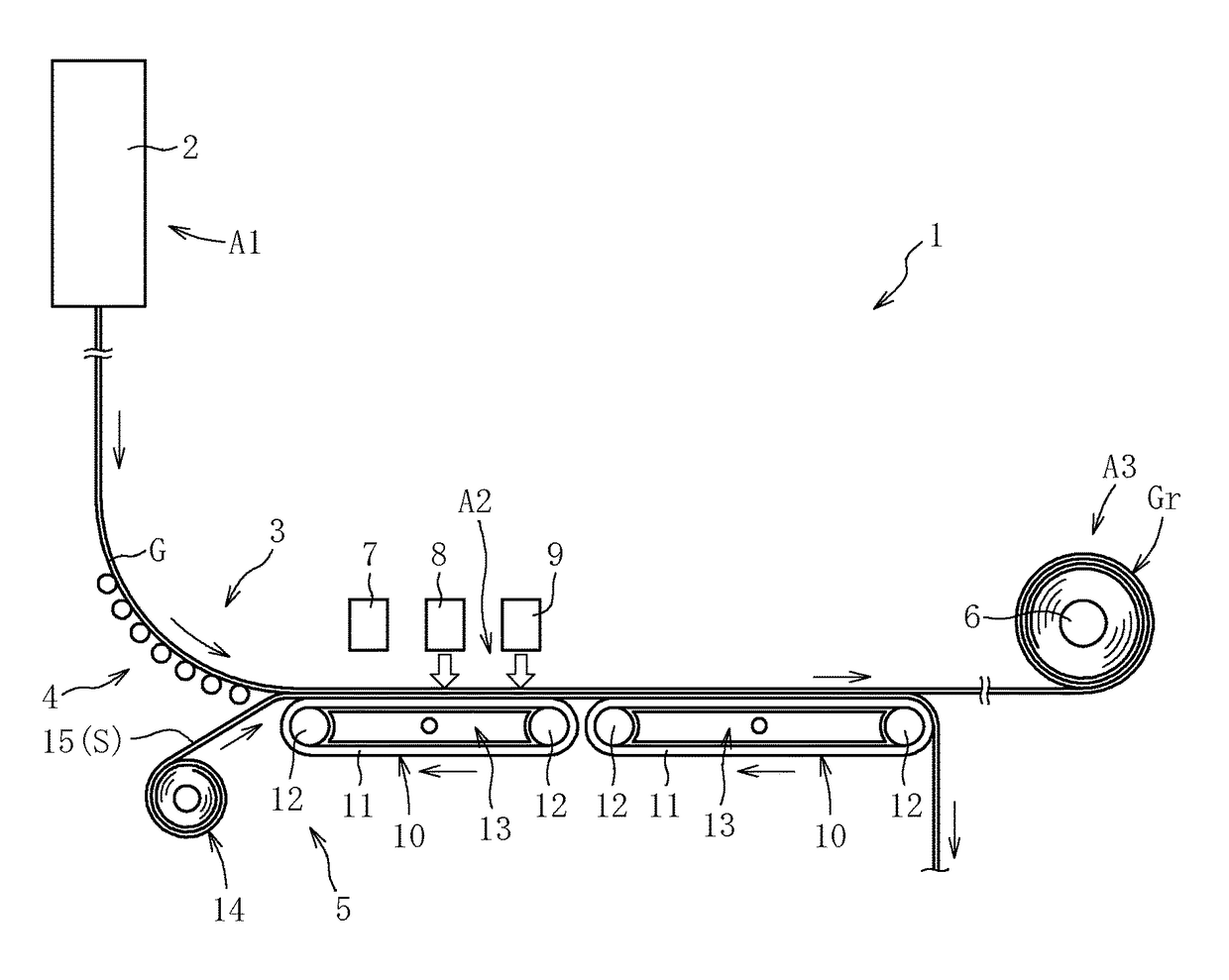
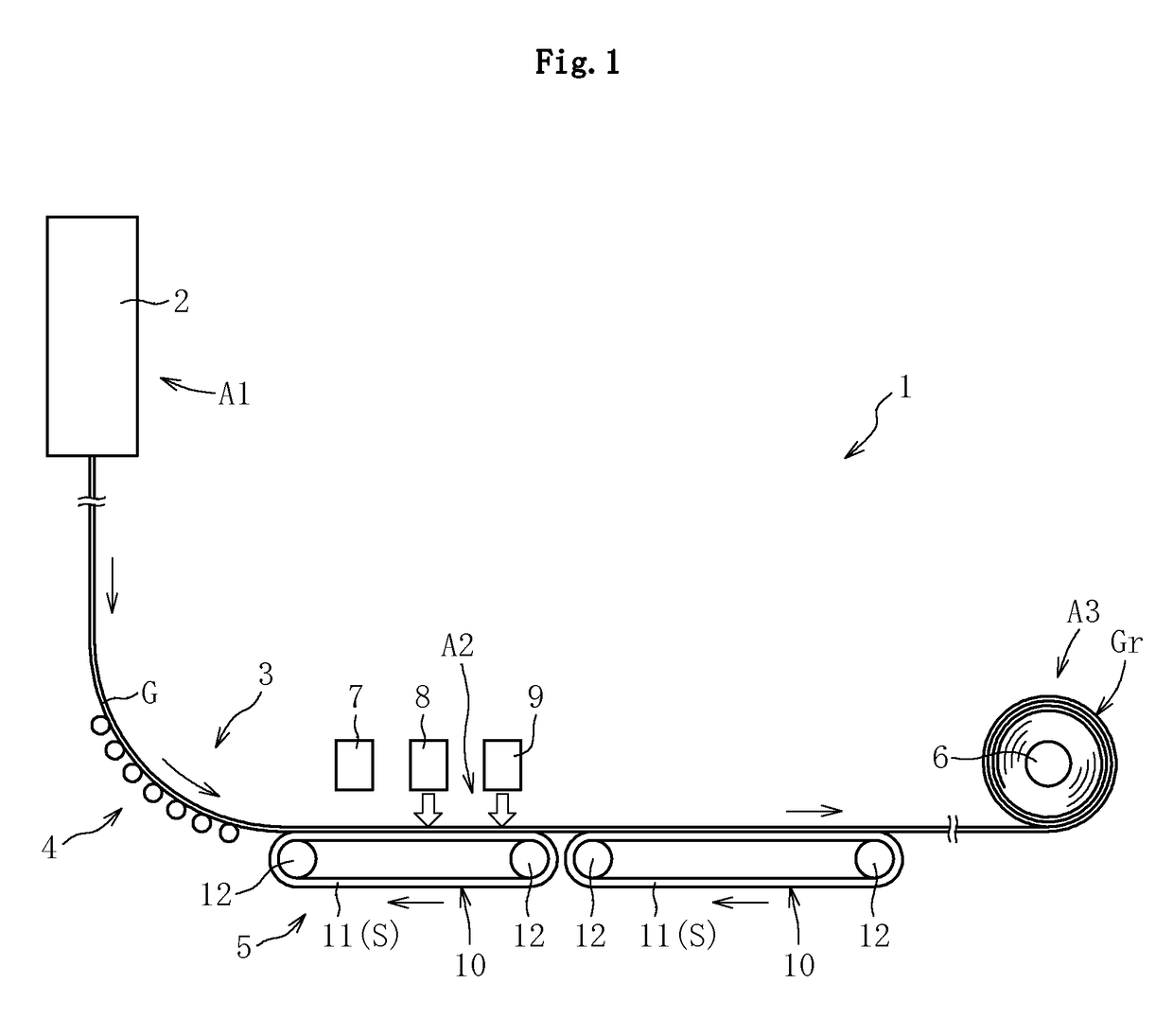
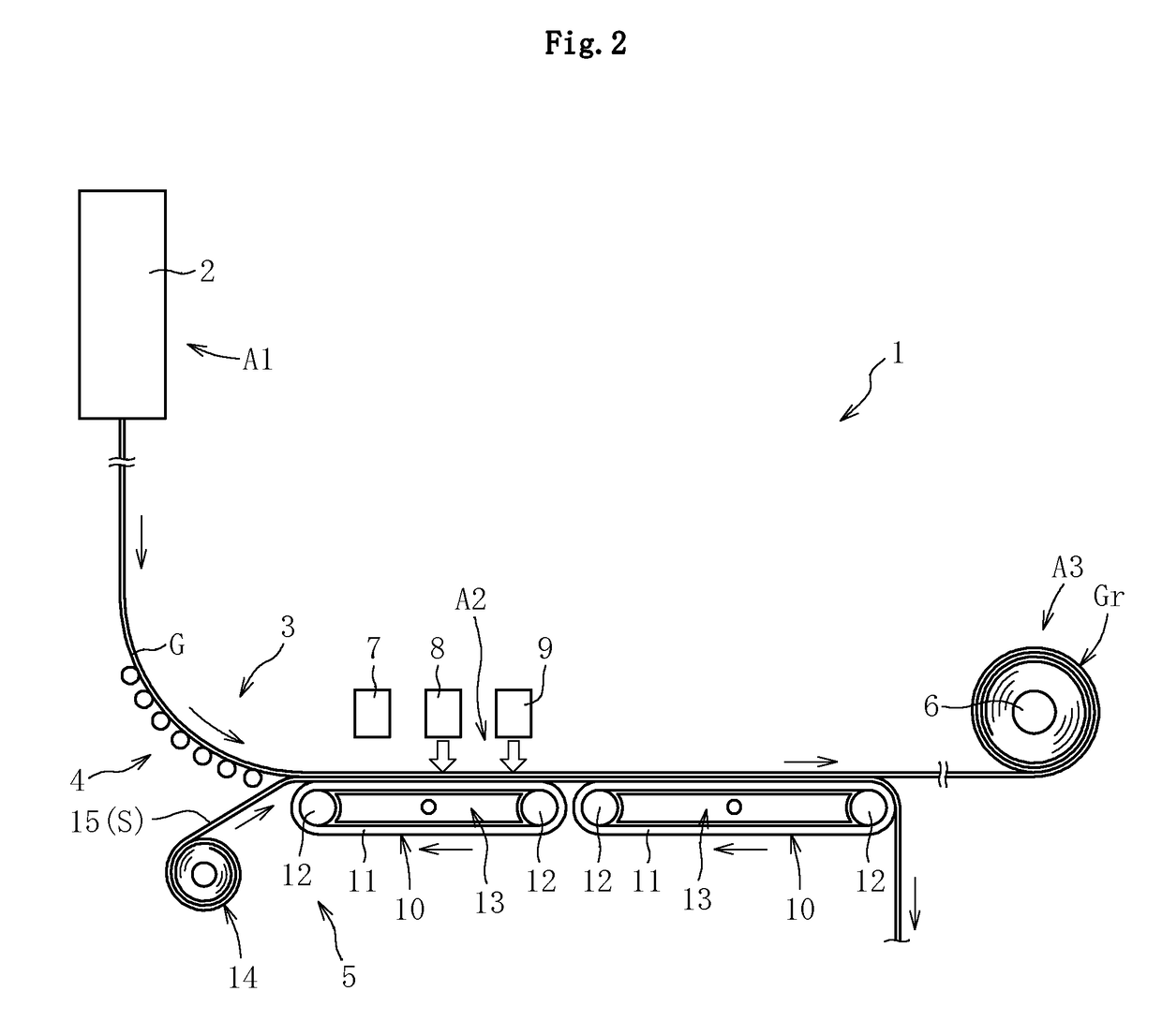
[0058]A confirmatory test was conducted to demonstrate usefulness of the present invention. In this confirmatory test, the manufacturing apparatus 1 having the structure illustrated in FIG. 1 was used, and glass films G having thicknesses of 100 μm and 50 μm were successively formed by the forming device 2 and continuously delivered to the downstream side by the horizontal conveyance section 5. Further, the glass films G were rolled by the rolling device 6. Under the condition described above, confirmation was made on the degree of the tensile force imparted to the glass film G interposed between the horizontal conveyance section 5 and the rolling device 6, and on the frequency of weaving occurring in the glass roll Gr, in accordance with the type of the endless belt 11 used as the support section S. In the confirmatory test, there were prepared five types of endless belts 11 having coefficients of static friction on the glass film G of 0.2, 0.6, 1.0, 1.6, and 3.2, and the frequency...
PUM
| Property | Measurement | Unit |
|---|---|---|
| thickness | aaaaa | aaaaa |
| thickness | aaaaa | aaaaa |
| thickness | aaaaa | aaaaa |
Abstract
Description
Claims
Application Information
 Login to View More