High temperature heat-collecting pipe hard glass and Kovar alloy sealing method
What is AI technical title?
AI technical title is built by Patsnap AI team. It summarizes the technical point description of the patent document.
A hard glass and heat collecting tube technology, applied in the sealing field of hard glass and Kovar alloy
Inactive Publication Date: 2008-08-13
NANJING SANLE ELECTRONICS INFORMATION IND GRP
View PDF0 Cites 7 Cited by
Summary
Abstract
Description
Claims
Application Information
AI Technical Summary
This helps you quickly interpret patents by identifying the three key elements:
Problems solved by technology
Method used
Benefits of technology
Problems solved by technology
my country is not yet able to meet this requirement
Method used
the structure of the environmentally friendly knitted fabric provided by the present invention; figure 2 Flow chart of the yarn wrapping machine for environmentally friendly knitted fabrics and storage devices; image 3 Is the parameter map of the yarn covering machine
View more
Image
Smart Image Click on the blue labels to locate them in the text.
Viewing Examples
Smart Image
Click on the blue label to locate the original text in one second.
Reading with bidirectional positioning of images and text.
Smart Image
Examples
Experimental program
Comparison scheme
Effect test
Embodiment 1
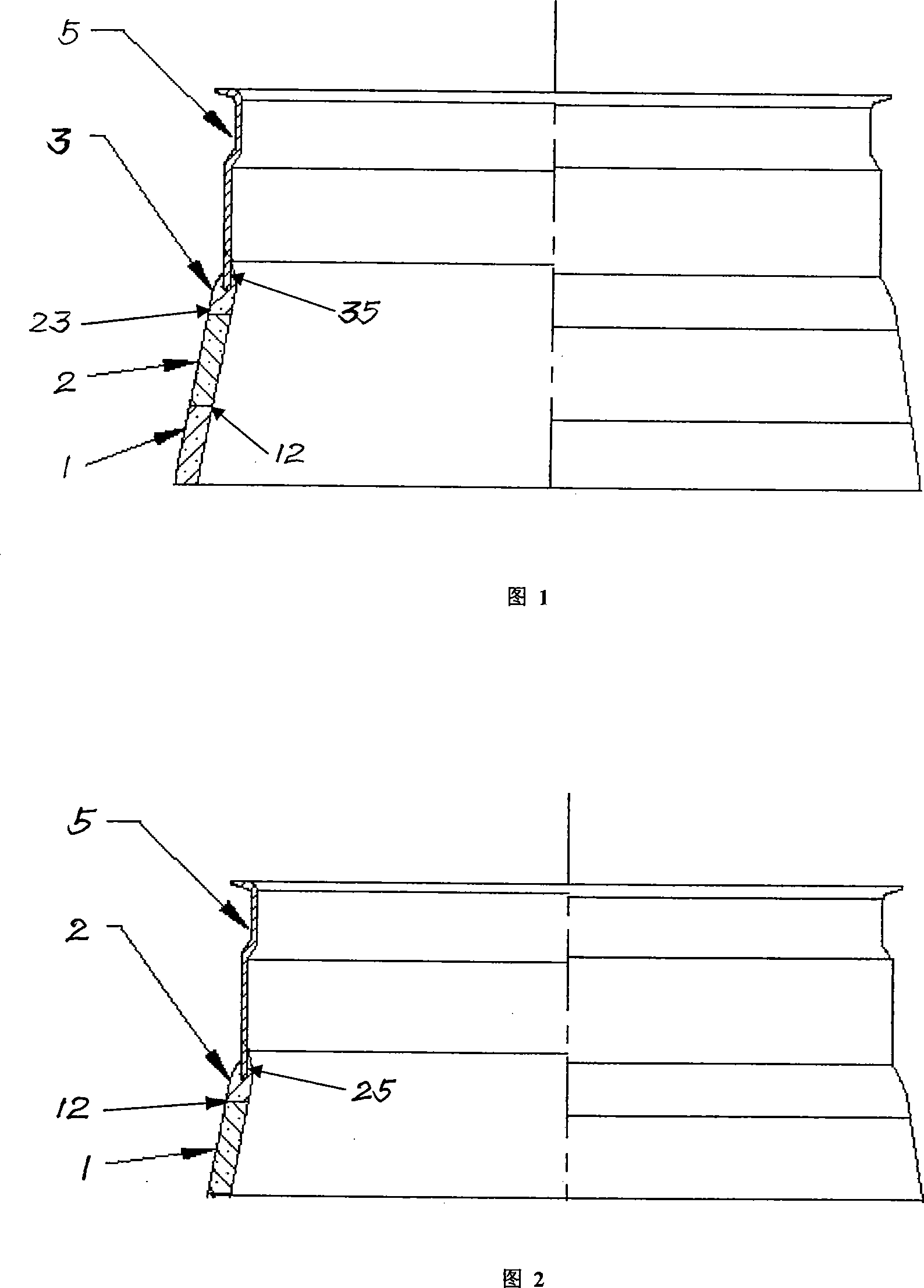
[0011] Referring to Fig. 1, hard glass 1, two transition glass joints 2, 3, and Kovar tube 5 are sequentially sealed (butted). The expansion coefficient of hard glass, two transition glass joints, and Kovar alloy is (32-34)*10 -7 / °C, (39-41)*10 -7 / °C, (46-48)*10 -7 / °C, (50.3-53.7)*10 -7 / °C.
Sealing zone 12 between hard glass 1 and transition glass joint 2
900-1250
The sealing area 23 between the transition glass joint 2 and the transition glass joint 3
600-900
The sealing area 35 between the transition glass joint 3 and the Kovar tube 5
500-800
[0014] The heating temperatures of the sealing areas 12, 23, and 35 are gradually reduced, and the heating temperature difference of each sealing area is 250-300°C;
[0020] The difference between embodiment 2 and embodiment 1 is that the heating temperatures of the sealing areas 12, 23, and 35 are different, and the heating temperature difference of each sealing area is 50-100°C, as shown in the following table:
[0021] seal area
[0022] For the high-temperature heat collecting tube of this embodiment, a tensile test is carried out, and the tensile strength reaches 700 kg. In the fatigue test, the stretching cycle was more than 38,000 times. Carry out small batch production, and the finished product rate reaches 88%.
Embodiment 3
[0024] The difference between Embodiment 3 and Embodiment 1 is that the heating temperatures of the sealing areas 12, 23, and 35 are different, and the heating temperature difference of each sealing area is 100-200°C, as shown in the following table:
[0025] seal area
[0026] For the high-temperature heat collecting tube of this embodiment, a tensile test was carried out, and the tensile strength reached 760 kg. In the fatigue test, the stretching cycle was more than 44,000 times. Carry out small batch production, and the finished product rate reaches 92%.
the structure of the environmentally friendly knitted fabric provided by the present invention; figure 2 Flow chart of the yarn wrapping machine for environmentally friendly knitted fabrics and storage devices; image 3 Is the parameter map of the yarn covering machine
Login to View More
PUM
Login to View More
Abstract
An objective of the invention is to provide a sealing method which has high reliability and practicability and is used between the high-temperature thermal-collecting tube hard glass and the metal. The method adopts one or more than one transition glass joint to do transition sealing, the expansion factor of the hard glass, transition glass joint and the kovar which are sealed in sequence gradually increases, the difference value of the expansion factor of the adjacent two sealing pieces is (6- 11)* <-7> / DEG C; when the adjacent two sealing pieces are sealed the heating temperature of the sealing area is 500-1500 DEG C, and the temperature is kept for 5-30min; from the hard glass to the kovar the heating temperature of each sealing area is 50-300 DEG C; and the hard glass, transition glass joint and the kovar which are executed with sealing are done with stress-relieving annealing.
Description
technical field [0001] The invention relates to the sealing of hard glass and metal (kovar alloy) in high-temperature heat collecting tubes, in particular to the sealing method of hard glass and kovar alloy. Background technique [0002] High-temperature collector tube refers to a collector tube that can meet the working requirements of 400°C and withstand the temperature impact of -50-400°C. It is the core device for manufacturing solar thermal power generation. It is mainly composed of a hard glass shell with high light transmission, a metal (kovar alloy) inner tube covered with a heat-absorbing coating, an expansion joint with a good length compensation function, and connecting flanges for inner and outer tubes. The expansion coefficient of hard glass is generally (27-35)*10 -7 For high boron glass at / ℃, the expansion coefficient of Kovar alloy is generally (50.3-53.7)*10 -7 / °C (in the case of (30-450)°C). [0003] At present, in the manuf...
Claims
the structure of the environmentally friendly knitted fabric provided by the present invention; figure 2 Flow chart of the yarn wrapping machine for environmentally friendly knitted fabrics and storage devices; image 3 Is the parameter map of the yarn covering machine
Login to View More
Application Information
Patent Timeline
Application Date:The date an application was filed.
Publication Date:The date a patent or application was officially published.
First Publication Date:The earliest publication date of a patent with the same application number.
Issue Date:Publication date of the patent grant document.
PCT Entry Date:The Entry date of PCT National Phase.
Estimated Expiry Date:The statutory expiry date of a patent right according to the Patent Law, and it is the longest term of protection that the patent right can achieve without the termination of the patent right due to other reasons(Term extension factor has been taken into account ).
Invalid Date:Actual expiry date is based on effective date or publication date of legal transaction data of invalid patent.
Login to View More
Patent Type & AuthorityApplications(China)
IPC IPC(8): C03C29/00
Inventor张沪基王俊毅钱新荣王娟高迎春潘生云
OwnerNANJING SANLE ELECTRONICS INFORMATION IND GRP


 Login to View More
  Login to View More