Photo-induced polymer holographic material mixed with nano-silicon dioxide and preparation method thereof

A nano-silicon dioxide and photopolymer technology, which is applied in the field of optical holographic storage, can solve the problems of not being able to meet the large refractive index modulation degree and high spatial stability at the same time.

CN101697280AInactive Publication Date: 2010-04-21HENAN UNIVERSITY
0 Cites 12 Cited by

Patent Information

Authority / Receiving Office
CN · China
Patent Type
Applications(China)
Current Assignee / Owner
Publication Date
2010-04-21
Estimated Expiration
Not applicable · inactive patent

Smart Images

  • Figure 1
    Figure 1
  • Figure 2
    Figure 2
  • Figure 3
    Figure 3
Patent Text Reader

Abstract

The invention relates to a photo-induced polymer holographic material mixed with nano-silicon dioxide and a preparation method thereof. The photo-induced polymer holographic material comprises polyvinyl alcohol, acrylic amide, N,N'-methylenebisacrylamide, methylene blue, triethanol amine and nano-silicon dioxide. The preparation process comprises the following steps: firstly, adding the polyvinyl alcohol to deionized water and obtaining a polyvinyl alcohol solvent; secondly, dissolving the N,N'-methylenebisacrylamide in the deionized water, respectively adding nano-silicon dioxide granules and the acrylic amide and uniformly stirring; thirdly, adding the triethanol amine to the solvent obtained from the second step and fully stirring; fourthly, simultaneously adding the methylene blue and the mixed solvent prepared from the third step to the polyvinyl alcohol solvent and obtaining a photopolymer collosol; and fifthly, pouring the collosol on a glass substrate and obtaining a photopolymer dry film after the water is volatized. The materials simultaneously have great refractive index modulation degree and space stability, have the diffraction efficiency reaching 93 percent and are suitable for photo-holographic storage.
Need to check novelty before this filing date? Find Prior Art

Description

Technical field

[0001] The invention relates to optical holographic storage, in particular to a photopolymer holographic recording material doped with water-soluble nano silica particles modified by amino groups and a preparation method thereof. Background technique

[0002] Compared with traditional storage methods such as magnetic storage and magneto-optical storage, high-density digital holographic storage has the advantages of high redundancy, high storage density, large storage capacity, high data transmission rate and short access time, and parallel addressing. , And become a research hotspot in the field of massive information storage technology. Since 2000, world-renowned companies such as InPhase in the United States, Optware in Japan, Polight in the United Kingdom and other scientific research institutions have been engaged in the research of digital holographic storage technology. It can be seen from the latest research results that the main reason affecting the pract...

Examples

Embodiment 1

[0018] Example 1: Prepare according to the above-mentioned specific preparation process, and the final dry film component content of the photopolymer prepared is:

[0019] Polyvinyl alcohol: 47.133wt%

[0020] Acrylamide: 14.100wt%

[0021] N,N’-methylenebisacrylamide: 3.924wt%

[0022] Triethanolamine: 31.643wt%

[0023] Methylene blue: 0.076wt%

[0024] Nano silica particles: 3.124wt%

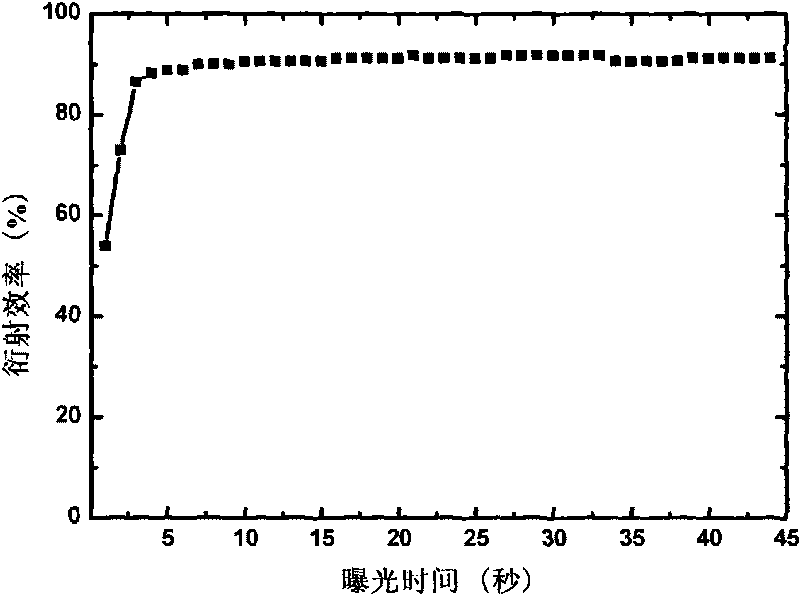
[0025] Such as figure 2 As shown, the obtained diffraction efficiency can reach 93%.

Embodiment 2

[0026] Example 2: Prepare according to the above specific preparation process, and the final photopolymer film component content is:

[0027] Polyvinyl alcohol: 47.562wt%

[0028] Acrylamide: 14.228wt%

[0029] N,N’-methylenebisacrylamide: 3.959wt%

[0030] Triethanolamine: 31.929wt%

[0031] Methylene blue: 0.077wt%

[0032] Nano silica particles: 2.254wt%

[0033] The diffraction efficiency obtained in this embodiment can reach 88%.

Embodiment 3

[0034] Example 3: Prepare according to the above specific preparation process, and the final photopolymer film component content is:

[0035] Polyvinyl alcohol: 46.632wt%

[0036] Acrylamide: 13.951wt%

[0037] N, N`-methylenebisacrylamide: 3.882wt%

[0038] Triethanolamine: 31.307wt%

[0039] Methylene blue: 0.0755wt%

[0040] Nano silica particles: 4.153wt%

[0041] The diffraction efficiency obtained in this embodiment can reach 86%.