
Application of B/E bi-methoxy silybin in preparing medicaments for treating viral hepatitis B
A technology of dimethoxyl and silibinin, which is applied in the field of medicine, can solve problems such as new uses not being effectively developed, and achieve the effects of convenient source of raw materials, convenient synthesis, and inhibition of HBV DNA replication.
- Summary
- Abstract
- Description
- Claims
- Application Information
AI Technical Summary
Problems solved by technology
Method used
Image

Examples
Embodiment 1
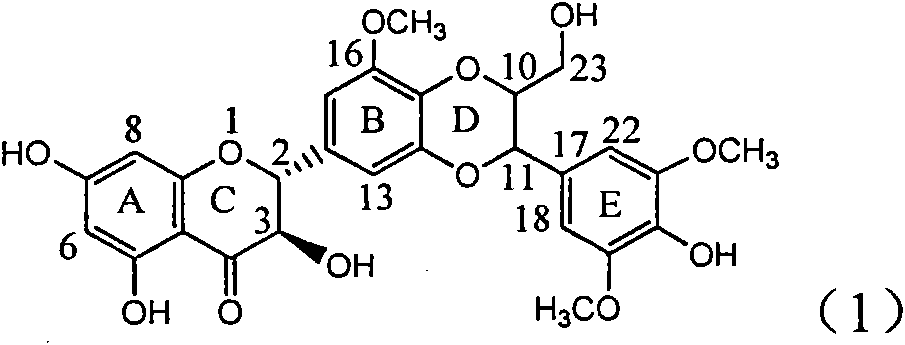
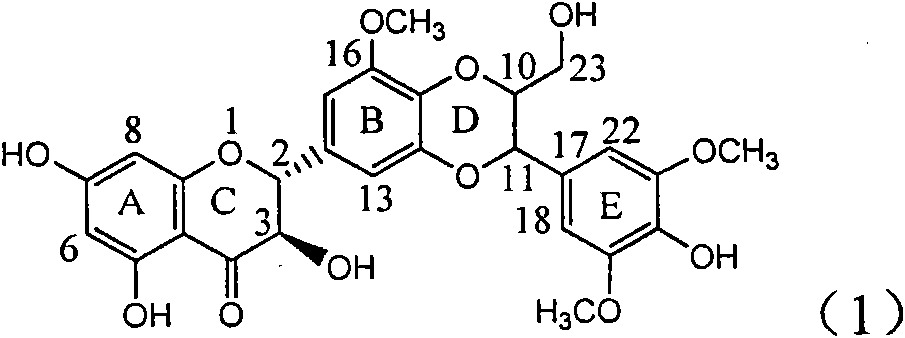
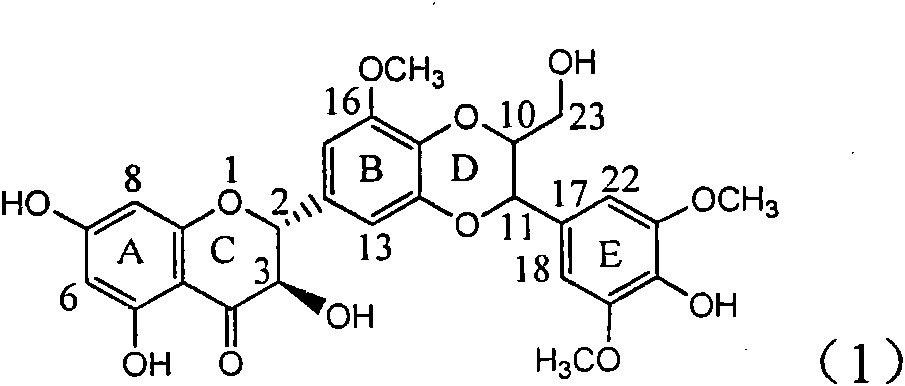
[0029] Example 1: Compound (±)-2-[2,3-dihydro-3-(4-hydroxy-3,5-dimethoxyphenyl)-2-hydroxymethyl-8-methoxy- Preparation of 1,4-benzodioxane-6-]-2,3-dihydro-3,5,7-trihydroxy-4H-1-benzopyran-4-one
[0030] 1.1 Instruments and reagents:
[0031] The ultraviolet spectrum was measured with a Shimadzu UV-240 ultraviolet spectrophotometer; the hydrogen nuclear magnetic resonance spectrum 1 H-NMR is measured by INOVA type superconducting nuclear magnetic resonance spectrometer (VARIAN INOVA-400MHz) (tetramethylsilyl ether TMS is the internal standard); (100-200, 200-300 and 300-400 mesh) and silica gel GF254 (10-40 mesh) for thin-layer chromatography are produced by Qingdao Ocean Chemical Factory; all reagents used are analytically pure, thin-layer preparative chromatography (PTLC ) uses the aluminum foil silica gel plate of Merck Company; Sephadex LH-20 used for column chromatography adopts the product of Amersham Pharmacia Biotech AB Company of Sweden; Reversed-phase silica gel RP...
Embodiment 2
[0044] Example 2: Inhibitory Effect of Compound (1) on Hepatitis B Surface Antigen (HBsAg) Secreted by HepG2.2.15 Cells
[0045] 2.1 Cell culture:
[0046] HepG2.2.15 cells were cultured in DMEM medium containing 10% inactivated fetal bovine serum, 100 U / ml penicillin and 100 U / ml streptomycin, 100 μg / ml G418 at 37°C, 5% CO 2 , cultured in an incubator with 100% relative humidity.
[0047] 2.2 The inhibitory effect of the compound of formula (1) on HepG2.2.15 cell growth was measured by MTT method:
[0048] Take the HepG2.2.15 cells in the logarithmic growth phase, and dilute the cells to 1×10 with medium 5 cells / ml, seeded in 96-well cell culture plate, 100 μl per well, at 37°C, 5% CO 2 After cultivating in an incubator with 100% relative humidity for 24 hours, add compound (1) diluted with medium, the concentration is 1000, 200, 40 and 8 μg / ml respectively, 200 μl per well, and three concentrations are set for each Duplicate wells, placed at 37°C, 5% CO 2 , cultivated...
Embodiment 3
[0058] Example 3: Inhibitory Effect of Compound (1) on Hepatitis B e Antigen (HBeAg) Secreted by HepG2.2.15 Cells
[0059]3.1 Cell culture: the method is the same as in Example 2.
[0060] 3.2 Determination of the inhibitory effect of the compound of formula (1) on the growth of HepG2.2.15 cells by MTT method: the method is the same as in Example 2.
[0061] 3.3 Determination of the inhibitory effect of the compound on hepatitis B e antigen (HBeAg): take the HepG2.2.15 cells in the logarithmic growth phase, and dilute the cells to 1 × 10 with the medium 5 / ml, seeded in 96-well cell culture plate, 100ml per well, at 37°C, 5% CO 2 After culturing in an incubator with 100% relative humidity for 24 hours, add samples diluted with culture medium at concentrations of 20 μg / ml, 4 μg / ml and 0.84 μg / ml, 200 μl per well, and set three concentrations for each Multiple wells were placed at 37°C, 5% CO 2 , cultivated in an incubator with 100% relative humidity, change the culture med...
PUM
 Login to View More
 Abstract
Description
Claims
Application Information
 Login to View More