
Monoclonal antibodies of avian influenza H5HA antigens
A monoclonal antibody and vector technology, applied in the biological field, can solve the problems of stimulating the immune system of the host and difficult to express gene cloning effectively, and achieve the effect of easy transcription and translation, stable mRNA, and improved expression.
- Summary
- Abstract
- Description
- Claims
- Application Information
AI Technical Summary
Problems solved by technology
Method used
Image


Examples
Embodiment 1
[0035] The construction of embodiment 1.H5-VN HADNA vaccine
[0036] MacVector 7.2 software was used to analyze Influenza A virus (A / Viet Nam / 1203 / 2004 (H5N1) (according to the published gene bank data), and found that the codons favored by the HA gene derived from A / VietNam1203 / 04 were similar to those of mammalian cells The codons favored by the genes are very different, so the codon-optimized H5-VN HA gene is designed, and the sequence is SEQ ID NO.1. The preferred codons of mammalian cells in the codon-optimized H5-VN HA gene The sub-frequency is higher than that of the wild-type H5-VN HA gene ( figure 1 ). Compared with the wild type, the DNA sequence is changed, but the amino acid sequence of the HA protein is unchanged. The designed sequence was synthesized by Geneart Company in Germany, loaded into plasmid pUC18, and constructed into recombinant plasmid pUC18 / H5-VN. The synthesized sequence was confirmed to be correct by sequencing.
[0037] According to previous r...
Embodiment 2
[0043] Example 2. Cell Transfection
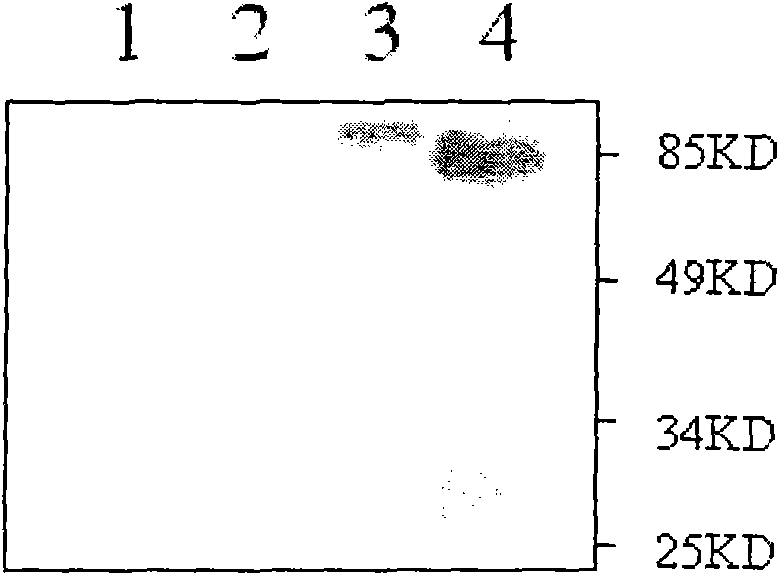
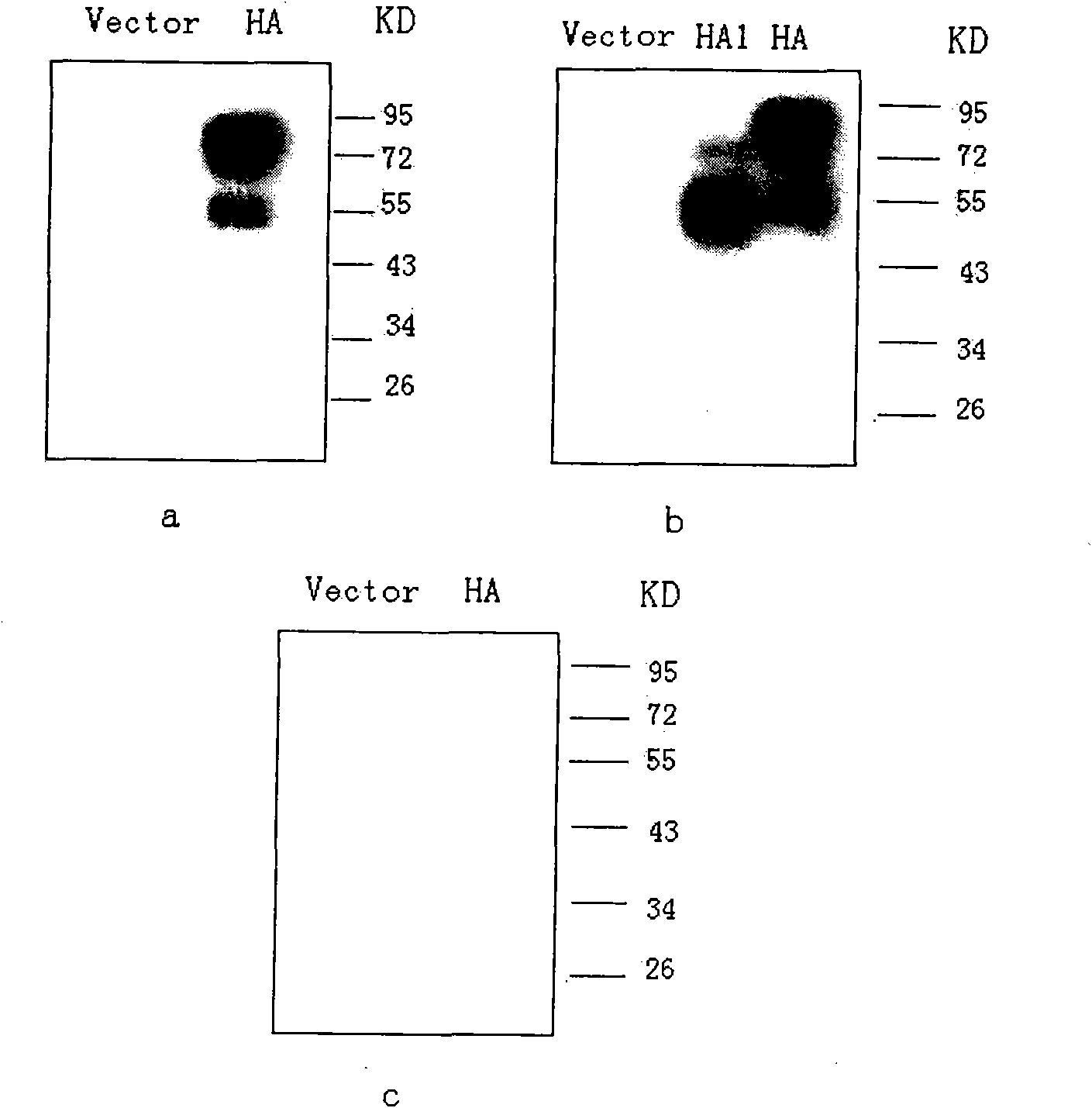
[0044] 293T cells were treated with double-antibody DMEM high-glucose medium containing 10% fetal bovine serum at 37°C, 5% CO 2 Cultivate in a saturated humidity incubator until the logarithmic growth phase, digest with 2.5g / L trypsin, and use 1.0×10 6 Cells (6 mL) were inoculated in a 60 mm culture dish, and transfection was started when they grew to 80% confluence. Cell transfection was carried out according to the PEI transfection method. Take 50 μL of PEI and add it to 930 μL of double-antibody-containing DMEM high-glucose medium, and add 8.0 μg of H5-VN HA recombinant plasmid HA-VN.tPA to the above culture medium, lightly Gently mix, incubate at room temperature for 15min, then add 1ml of PEI / DNA complex to the culture flask and shake gently to mix evenly, meanwhile, transfect cells with pJW4303 empty plasmid as negative control, after 10h, replace without serum containing Double-antibody DMEM medium. Western blot analysis was perf...
Embodiment 3
[0046] Example 3. Establishment of hybridoma cell lines
[0047] Step 1: Animal Immunization
[0048] Seven Balb / c mice were immunized with the HA-VN.tPA vaccine prepared in Example 1. Immunization by intramuscular injection combined with in vivo gene introduction, ensure that the needle insertion depth is 2 mm, inject the vaccine, observe the injection local uplift, and immediately perform in vivo electrotransfection at the injection site with WJ-2002 live gene introduction instrument (technical parameters: voltage 50V, pulse The number of times is 3 times in front and back, the wave width is 60 ms, and the frequency is 30 Hz), and the electrotransfection is effective when the mouse leg muscles shake. DNA immunization was carried out 4 times at week 0, 2, 4, and 8. After the fourth DNA immunization, 293T cells were transfected by intraperitoneal injection of H5-VN.tPA, and each mouse was injected with 5x10 6 -1x10 7 cells.
[0049] Step 2: Cell Fusion
[0050] Four days ...
PUM
 Login to View More
 Abstract
Description
Claims
Application Information
 Login to View More