
Carbon brush for truck starting motor as well as manufacture method and application thereof
A technology for starting motors and carbon brushes, which is applied in the manufacture of brushes, circuits, and current collectors. It can solve the problems of large sparks and the life of carbon brushes cannot meet the requirements of use, and achieve the goals of improving service life, ensuring service life, and high conductivity. Effect
- Summary
- Abstract
- Description
- Claims
- Application Information
AI Technical Summary
Problems solved by technology
Method used
Image

Examples
Embodiment 1
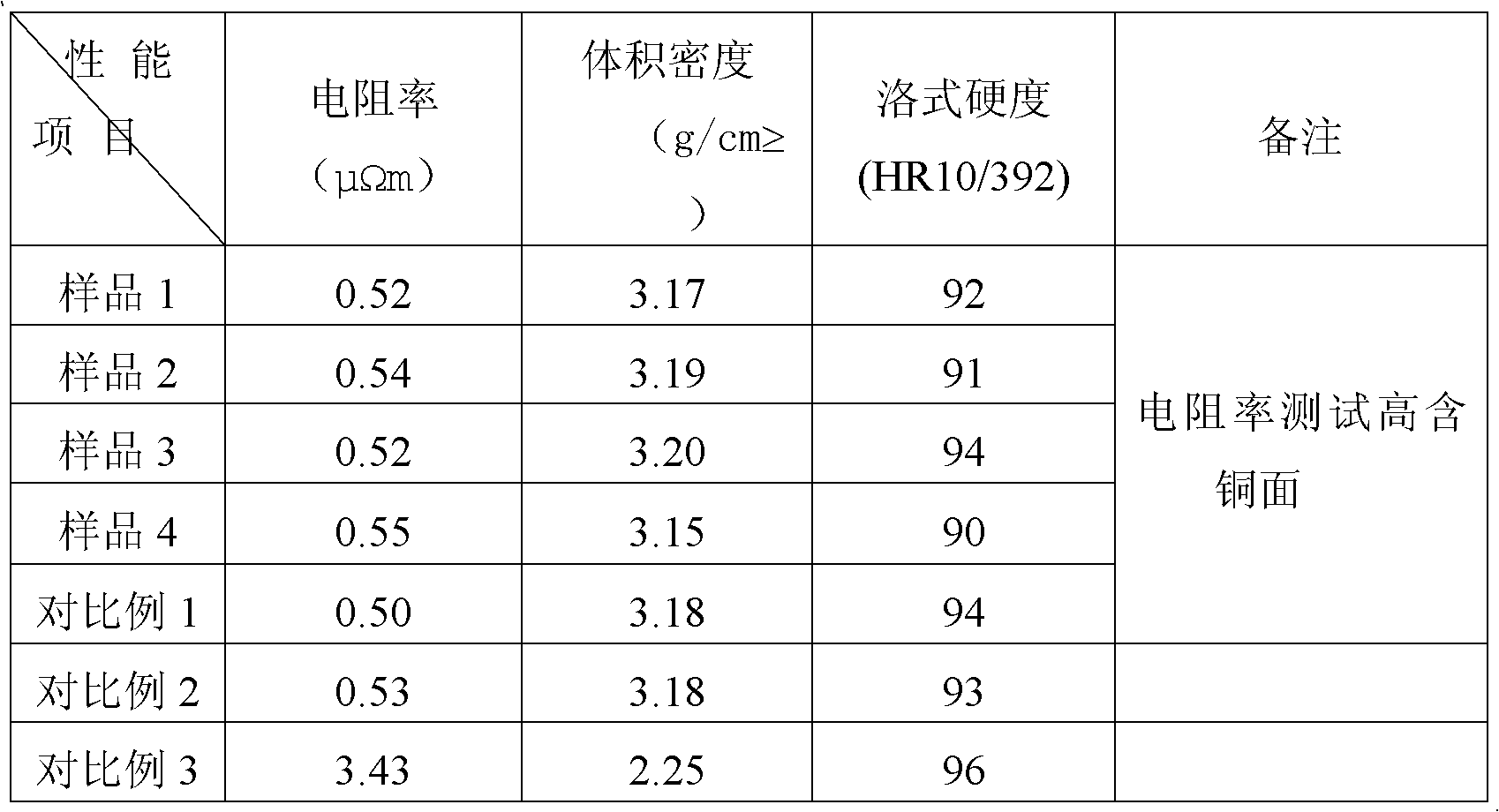
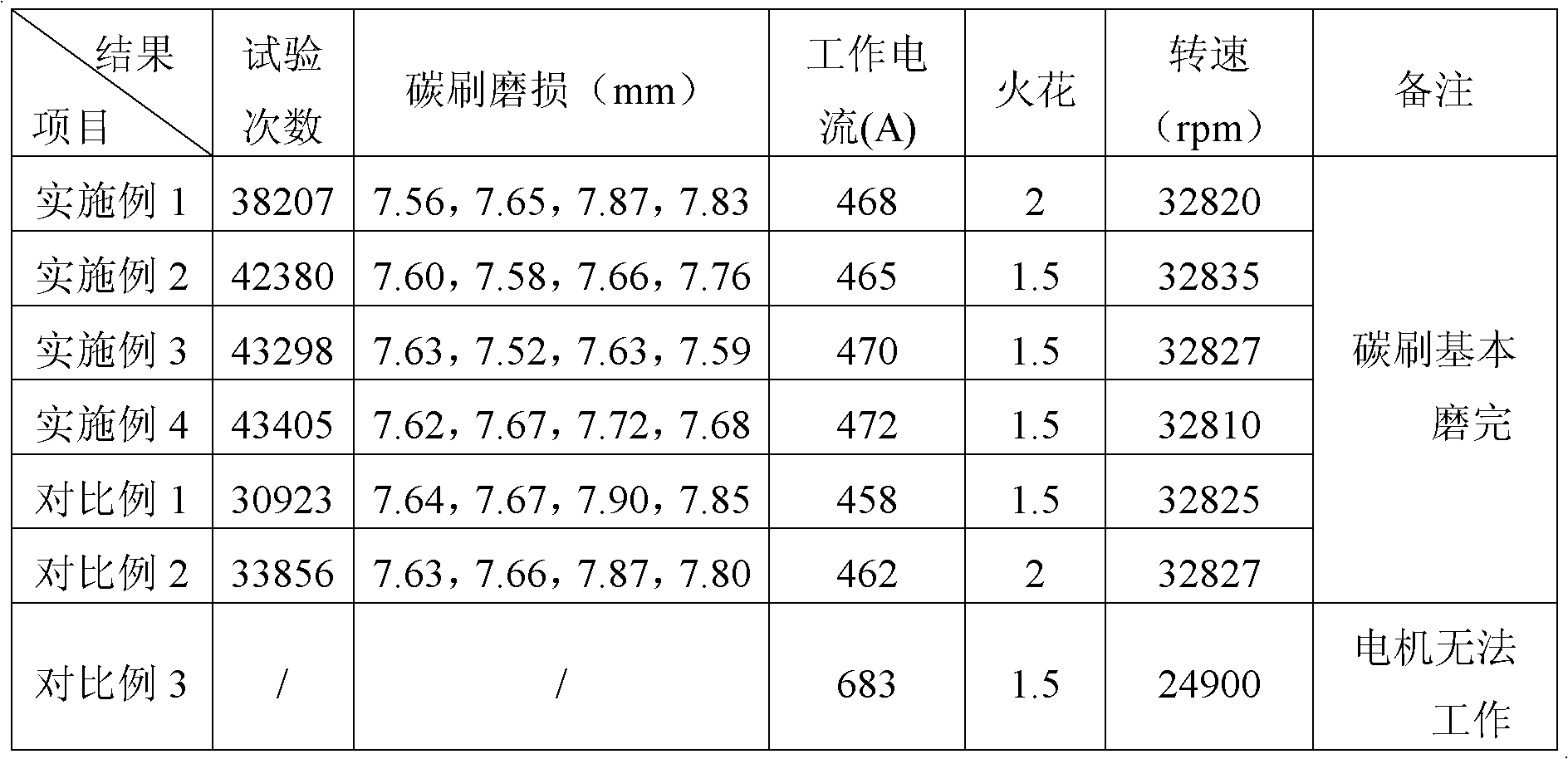
[0025] Graphite powder 78%, phenolic resin 20%, phosphoric acid 2%, after mixing at room temperature for 0.5 hours, add 30% (based on dry powder weight) alcohol, mix at 90-100°C for 1 hour, then crush , and sieved to obtain a one-stage colloidal powder. The first-stage colloidal powder 39%, copper powder 58%, molybdenum disulfide 3%, mixed at room temperature for 1 hour to make pressed powder A; the first-stage colloidal powder 70%, copper powder 27%, molybdenum disulfide 3% , and mixed at room temperature for 1 hour to make compressed powder B. Compressed powder A and compressed powder B were pressed into a double-layer product under a unit pressure of 4 MPa by twice feeding method, and sample 1 was produced through high temperature heat treatment at 750°C.
Embodiment 2
[0027] Graphite powder 76%, phenolic resin 20%, phosphoric acid 4%, after mixing at room temperature for 0.5 hours, add 30% (based on dry powder weight) alcohol, mix at 90-100°C for 1 hour, and then crush , and sieved to obtain a one-stage colloidal powder. The first-stage colloidal powder 39%, copper powder 58%, molybdenum disulfide 3%, mixed at room temperature for 1 hour to make pressed powder A; the first-stage colloidal powder 70%, copper powder 27%, molybdenum disulfide 3% , and mixed at room temperature for 1 hour to make compressed powder B. Compressed powder A and compressed powder B were pressed into a double-layer product under a unit pressure of 4 MPa by two feeding methods, and sample 2 was produced through a high temperature heat treatment at 750°C.
Embodiment 3
[0029] Graphite powder 73%, phenolic resin 20%, phosphoric acid 7%, after mixing at room temperature for 0.5 hours, add 30% (based on dry powder weight) alcohol, mix at 90-100°C for 1 hour, then crush , and sieved to obtain a one-stage colloidal powder. The first-stage colloidal powder 39%, copper powder 58%, molybdenum disulfide 3%, mixed at room temperature for 1 hour to make pressed powder A; the first-stage colloidal powder 70%, copper powder 27%, molybdenum disulfide 3% , and mixed at room temperature for 1 hour to make compressed powder B. Compressed powder A and compressed powder B were pressed into a double-layer product under a unit pressure of 4 MPa by twice feeding method, and sample 3 was prepared by high temperature heat treatment at 750°C.
PUM
 Login to View More
 Abstract
Description
Claims
Application Information
 Login to View More