Linear permanent magnet motor operating mechanism of high-voltage circuit breaker

A high-voltage circuit breaker and operating mechanism technology, which is applied to the field of linear permanent magnet motor operating mechanisms, can solve the problems of difficulty in meeting the long-stroke opening and closing operation requirements of the high-voltage circuit breaker, the short stroke of the permanent magnet mechanism, and the difficulty in guaranteeing the opening and closing operation. , to reduce the risk of irreversible demagnetization, increase the magnetic field density, and increase the torque density

CN102157310AInactive Publication Date: 2011-08-17SOUTHEAST UNIV
7 Cites 3 Cited by

Patent Information

Authority / Receiving Office
CN · China
Patent Type
Applications(China)
Current Assignee / Owner
Publication Date
2011-08-17
Estimated Expiration
Not applicable · inactive patent

Smart Images

  • Figure 1
    Figure 1
  • Figure 2
    Figure 2
  • Figure 3
    Figure 3
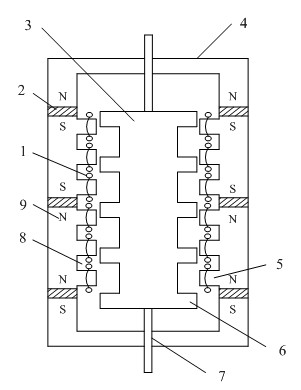
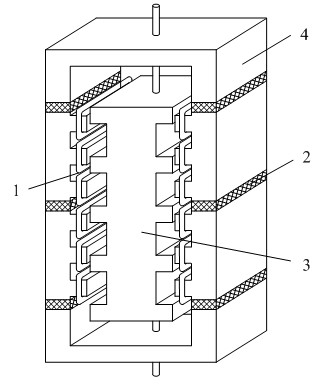
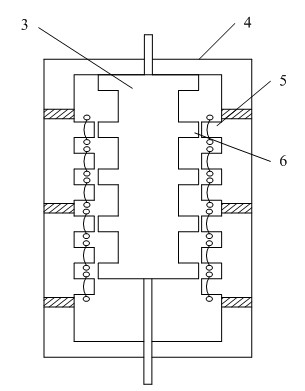
Patent Text Reader

Abstract

The invention relates to a linear permanent magnet motor operating mechanism of a high-voltage circuit breaker, comprising a stator core, a rotor core, drive rods and permanent magnets, wherein the stator core is a box body; the rotor core is arranged in the stator core; the drive rods arranged on both ends of the rotor core penetrate through shells positioned on the upper and the lower ends of the rotor core and can move up and down; the side wall of the stator core is provided with the permanent magnets; upper and lower adjacent permanent magnets are opposite in polarity; the permanent magnets positioned on the left and the right edges of the box body are same in polarity placement directions; stator salient poles with the number of integral multiples of a phase number are arranged on the inner side wall of the stator core and between the two adjacent permanents and are provided with armature coils; the outer side wall of the rotor core is provided with rotor salient poles; when therotor core is positioned on a highest position, the stator salient pole positioned on the uppermost end of the stator core just faces to the rotor salient poles; and when the rotor core is positionedon a lowest position, the stator salient pole positioned on the lowest end of the stator core just faces to the rotor salient poles.
Need to check novelty before this filing date? Find Prior Art

Description

technical field

[0001] The invention belongs to the technical field of switchgear in electrical engineering, and in particular relates to a linear permanent magnet motor operating mechanism of a high-voltage circuit breaker. Background technique

[0002] The operating mechanisms of traditional high-voltage circuit breakers mainly include hydraulic mechanisms, pneumatic mechanisms, spring mechanisms and electromagnetic mechanisms. The hydraulic operating mechanism has a series of advantages such as high energy intensity, fast response, low noise, and reliable action. The pneumatic operating mechanism uses compressed air as an energy source to generate thrust, and does not require high-power DC power supply or laying control cables. Pneumatic and hydraulic systems can meet the long-stroke and high-power operation requirements, and are mainly used in high-voltage circuit breakers with high voltage levels. However, the system is complex and the reliability is not high enough. Th...

Examples

Embodiment Construction

[0020] The present invention will be further described below in conjunction with accompanying drawing.

[0021] Depend on figure 1 It can be seen that a linear permanent magnet motor operating mechanism for a high-voltage circuit breaker includes a stator core 4, a mover core 3, a drive rod 7, and a permanent magnet 2. The stator core 4 is a box, and the mover core 3 is placed In the stator core 4, the drive rods 7 arranged at both ends of the mover core 3 pass through the shells at both ends of the stator core 4 and can move up and down. The side walls of the stator core 4 are provided with permanent magnets 2, and the poles of the upper and lower adjacent permanent magnets opposite, that is, the polarities of the opposite faces of the upper and lower adjacent permanent magnets are the same, such as figure 1 As shown in , the N poles to N poles, S poles to S poles of the adjacent permanent magnets up and down, and the permanent magnets on the left and right sides of the bo...