
Synthetic method for preparing nanometer cuprous oxide from nitrogen-doped cuprous oxide
A nano-cuprous oxide and cuprous oxide technology, applied in the direction of copper oxide/copper hydroxide, nanotechnology, etc., can solve the problems of reducing photogenerated electron-hole recombination rate, high photogenerated electron-hole recombination rate, and constraints , to achieve the effect of improving the visible light catalytic activity and reducing the electron-hole recombination rate
- Summary
- Abstract
- Description
- Claims
- Application Information
AI Technical Summary
Problems solved by technology
Method used
Image

Examples
Embodiment 1
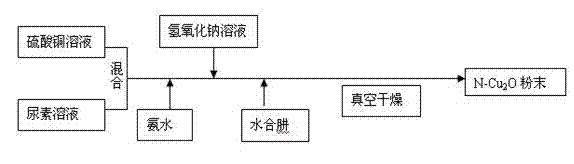
[0020] Example 1: Mix 50ml of copper sulfate solution and 1ml of urea solution to obtain A solution; add 15ml of ammonia solution with a concentration of 0.10 mol / L to the A solution, stir for 15 minutes, and then add 5ml of 1.5 mol / L After the solution changes from blue to light green, add 2ml of hydrazine hydrate with a concentration of 1.4mol / L dropwise until the solution gradually changes from green to light green to obtain mixed solution B; after stirring the above B solution for 5h , the solution is suction filtered, and the filter cake is vacuum-dried to obtain nitrogen-doped nano-cuprous oxide.
[0021] Add 0.05g of nitrogen-doped nano-cuprous oxide to 50ml of methylene blue solution (50mg / L), and place it in the dark for 24 hours to fully reach adsorption saturation. Lux (Lux) under the fluorescent light source for 3.5h, sampling every half hour, centrifuged, take the supernatant to measure the absorbance value, the degradation rate is 50%.
Embodiment 2
[0022] Example 2: 50ml of copper sulfate solution and 1.5ml of urea solution were stirred and mixed uniformly to obtain solution A; 3ml of ammonia solution with a concentration of 0.15 mol / L was added to solution A, and after stirring for 30min, 10ml of ammonia solution with a concentration of 0.8 mol / L was added. L of sodium hydroxide solution, after the solution changes from blue to light green, add 7ml of hydrazine hydrate with a concentration of 0.7mol / L dropwise until the solution gradually changes from green to light green to obtain mixed solution B; stir the above B solution for 2h Finally, the solution is filtered with suction, and the filter cake is vacuum-dried to obtain nitrogen-doped nano-cuprous oxide.
[0023] Add 0.05g of nitrogen-doped nano-cuprous oxide to 50ml of methylene blue solution (50mg / L), and place it in the dark for 24 hours to fully reach adsorption saturation. Lux (Lux) under the fluorescent light source for 3.5h, sampling every half hour, centrifu...
Embodiment 3
[0024] Example three: 50ml of copper sulfate solution and 3.5ml of urea solution were stirred and mixed uniformly to obtain solution A; 10ml of ammonia solution with a concentration of 0.15mol / L was added to solution A, and after stirring for 15min, 7ml with a concentration of 1mol / L was added After the solution changes from blue to light green, add 3ml of hydrazine hydrate with a concentration of 1mol / L dropwise until the solution gradually changes from green to light green to obtain mixed solution B; after stirring the above B solution for 3h, The solution is suction filtered, and the filter cake is vacuum-dried to obtain nitrogen-doped nano-cuprous oxide.
[0025] Add 0.05g of nitrogen-doped nano-cuprous oxide to 50ml of methylene blue solution (50mg / L), and place it in the dark for 24 hours to fully reach adsorption saturation. Lux (Lux) under the fluorescent light source for 3.5h, sampling every half hour, centrifuged, take the supernatant to measure the absorbance value,...
PUM
 Login to View More
 Abstract
Description
Claims
Application Information
 Login to View More