
Mass multisource heterogeneous spatial information data seamless integration management method
A seamless integration and spatial information technology, applied in the direction of electrical digital data processing, special data processing applications, instruments, etc., can solve the problems of no advanced integration and integration of available products, so as to improve the level of scientific management and decision-making, and promote Geographical information sharing, integration and efficient effects
- Summary
- Abstract
- Description
- Claims
- Application Information
AI Technical Summary
Problems solved by technology
Method used
Image

Examples
Embodiment Construction
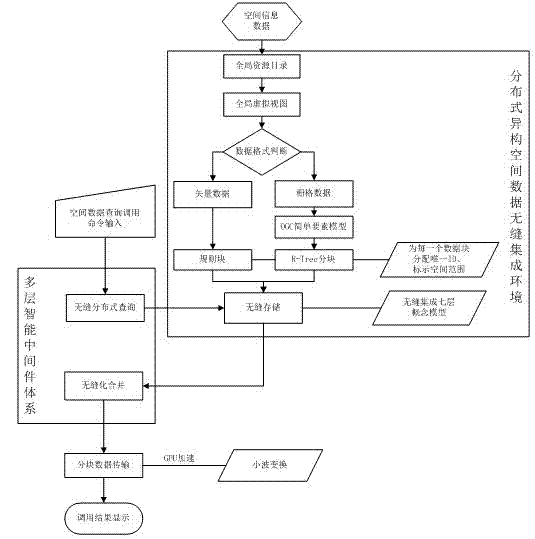
[0026] Such as figure 1 As shown, the method steps of an embodiment of the present invention are as follows:
[0027] 1) Spatial information data with a huge amount of input data, coming from several data sources and distributed in different places;
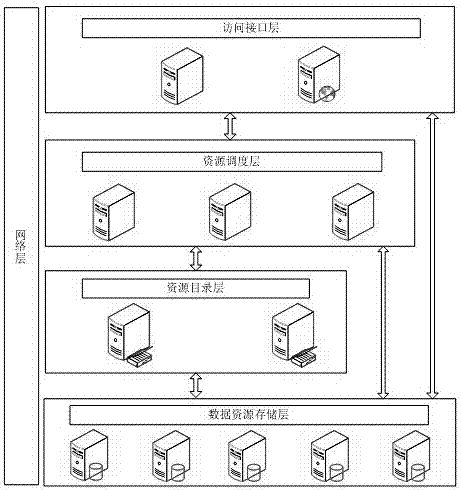
[0028] 2) Build a global resource directory (such as figure 2 ), forming a global virtual view of resources in a distributed computing environment. The global virtual view includes data resource storage layer, resource directory layer, resource scheduling layer, and access interface layer from bottom to top. Each layer communicates in pairs; global resources The directory realizes the discovery, organization and management of massive data in a distributed network environment, and at the same time realizes the unified access and location query of spatial information resources in the distributed database through the data resource access interface;
[0029]3) Determine the spatial information data format, if it is raster data, di...
PUM
 Login to View More
 Abstract
Description
Claims
Application Information
 Login to View More