Unlock instant, AI-driven research and patent intelligence for your innovation.

Enhancement of input/output for non source-synchronous interfaces

A technology of interface circuit and output unit, applied in the field of electrical interface, can solve problems such as change and impracticality

Inactive Publication Date: 2013-02-06
SANDISK TECH LLC
View PDF21 Cites 3 Cited by
  • Summary
  • Abstract
  • Description
  • Claims
  • Application Information

AI Technical Summary

Problems solved by technology

However, this method may not be practical to use in many devices as it may result in substantial changes to the interface (e.g. adding signal pins)
Thus, there is room for improvement in such interfaces

Method used

the structure of the environmentally friendly knitted fabric provided by the present invention; figure 2 Flow chart of the yarn wrapping machine for environmentally friendly knitted fabrics and storage devices; image 3 Is the parameter map of the yarn covering machine
View more

Image

Smart Image Click on the blue labels to locate them in the text.
Viewing Examples
Smart Image
  • Enhancement of input/output for non source-synchronous interfaces
  • Enhancement of input/output for non source-synchronous interfaces
  • Enhancement of input/output for non source-synchronous interfaces

Examples

Experimental program
Comparison scheme
Effect test

Embodiment Construction

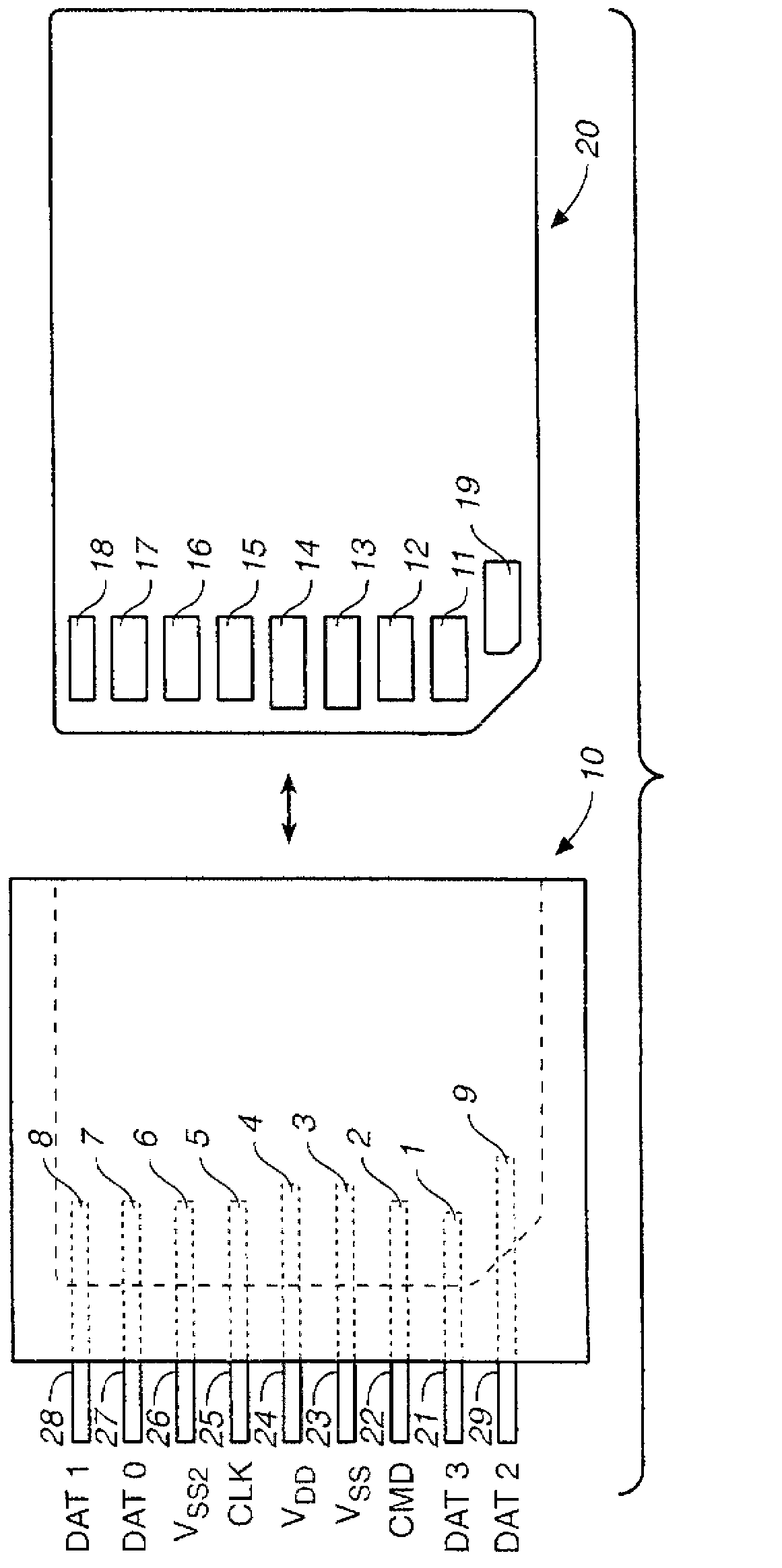
[0012] The interfaces and corresponding techniques are given below for the use of devices whose core circuitry operates in one voltage domain but exchanges signals with another device (or "host") according to a different voltage domain; and for use with double data rate (DDR) transport provides the use of such an interface for data. A specific example of this is a memory card, where the internal circuitry uses one voltage range for its core operating voltage, but uses a different input / output voltage range to exchange signals with the host. According to a general set of aspects given below, the interface receives data signals from the device in the core operating voltage domain of the device, level shifts these signals into the input / output voltage domains respectively, and then combines them into DDR signals for Transmitted to the host device, where the (not level-shifted) clock signal from the host device is used as a select signal to form the DDR data signal.

[0013] As d...

the structure of the environmentally friendly knitted fabric provided by the present invention; figure 2 Flow chart of the yarn wrapping machine for environmentally friendly knitted fabrics and storage devices; image 3 Is the parameter map of the yarn covering machine
Login to View More

PUM

No PUM Login to View More

Abstract

An interface for use of device whose core circuitry operates in one voltage domain, but exchanges signal with another device (or ''host'') according a different voltage domain, and the use of such an interface for supplying data using a double data rate (DDR) transfer, is presented. One concrete example of this situation is a memory card, where the internal circuitry uses one voltage range for its core operating voltages, but exchanges signals with a host using different, input / output voltage range. According to a general set of aspects, the interface receives data signals from the device at the device's core operating voltage domain, individually level shifts these to the input / output voltage domain, and then combines them into a DDR signal for transfer to the host device, where a (non-level shifted) clock signal from the host device is used as the select signal to form the DDR data signal.

Description

technical field [0001] The present invention relates generally to the field of electrical interfaces and, more particularly, to the data output of non-source synchronous interfaces. Background technique [0002] A simple interface for data transfer purposes between integrated circuit devices will typically include a clock signal provided by a host device that is used by a slave device to output data to the host. A specific example is a host read cycle to a memory card or other storage device. The timing of data output from the slave device then depends on the arrival of the clock signal. There is an ongoing process for increasing the performance of these devices. When higher transfer speeds are desired, one approach is to migrate the interface protocol to a source synchronous scheme where both clock and data signals are provided from the same device, such as in the DDR (Double Data Rate) arrangement used in DRAM devices . However, this approach may not be practical to us...

Claims

the structure of the environmentally friendly knitted fabric provided by the present invention; figure 2 Flow chart of the yarn wrapping machine for environmentally friendly knitted fabrics and storage devices; image 3 Is the parameter map of the yarn covering machine
Login to View More

Application Information

Patent Timeline
no application Login to View More
Patent Type & Authority Applications(China)
IPC IPC(8): G11C7/10
CPCG11C7/1066G11C7/10G11C16/10
Inventor M.戴维森R.赫伦L.伊戈尔马梅尼R.塔尔A.德鲁克
Owner SANDISK TECH LLC