
A kind of comprehensive utilization process of lignocellulosic biomass
A lignocellulose and biomass technology, applied in the direction of sugar derivatives, sugar derivatives, sugar derivatives preparation, etc., can solve the complex extraction process route and affect the extraction efficiency of components, etc., to achieve a simple process route and ensure High activity, yield, and high extraction efficiency
- Summary
- Abstract
- Description
- Claims
- Application Information
AI Technical Summary
Problems solved by technology
Method used
Image

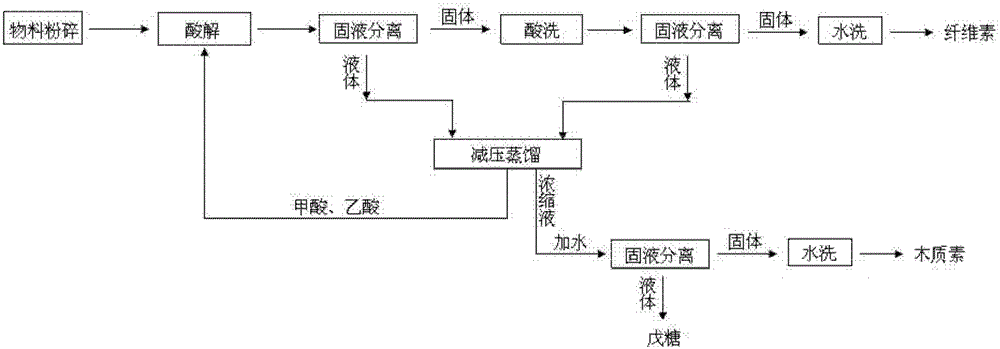
Examples
Embodiment 1
[0047] In this embodiment, first corncobs (mass component composition: moisture 18.73%, cellulose 39.33%, hemicellulose 30.73%, lignin 29.94%) are crushed, washed with water to remove dust and crushed to a particle size of 0.5-20cm , preferably 0.5-5cm.
[0048] The comprehensive utilization technique of lignocellulosic biomass described in this embodiment comprises the steps:
[0049] (1) After the biomass raw material is pulverized and pretreated, use an organic acid solution with a concentration of 90% formic acid and 5% acetic acid and 5% water to carry out acid hydrolysis of the treated lignocellulosic biomass to control the reaction The temperature was 165°C, and the reaction was carried out for 10 minutes. The liquid-solid mass ratio of the mixed acid solution of formic acid and acetic acid to the biomass raw material was 1:20, and the obtained reaction solution was subjected to solid-liquid separation for the first time;
[0050] (2) the organic acid solution that is ...
Embodiment 2
[0064] In this embodiment, first corncobs (mass component composition: moisture 18.73%, cellulose 39.33%, hemicellulose 30.73%, lignin 29.94%) are crushed, washed with water to remove dust and crushed to a particle size of 0.5-20cm , preferably 0.5-5cm.
[0065] The comprehensive utilization technique of lignocellulosic biomass described in this embodiment comprises the steps:
[0066] (1) After the biomass raw material is pulverized and pretreated, the lignocellulosic biomass after treatment is acid-hydrolyzed by using an organic acid solution containing 40% formic acid and 50% acetic acid and 10% water to control The reaction temperature is 110°C, the reaction is 180min, the liquid-solid mass ratio of the mixed acid solution of formic acid and acetic acid to the biomass raw material is 1:15, and the obtained reaction solution is subjected to solid-liquid separation for the first time;
[0067] (2) The solid that is separated in step (1) is added into the organic acid soluti...
Embodiment 3
[0081] In this embodiment, first corncobs (mass component composition: moisture 16.25%, cellulose 31.45%, hemicellulose 34.77%, lignin 33.78%) are crushed, washed with water to remove dust and crushed to a particle size of 0.5-20cm , preferably 0.5-5cm.
[0082] The comprehensive utilization technique of lignocellulosic biomass described in this embodiment comprises the steps:
[0083] (1) After the biomass raw material is crushed and pretreated, use an organic acid solution containing 50% formic acid and 40% acetic acid and 10% water to carry out acid hydrolysis on the treated lignocellulosic biomass, and control The reaction temperature is 135° C., the reaction is 30 minutes, the liquid-solid mass ratio of the mixed acid solution of formic acid and acetic acid to the biomass raw material is 1:5, and the obtained reaction solution is subjected to solid-liquid separation for the first time;
[0084] (2) the solid that is separated in the step (1) is added the formic acid that...
PUM
| Property | Measurement | Unit |
|---|---|---|
| clearance rate | aaaaa | aaaaa |
Abstract
Description
Claims
Application Information
 Login to View More