Modular cage rotor stator self-excited synchronous motor and its control method

A technology of rotor stator and synchronous motor, applied in electronic commutation motor control, synchronous generator, motor generator control and other directions, can solve uncertain parameter changes and large disturbances, poor anti-interference ability, complex manufacturing process, etc. question

CN103151887BActive Publication Date: 2016-05-18张凤阁
6 Cites 0 Cited by

Patent Information

Authority / Receiving Office
CN · China
Patent Type
Patents(China)
Current Assignee / Owner
Publication Date
2016-05-18

Smart Images

  • Figure 1
    Figure 1
  • Figure 2
    Figure 2
  • Figure 3
    Figure 3
Patent Text Reader

Abstract

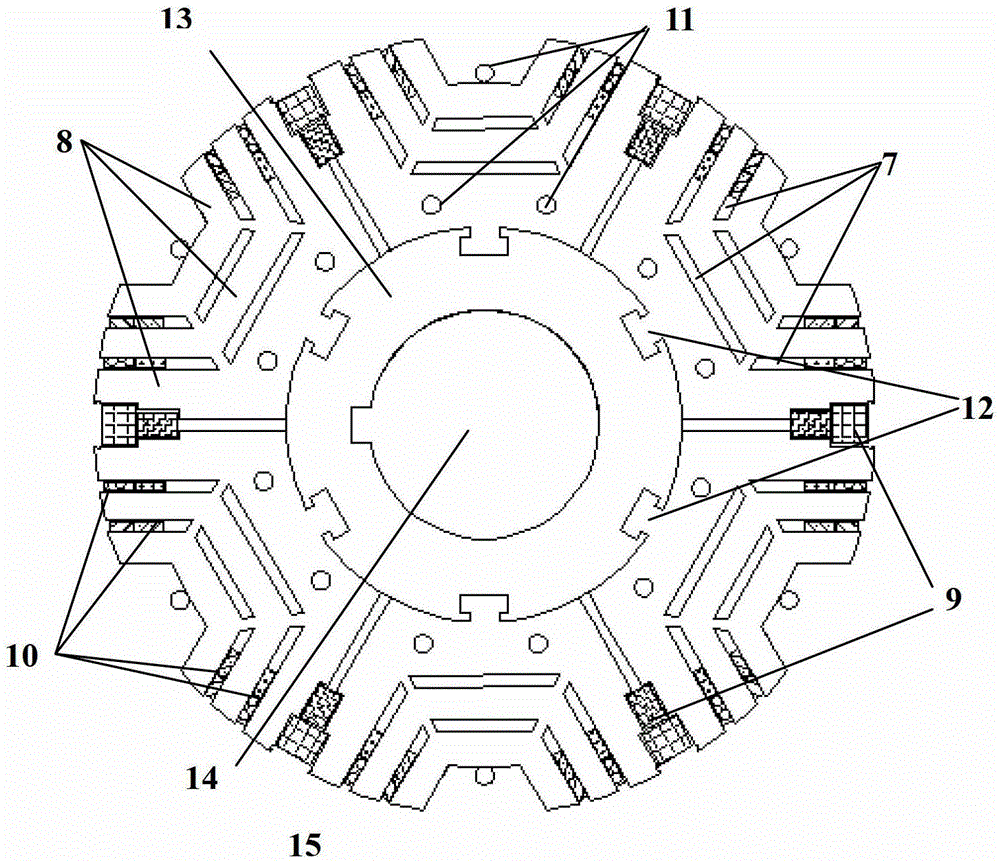
The invention relates to a synchronous motor, which is characterized in that a set of 2 p pole three-phase armature windings and a set of 2 q Pole single-phase excitation winding, which supplies power to the excitation winding to realize self-excitation of the stator. The rotor is composed of cage rotor modules along the circumferential direction to form a rotor with salient poles. Each cage rotor module is made of positioning slots and non-magnetic materials. The sleeves are connected; the cage rotor module has multiple radial trapezoidal slots, and each trapezoidal slot has several different stepped slot widths in the radial direction. Short-circuit cage bars are placed in the trapezoidal slots, and the edge of the adjacent cage rotor module It is a stepped notch, and after splicing, a common trapezoidal groove is formed. The depth of the gap at the bottom of the groove reaches the outer surface of the sleeve, and a common cage is placed in the groove; The coupling capability of the sleeve windings is maximized, resulting in a new modular cage-rotor-stator self-excited synchronous motor structure with high power density and excellent steady-state and dynamic performance.
Need to check novelty before this filing date? Find Prior Art

Description

technical field

[0001] The invention relates to a synchronous motor, in particular to a modular cage barrier rotor stator self-excited synchronous motor and a control method thereof. The motor can be operated as a motor or as a generator. Background technique

[0002] The stator of the modular cage-rotor-stator self-excited synchronous motor consists of 2 p pole three-phase symmetrical armature winding and 2 q Pole single-phase symmetrical field winding (or 2 q pole three-phase symmetrical armature winding and 2 p Pole single-phase symmetrical field winding), and satisfy 2 p -2 q ≥4, the coupling between the two sets of windings is by p r = p + q It is realized by a specially designed rotor for the poles, so this kind of motor does not need to install brush slip rings, and can realize electromechanical energy conversion through the interaction between the magnetic field of the excitation winding and the magnetic field of the armature winding. Compared with the conve...

Examples

Embodiment Construction

[0068] The present invention is described in detail below in conjunction with accompanying drawing:

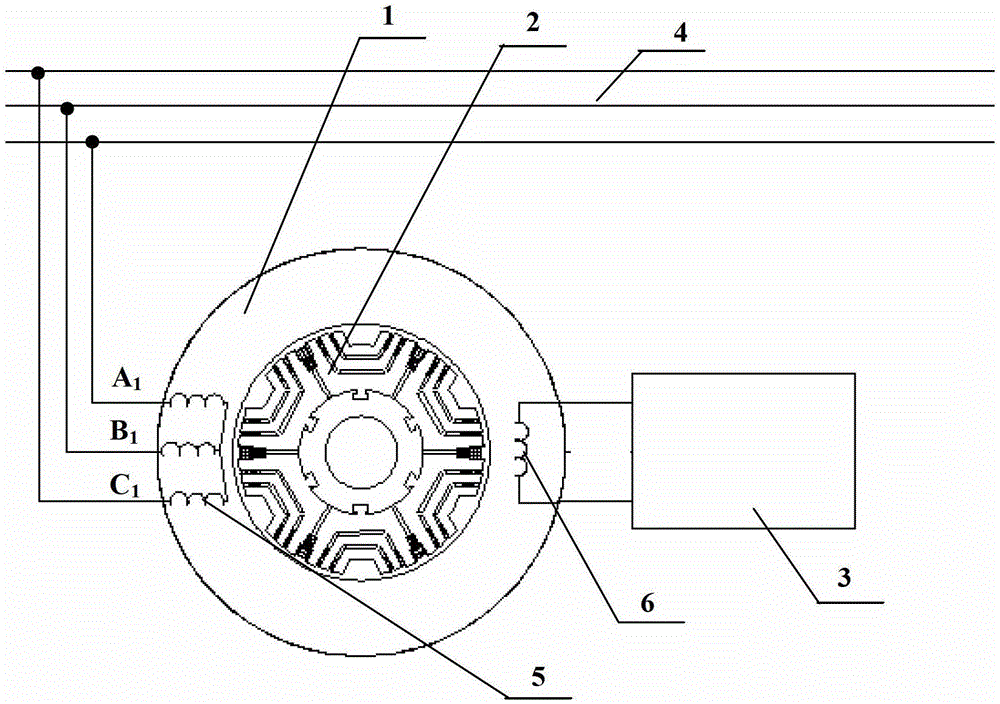
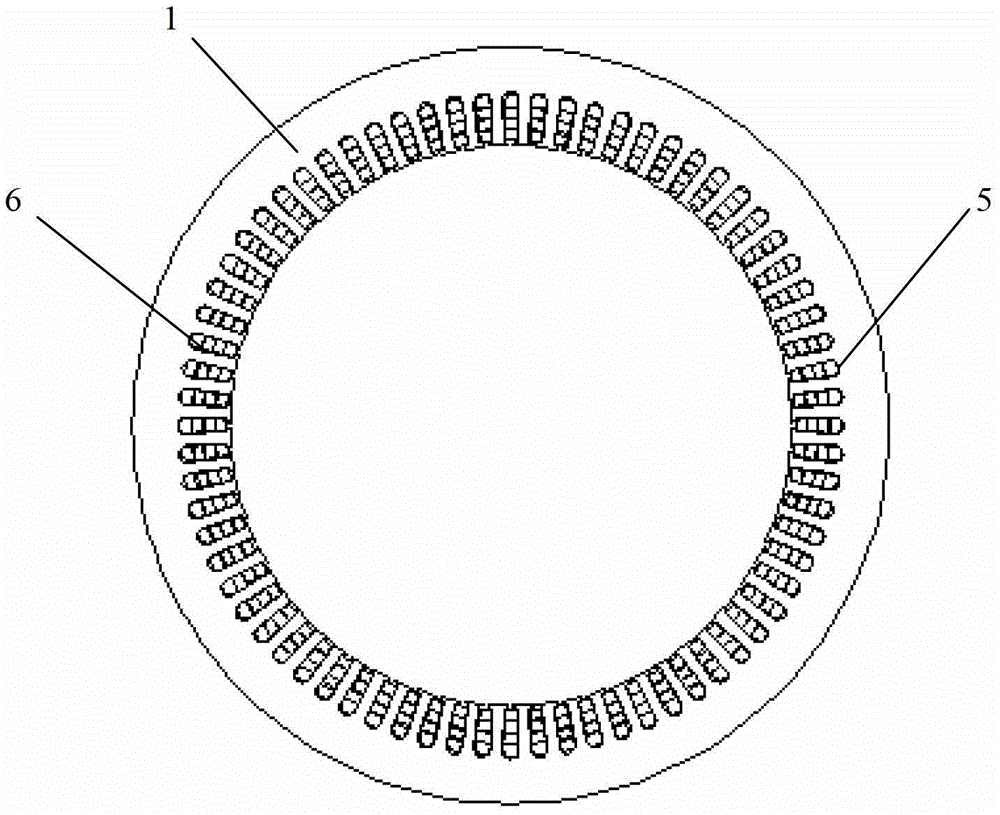
[0069] figure 1 It is a schematic structural diagram of the self-excited synchronous motor system of the modular cage rotor stator of the present invention, the system mainly includes a stator 1, a rotor 2, and a bidirectional inverter 3, wherein 2 inverters are placed on the stator 1 p Three-phase symmetrical armature windings with poles 5 and 2 q The single-phase symmetrical field winding 6 of the pole, the number of poles of the armature winding 5 and the field winding 6 can also be interchanged, and all satisfy 2 p -2 q ≥4, which can maximize the electromagnetic coupling of two sets of stator windings with different pole numbers. The electromagnetic coupling between two sets of stator windings with different numbers of poles is maximized. The armature winding 5 is connected to the grid 4 , and the field winding 6 is connected to the bidirectional inverter 3 . By cont...