Unlock instant, AI-driven research and patent intelligence for your innovation.

Detection method for scratches and defects on surfaces of metal components

A defect detection and component technology, applied in the direction of optical testing defects/defects, etc., can solve the problems of weak scratch defect texture, difficulty in human eye recognition, classification and quantification, and small defect degree.

Inactive Publication Date: 2013-06-26
SHENYANG LIGONG UNIV
View PDF7 Cites 25 Cited by
  • Summary
  • Abstract
  • Description
  • Claims
  • Application Information

AI Technical Summary

Problems solved by technology

There may be different degrees of defects on the surface of any metal parts, among which scratches are one of the common surface defects, which may seriously affect the quality of the product
The traditional detection of scratches on the surface of metal parts is done by human eyes, and there are many subjective factors and problems that can only be judged qualitatively
In addition, the texture of scratches on the surface of some metal parts is weak and the degree of defects is small. It is difficult to recognize, classify and quantify them with human eyes. Therefore, it is imperative to automatically detect them based on vision.

Method used

the structure of the environmentally friendly knitted fabric provided by the present invention; figure 2 Flow chart of the yarn wrapping machine for environmentally friendly knitted fabrics and storage devices; image 3 Is the parameter map of the yarn covering machine
View more

Image

Smart Image Click on the blue labels to locate them in the text.
Viewing Examples
Smart Image
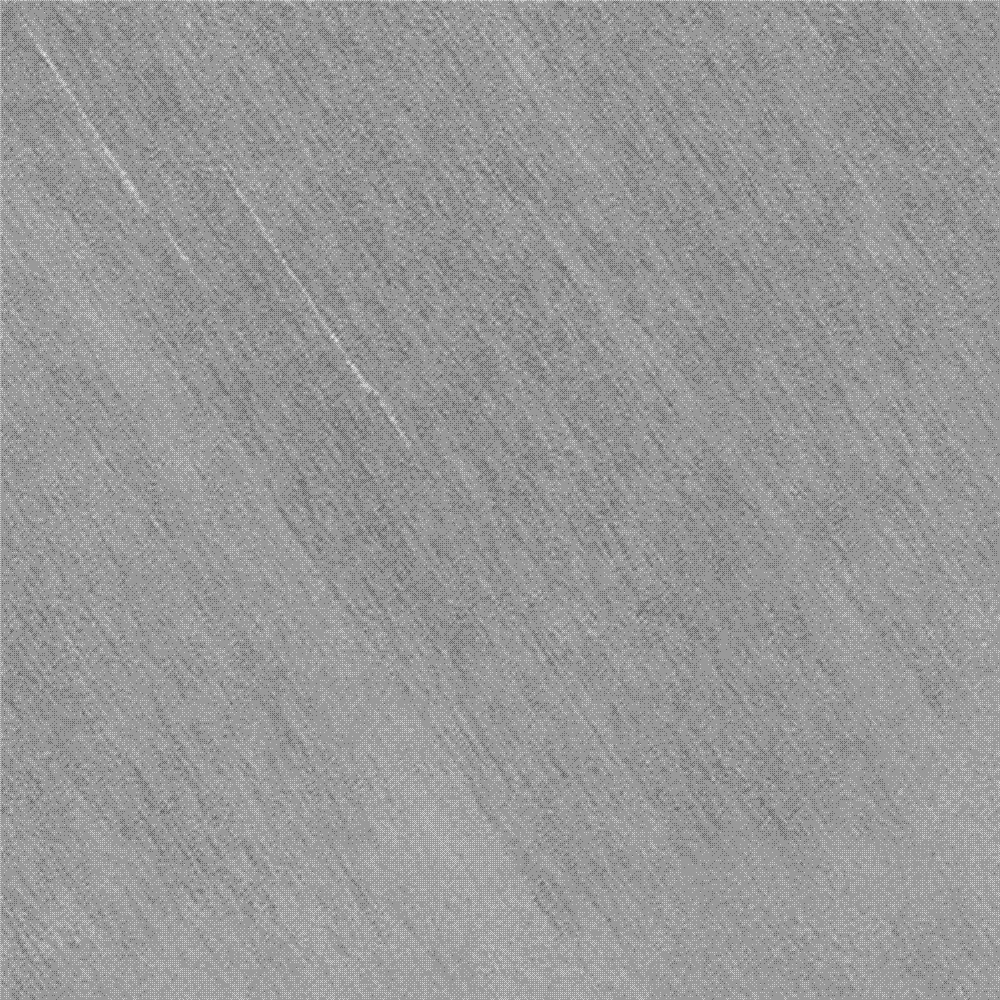
  • Detection method for scratches and defects on surfaces of metal components
  • Detection method for scratches and defects on surfaces of metal components
  • Detection method for scratches and defects on surfaces of metal components

Examples

Experimental program
Comparison scheme
Effect test

Embodiment Construction

[0028] Below in conjunction with accompanying drawing, the present invention is further described.

[0029] Such as Figure 7 shown in the scratch processing flow, the figure 2 The image initialization shown in the figure can provide information for future scratch processing and specify the image area to be processed through image initialization, so as to improve the accuracy and speed of scratch recognition. Should image 3 The segmentation threshold is set as shown, and the image is segmented. This process is to dynamically adjust the threshold through binarization, and pass the threshold to the function module of segmenting the image. The criteria for determining the threshold are: the image texture on the image surface is relatively clear, and when the edge contour is complete, the dark area of ​​the specular surface is also relatively dark. At this time, the binarization threshold can be determined as the segmentation threshold of the segmented image. Should Figure ...

the structure of the environmentally friendly knitted fabric provided by the present invention; figure 2 Flow chart of the yarn wrapping machine for environmentally friendly knitted fabrics and storage devices; image 3 Is the parameter map of the yarn covering machine
Login to View More

PUM

No PUM Login to View More

Abstract

The invention discloses a detection method for scratches and defects on the surfaces of metal components. The detection method comprises the process steps of (1) obtaining the images of the surfaces of the metal components, and selecting a processing domain; (2) performing image processing and analysis on the surfaces of the metal components; and (3) automatically marking scratches and processing, wherein the step particularly comprises the following steps: 1, after the image analysis, segmenting and extracting the texture information of the scratches and the defects of the images by adopting an image segmentation method; 2, after the information of the scratches and the defects is extracted, performing scratch identification comprising image segmentation or object separation, characteristic extraction and selection, optimal decision classification making, and object determination; and 3, quantizing the scratches. According to the detection method disclosed by the invention, the steps of scratch and defect processing and partial algorithms are emphasized, and location, extraction and quantization for tiny scratches and defects can be performed; and the method is high in identification accuracy, objective in detection standards, and quantitative in description. Detection algorithms for the scratches and the defects exist in the form of plug-in, thus being convenient to be integrated in application software to update the software.

Description

technical field [0001] The invention relates to the field of machine vision, and in particular discloses a method for detecting scratches on the surface of metal parts. The method can accurately extract fine scratches. Background technique [0002] Machine vision is widely used in the fields of national economy, scientific research and national defense construction. Its biggest advantage is non-contact measurement. Compared with other methods, it has great advantages in safety, reliability, detection accuracy, detection speed and detection cost. In terms of surface defect detection, machine vision has a wide range of applications. There may be different degrees of defects on the surface of any metal parts, among which scratches are one of the common surface defects, which may seriously affect the quality of the product. The traditional detection of scratches on the surface of metal parts is done by human eyes, and there are many subjective factors and problems that can onl...

Claims

the structure of the environmentally friendly knitted fabric provided by the present invention; figure 2 Flow chart of the yarn wrapping machine for environmentally friendly knitted fabrics and storage devices; image 3 Is the parameter map of the yarn covering machine
Login to View More

Application Information

Patent Timeline
no application Login to View More
IPC IPC(8): G01N21/88
Inventor 姜月秋仇维高宏伟
Owner SHENYANG LIGONG UNIV