This helps you quickly interpret patents by identifying the three key elements:
Problems solved by technology
Method used
Benefits of technology
Problems solved by technology
[0009] Therefore, in recent years, research on hydrogelling agents including low-molecular-weight compounds has been vigorously carried out with much attention paid to their functionality, although it is difficult to elucidate the mechanism of self-assembly of low-molecular-weight compounds in water and to design molecules.
Method used
the structure of the environmentally friendly knitted fabric provided by the present invention; figure 2 Flow chart of the yarn wrapping machine for environmentally friendly knitted fabrics and storage devices; image 3 Is the parameter map of the yarn covering machine
View more
Image
Smart Image Click on the blue labels to locate them in the text.
Viewing Examples
Smart Image
Click on the blue label to locate the original text in one second.
Reading with bidirectional positioning of images and text.
Smart Image
Examples
Experimental program
Comparison scheme
Effect test
Embodiment
[0180] Hereinafter, although an Example and a test example are given as an example and this invention is demonstrated in detail, this invention is not limited to these examples.
[0181] In addition, the meanings of the abbreviations used in the following Examples are as follows.
[0182] Gly: Glycine
[0183] His: Histidine
[0184] PVA: polyvinyl alcohol
Synthetic example 1
[0185] [Synthesis Example 1: Synthesis of Lipid Peptide (N-Palmitoyl-Gly-His)]
[0186] The lipopeptide used in this example was synthesized by the method shown below
[0187] Into a 500mL 4-neck flask, put 14.2g (91.6mmol) of histidine, 30.0g (91.6mmol) of N-palmitoyl-Gly-methyl ester, 300g of toluene, and add 35.3g of sodium methoxide 28% methanol solution as a base (183.2 mmol), heated to 60° C. with an oil bath, and continued to stir for 1 hour. Then, the oil bath was removed, and the solution was left to cool to 25° C., and the solution was reprecipitated with 600 g of acetone, followed by filtration. The solid obtained here was dissolved in a mixed solution of 600 g of water and 750 g of methanol, 30.5 mL (183.2 mmol) of 6 N hydrochloric acid was added thereto for neutralization, and a solid was precipitated, followed by filtration. Next, the obtained solid was dissolved in a liquid mixture of 120 g of tetrahydrofuran and 30 g of water at 60°C, 150 g of ethyl acetate w...
Embodiment 1
[0188] [Example 1: Preparation of gel sheet]
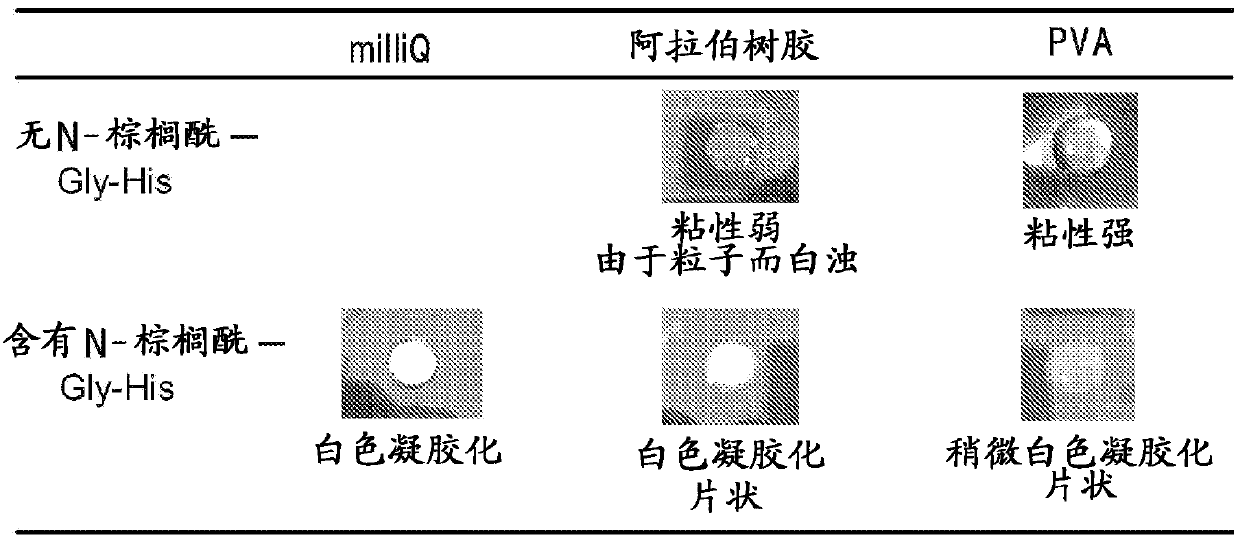
[0189] The N-palmitoyl-Gly-His synthesized above was dissolved in a 50 mM phosphate buffer (pH 7.5) at a concentration of 1% (w / w) at 100° C. using a sealed system. Gum arabic (Wako Pure Chemical Industries, Ltd.) was added dropwise thereto at a concentration of 10% (w / w) to form a gel. 200 μl was collected and dropped into a glass petri dish, and the state of the gel after standing overnight was observed. In addition, milliQ water was added dropwise to the overnight gel, and affinity with water was confirmed. In addition, instead of gum arabic, PVA (manufactured by Wako Pure Chemical Industries, Ltd., n = 1500 to 1800) was added dropwise to a concentration of 10% (w / w) to form a gel. late state.
[0190] In addition, as a comparison, using only gum arabic or only PVA without using N-palmitoyl-Gly-His, using the same operation, drop it into a glass petri dish, and observe the state after standing overnight in the same way .
...
the structure of the environmentally friendly knitted fabric provided by the present invention; figure 2 Flow chart of the yarn wrapping machine for environmentally friendly knitted fabrics and storage devices; image 3 Is the parameter map of the yarn covering machine
Login to View More
PUM
Login to View More
Abstract
The present invention aims to provide a gel sheet which has high biocompatibility and safety, can encapsulate both a hydrophilic medicinal agent and a hydrophobic medicinal agent therein, and can impart excellent sensation upon the application onto the human skin or the like. The gel sheet for solving the subject of the invention, comprises a lipidic peptide type gelling agent and a polymeric compound, wherein the gelling agent comprises a low-molecular-weight lipidic peptide having a molecular weight of 1,000 or less or a pharmaceutically usable salt thereof, and wherein the polymeric compound is contained in an amount of 1-50% (w / w) exclusive relative to the total mass of the gel.
Description
technical field [0001] The present invention relates to a gel sheet, and more specifically relates to a gel sheet containing a low-molecular lipid peptide gelling agent and a high-molecular compound. Background technique [0002] Gels, especially hydrogels formed into sheets, are effective in cosmetics and medical fields, such as facial masks, patches, skin penetration ingredients, anti-inflammatory and analgesic ingredients, etc. for beauty and skin treatments. Carriers of components are used in adhesive tapes for living organisms, wound dressings, etc. for the purpose of wound protection, drug immobilization, and the like. In these applications, the sheet-like gel is generally used by forming a hydrogel layer on a sheet-like support, and as the support, non-woven fabrics made of polyester, polypropylene, etc. are frequently used (Patent Document 1) . [0003] Natural products, organic / inorganic composite hydrogels, and synthetic polymers are generally used as base materi...
Claims
the structure of the environmentally friendly knitted fabric provided by the present invention; figure 2 Flow chart of the yarn wrapping machine for environmentally friendly knitted fabrics and storage devices; image 3 Is the parameter map of the yarn covering machine
Login to View More
Application Information
Patent Timeline
Application Date:The date an application was filed.
Publication Date:The date a patent or application was officially published.
First Publication Date:The earliest publication date of a patent with the same application number.
Issue Date:Publication date of the patent grant document.
PCT Entry Date:The Entry date of PCT National Phase.
Estimated Expiry Date:The statutory expiry date of a patent right according to the Patent Law, and it is the longest term of protection that the patent right can achieve without the termination of the patent right due to other reasons(Term extension factor has been taken into account ).
Invalid Date:Actual expiry date is based on effective date or publication date of legal transaction data of invalid patent.


 Login to View More
  Login to View More