Method for measuring zinc and nickel contents in zinc-nickel alloy electroplating solution

A measurement method, the technology of zinc-nickel alloy, is applied in the direction of material analysis by observing the influence on chemical indicators, and analysis by making materials undergo chemical reactions. End-point discoloration and insensitivity problems, to achieve the effect of quality assurance, accurate and consistent test results, and convenient testing process

CN103344641BActive Publication Date: 2015-04-22江南工业集团有限公司
1 Cites 2 Cited by

Patent Information

Authority / Receiving Office
CN · China
Patent Type
Patents(China)
Current Assignee / Owner
Publication Date
2015-04-22

Smart Images

  • Figure 1
    Figure 1
  • Figure 2
    Figure 2
  • Figure 3
    Figure 3
Patent Text Reader

Abstract

The invention relates to a method for measuring zinc and nickel contents in a zinc-nickel alloy electroplating solution and belongs to the technical field of methods for analyzing the electroplating solution. The method is mainly and technically characterized by comprising the following steps of: reacting dimethylglyoxime and Ni4+ to form a red soluble complex in the presence of an oxidant ammonium persulfate, adding sodium tartrate to eliminate iron and other impurity interference, and measuring the content of nickel in the zinc-nickel alloy electroplating solution by employing a colorimetric method; adding tartaric acid to mask iron and other impurities, with CuY-PAN as an indicator, titrating in an acetic acid-sodium acetate buffer solution with the PH being 5.5 by using an ethylene diamine tetraacetic acid (EDTA) standard titration solution by utilizing a replacement titration principle, calculating the total contents of zinc and nickel in the zinc-nickel alloy electroplating solution, and subtracting the nickel content from the total contents of zinc and nickel to solve the zinc content in the zinc-nickel alloy electroplating solution. The measurement method has the characteristics of simpleness in detection, convenient, rapid and environment-friendly detection process, low cost, accurate and consistent detection result and the like.
Need to check novelty before this filing date? Find Prior Art

Description

technical field

[0001] The invention relates to a method for measuring the content of zinc and nickel in a zinc-nickel alloy electroplating solution, belonging to the technical field of electroplating solution analysis methods, and is particularly suitable for measuring the contents of zinc and nickel in an alkaline zincate zinc-nickel alloy electroplating solution. Background technique

[0002] Zinc-nickel alloys have excellent mechanical properties, excellent corrosion resistance and brazing properties. The types of zinc-nickel alloy electroplating solutions mainly include chloride type, sulfate type and alkaline zincate type. The plating solution has strong dispersion ability, good coverage ability and high current efficiency. The zinc-nickel alloy coating has strong corrosion resistance, small coating stress and is bright and dry. It can be used as a substitute for cadmium coating and has been widely used in the production of military and civilian products since the 1980...

Examples

Embodiment Construction

[0048] The present invention will be further described below with regard to specific embodiments.

[0049] A kind of assay method of zinc-nickel content of zinc-nickel alloy electroplating solution, it comprises the following steps:

[0050] 1. Determination of nickel content

[0051] 1. Preparation of blank solution

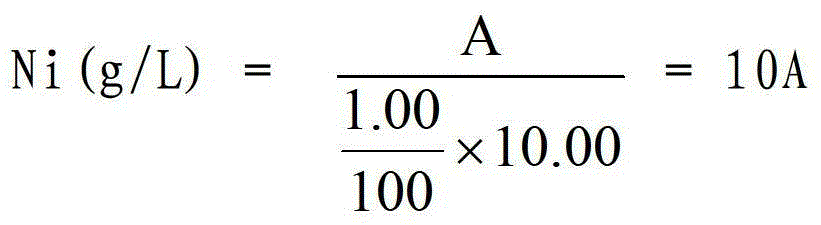
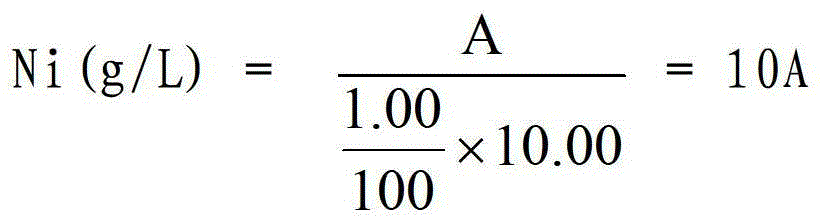
[0052] a. Take 1.00mL of the electroplating solution to be tested, place it in a 100mL volumetric flask, add water to dilute to the mark, and shake well;

[0053] b. Draw 10.00mL of the diluted plating solution and place it in a 100mL volumetric flask, then add 10mL of sodium tartrate solution with a concentration of 200g / L, 10mL of sodium hydroxide solution with a concentration of 100g / L, and 5mL of sodium hydroxide solution with a concentration of 5mL into the volumetric flask. Ammonium persulfate solution of 100g / L;

[0054] c. Add water to dilute to the mark, shake well and set aside.

[0055] 2. Draw the working curve

[0056] a. Add 0.00mL, 0.50mL, 1....