
Special population-oriented danger sensing and alarming system
A technology for special populations and alarm systems, applied in the fields of sensors, wireless communication, artificial intelligence and medical equipment, it can solve the problems of lack of data analysis methods, consumption, large network bandwidth and sensor energy.
- Summary
- Abstract
- Description
- Claims
- Application Information
AI Technical Summary
Problems solved by technology
Method used
Image

Examples
Embodiment Construction
[0016] The technical solutions in the embodiments of the present invention will be clearly and completely described below in conjunction with the drawings in the embodiments of the present invention.
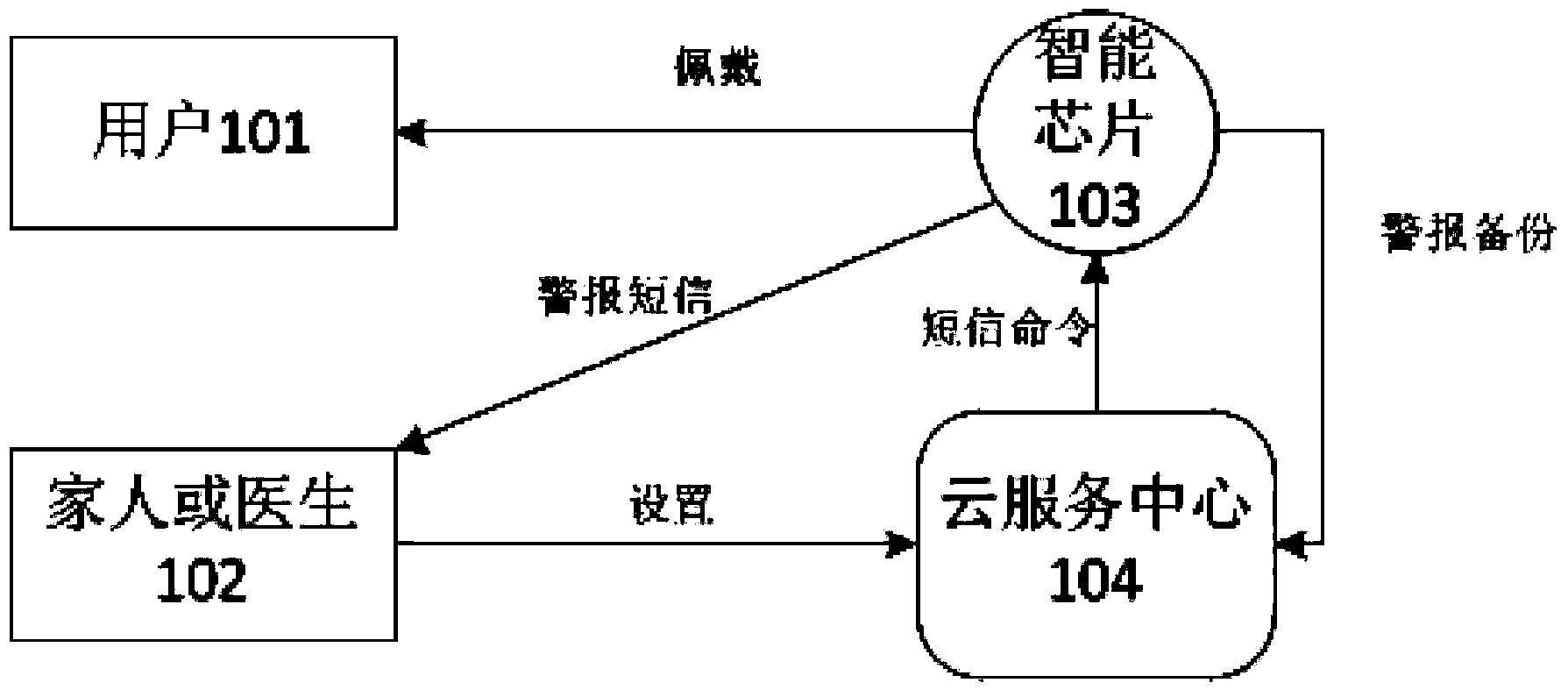
[0017] Such as figure 1 as shown, figure 1 The use case diagram of the danger perception and alarm system for special groups provided by the embodiment of the present invention. A danger perception and alarm system for special groups provided by the embodiment of the present invention monitors the behavior of the user (101), and requires the user to wear the smart chip (103), usually on the chest, belt, or arm. The cloud service center (104) provides a website externally, and the user (101) or his guardian (102) can register as a member and log in to the cloud service center to perform related configurations. Since the smart chip integrates a GSM module, each smart chip must be inserted into a SIM card to be used normally. After logging in to the cloud service center for the ...
PUM
 Login to View More
 Abstract
Description
Claims
Application Information
 Login to View More