
MMVI-CFAR target detection method
A technology of target detection and constant false alarm, applied in radio wave measurement systems, instruments, etc.
Patent Information
- Authority / Receiving Office
- CN · China
- Current Assignee / Owner
- Publication Date
- 2014-04-30
Smart Images
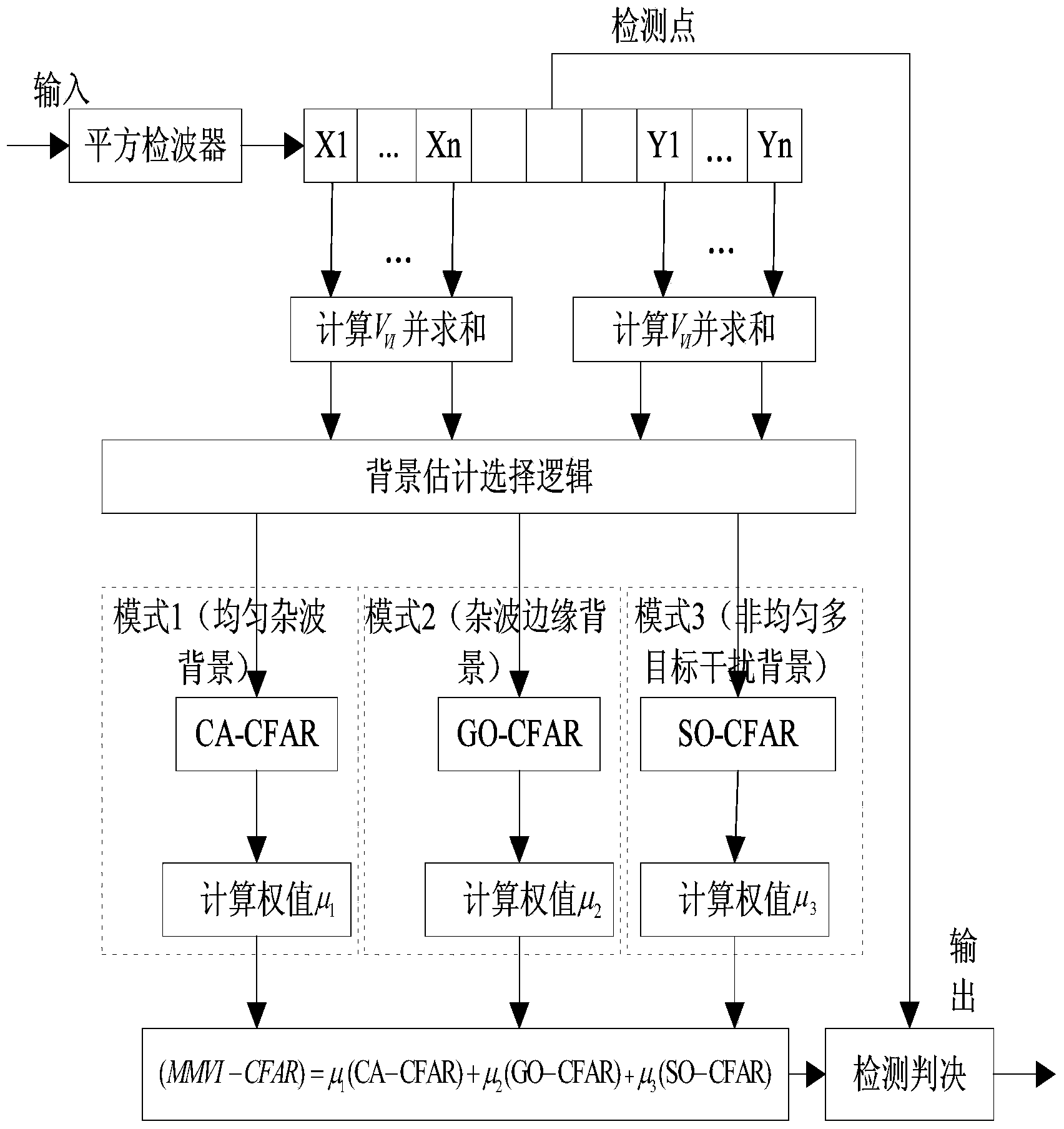
Figure 1 
Figure 2 
Figure 3
Abstract
Description
technical field
[0001] The invention belongs to the field of radar signal processing, and in particular relates to a multiple model variability index constant false alarm (Multiple Model Variability Index CFAR, MMVI-CFAR) target detection method. Background technique
[0002] At present, the airborne early warning radar signal processing often adopts long-term coherent accumulation method to increase the actual use of weak target echo signal energy and improve radar detection performance. Although the signal-to-noise ratio of the weak target echo signal has been improved after long-term energy accumulation and various clutter suppression, there are still various noises, clutter, and interference signals in the signal. When clutter and target echoes are displayed on the radar display at the same time, it will make it difficult to observe the target. If the target is in the clutter background, if the detection threshold we set is too high, the weak target will be buried in th...
Examples
Embodiment Construction
[0044] The present invention will be further described below in conjunction with the accompanying drawings.
[0045] Such as figure 1 As shown, a variable index CFAR object detection method based on multi-mode, performs weighted fusion of three CFAR detectors, that is, adopts unit-average GO-CFAR is used, and SO-CFAR is used in the non-uniform multi-target background; the specific steps are as follows:
[0046] Step 1. Establish uniform clutter background, clutter edge background and non-uniform multi-object background models respectively.
[0047] 1-1. Establish Rayleigh uniform distribution (Rayleigh distribution), Rayleigh distribution corresponds to a uniform clutter background, and its probability density function expression f 1 (x) is:
[0048] f 1 ( x ) = x σ 2 exp ( - ...