Supercharge Your Innovation With Domain-Expert AI Agents!

A Time Slot Scheduling Algorithm Based on Multipath Transmission in Wireless Sensor Networks

A multi-path transmission, wireless sensor technology, applied in the field of time slot scheduling algorithms, can solve the problems of waste of communication resources, complex time slot scheduling problems, affecting data transmission delay, etc., and achieve the effect of improving the utilization rate

Active Publication Date: 2018-01-30
BEIJING JIAOTONG UNIV
View PDF4 Cites 0 Cited by
  • Summary
  • Abstract
  • Description
  • Claims
  • Application Information

AI Technical Summary

Problems solved by technology

At the same time, multi-path transmission makes the time slot scheduling problem more complicated. Allocating corresponding time slot resources for each path will cause waste of communication resources and seriously affect the delay of data transmission.
[0004] Therefore, it is necessary to provide a time slot scheduling method to overcome the problems of communication resource waste and data transmission delay in the prior art

Method used

the structure of the environmentally friendly knitted fabric provided by the present invention; figure 2 Flow chart of the yarn wrapping machine for environmentally friendly knitted fabrics and storage devices; image 3 Is the parameter map of the yarn covering machine
View more

Image

Smart Image Click on the blue labels to locate them in the text.
Viewing Examples
Smart Image
  • A Time Slot Scheduling Algorithm Based on Multipath Transmission in Wireless Sensor Networks
  • A Time Slot Scheduling Algorithm Based on Multipath Transmission in Wireless Sensor Networks
  • A Time Slot Scheduling Algorithm Based on Multipath Transmission in Wireless Sensor Networks

Examples

Experimental program
Comparison scheme
Effect test

Embodiment Construction

[0028] The present invention will be further described below in conjunction with a set of embodiments and accompanying drawings.

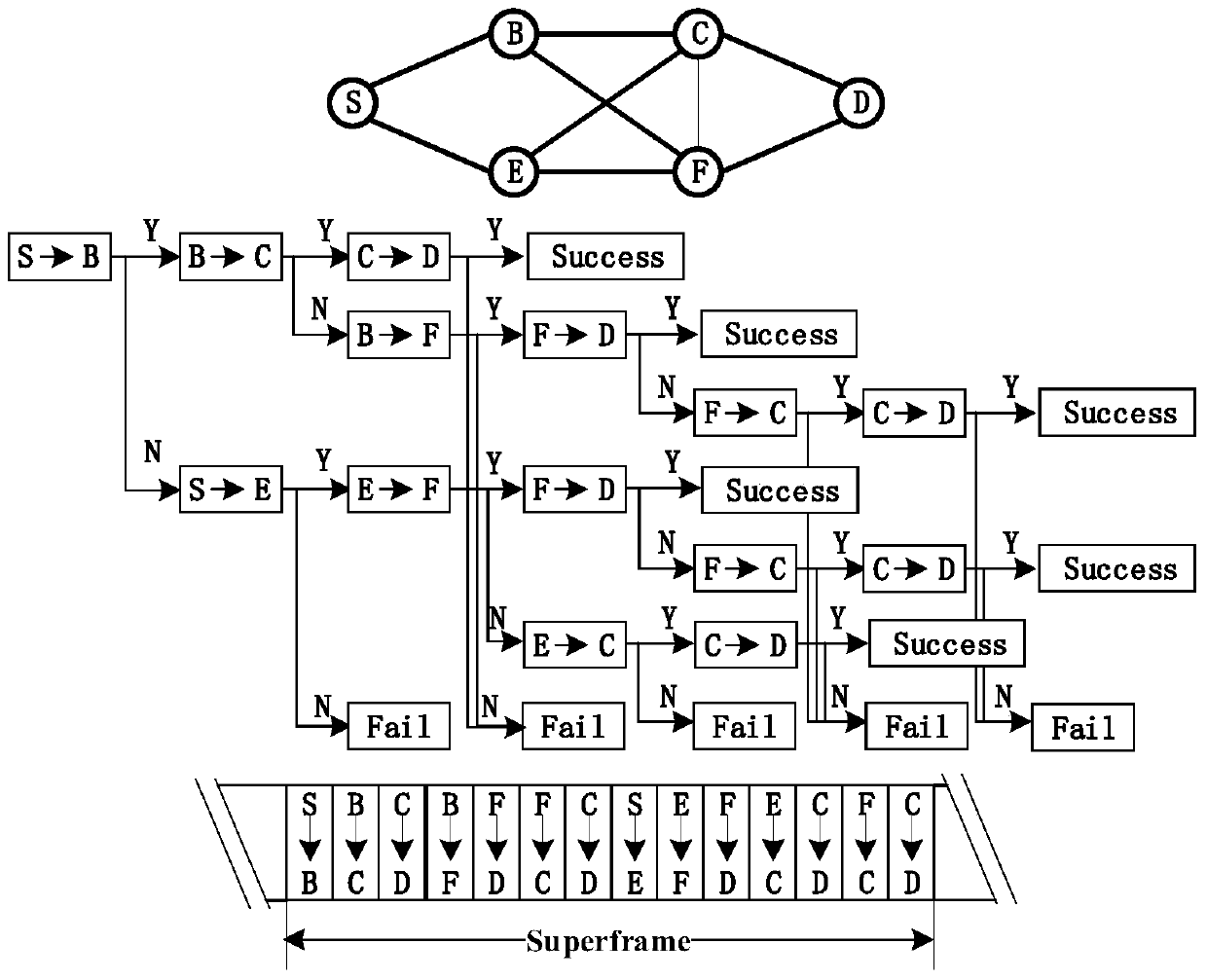
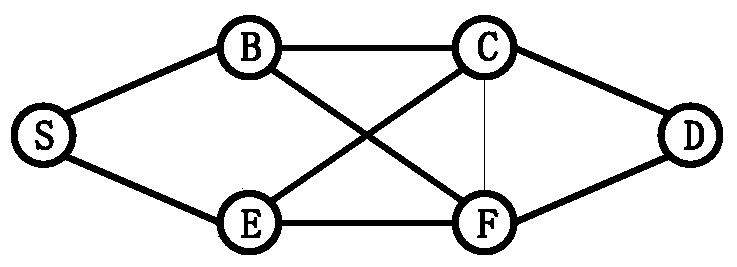
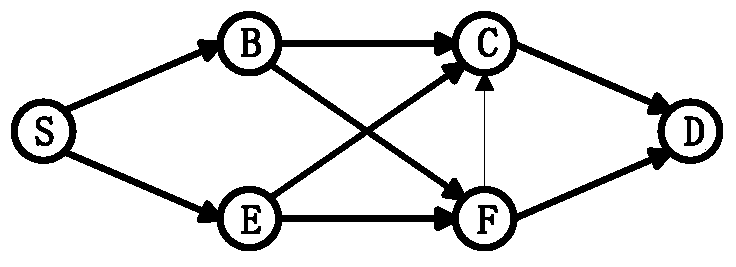
[0029] The time slot resource scheduling problem needs to be decided jointly by the network layer and the data link layer, and the specific implementation requires sequence. First, the network layer provides a routing graph for a pair of communication nodes, source nodes, or destination nodes by graph routing. The routing graph specifies the available neighbor nodes for the next hop, and then the data link layer schedules corresponding time slot resources for each hop. . In a network that supports multi-hop routing, time slot resource scheduling needs to consider the routing sequence, otherwise it will affect its real-time performance. In wireless sensor networks, multipath is an important technology to improve network reliability. However, if a corresponding time slot resource is allocated for each path of the data transmission of the source nod...

the structure of the environmentally friendly knitted fabric provided by the present invention; figure 2 Flow chart of the yarn wrapping machine for environmentally friendly knitted fabrics and storage devices; image 3 Is the parameter map of the yarn covering machine
Login to View More

PUM

No PUM Login to View More

Abstract

The invention discloses a wireless sensor network based multi-path transmission time slot scheduling algorithm. The wireless sensor network based multi-path transmission time slot scheduling algorithm includes: for primary network communication, generating a corresponding routing map Gg (Vg, Eg) according to network topology G, and setting a topological tree T according to the routing map, wherein each node in the topological tree includes one entry; traversing the topological tree T from a root node of the topological tree to generate a routing tree Ts; traversing the routing tree Ts to calculate and store layer numbers for each entry; optimizing the routing tree Ts to obtain an optimized routing tree To; traversing the routing tree To for time slot allocation; performing limited time slot scheduling if scheduling time slots are limited. According to the scheme, non-conflicted links in different routes are scheduled in a same time slot, and optimal scheduling of time slots is realized through virtual sharing of the same time slot by the non-conflicted links. Timeliness and validity in time slot scheduling are guaranteed while the problem of interference in transmission is avoided.

Description

technical field [0001] The invention relates to the field of wireless communication, in particular to a time slot scheduling algorithm based on wireless sensor network multipath transmission. Background technique [0002] WSNs (Wireless Sensor Networks, wireless sensor network) is an important part of the computer network, which is composed of a large number of low-cost, low-power micro-sensor nodes, and forms a multi-hop self-organizing network through wireless communication. The terminal node is responsible for collecting object information in the physical world (such as: temperature, humidity, light intensity, etc.), and then aggregates and sends the data to the server. [0003] TDMA (Time Division Multiple Access, Time Division Multiple Access) protocol is an important technical protocol in the access control layer in wireless sensor networks, and time slot allocation plays a vital role in the TDMA protocol. The allocation of time slots determines the order of transmiss...

Claims

the structure of the environmentally friendly knitted fabric provided by the present invention; figure 2 Flow chart of the yarn wrapping machine for environmentally friendly knitted fabrics and storage devices; image 3 Is the parameter map of the yarn covering machine
Login to View More

Application Information

Patent Timeline
no application Login to View More
Patent Type & Authority Patents(China)
IPC IPC(8): H04W72/04H04W40/24H04W84/18
Inventor 杨冬赵晶王洪超高德云张宏科
Owner BEIJING JIAOTONG UNIV
Features
  • R&D
  • Intellectual Property
  • Life Sciences
  • Materials
  • Tech Scout
Why Patsnap Eureka
  • Unparalleled Data Quality
  • Higher Quality Content
  • 60% Fewer Hallucinations
Social media
Patsnap Eureka Blog
Learn More