Unlock instant, AI-driven research and patent intelligence for your innovation.

Radar Target Poles Extraction Method Based on Sparse Representation Theory

A radar target and sparse representation technology, applied in radio wave measurement systems, instruments, etc., can solve the problems of high signal-to-noise ratio requirements, high signal-to-noise ratio requirements of the matrix beam method, and difficulty in extracting the extreme points of radar targets. Requirements for echo signal-to-noise ratio and the effect of improving practicability

Active Publication Date: 2017-06-20
NANJING UNIV OF SCI & TECH +2
View PDF3 Cites 0 Cited by
  • Summary
  • Abstract
  • Description
  • Claims
  • Application Information

AI Technical Summary

Problems solved by technology

[0003] It can be seen that it is of great significance to accurately extract the pole features of the target, but it is also very difficult to extract the poles of the radar target. There are problems such as the number of target poles is unknown, and the pole extraction results are easily affected by noise.
Most of the currently used pole extraction methods are based on spectral estimation techniques, such as the Prony algorithm (C.W.Chuang and D.L.Moffatt, "Natural resonances of radar targets via prony's method and target discrimination," IEEE Trans.Aerosp.Electron.Syst., vol.12, no.5, pp.583–589, Sept.1976.), matrix beam algorithm (T.K.Sarkar and O.Pereira, "Using the matrix pencil method to estimate the parameters of a sum of complex exponentials," IEEE Antennas Propag.Mag. , vol.37, no.1, pp.48–55, Feb.1995.), etc., such algorithms have higher requirements on signal-to-noise ratio. Generally speaking, the matrix beam method has better anti-noise ability than the Prony method, but In practical applications, the matrix beam method still requires a high signal-to-noise ratio

Method used

the structure of the environmentally friendly knitted fabric provided by the present invention; figure 2 Flow chart of the yarn wrapping machine for environmentally friendly knitted fabrics and storage devices; image 3 Is the parameter map of the yarn covering machine
View more

Image

Smart Image Click on the blue labels to locate them in the text.
Viewing Examples
Smart Image
  • Radar Target Poles Extraction Method Based on Sparse Representation Theory
  • Radar Target Poles Extraction Method Based on Sparse Representation Theory
  • Radar Target Poles Extraction Method Based on Sparse Representation Theory

Examples

Experimental program
Comparison scheme
Effect test

Embodiment Construction

[0021] The present invention will be described in further detail below in conjunction with the accompanying drawings.

[0022] The invention is a radar target pole extraction method based on sparse representation theory. The main function of the present invention is to extract the pole information of the radar target, and the specific implementation steps are as follows:

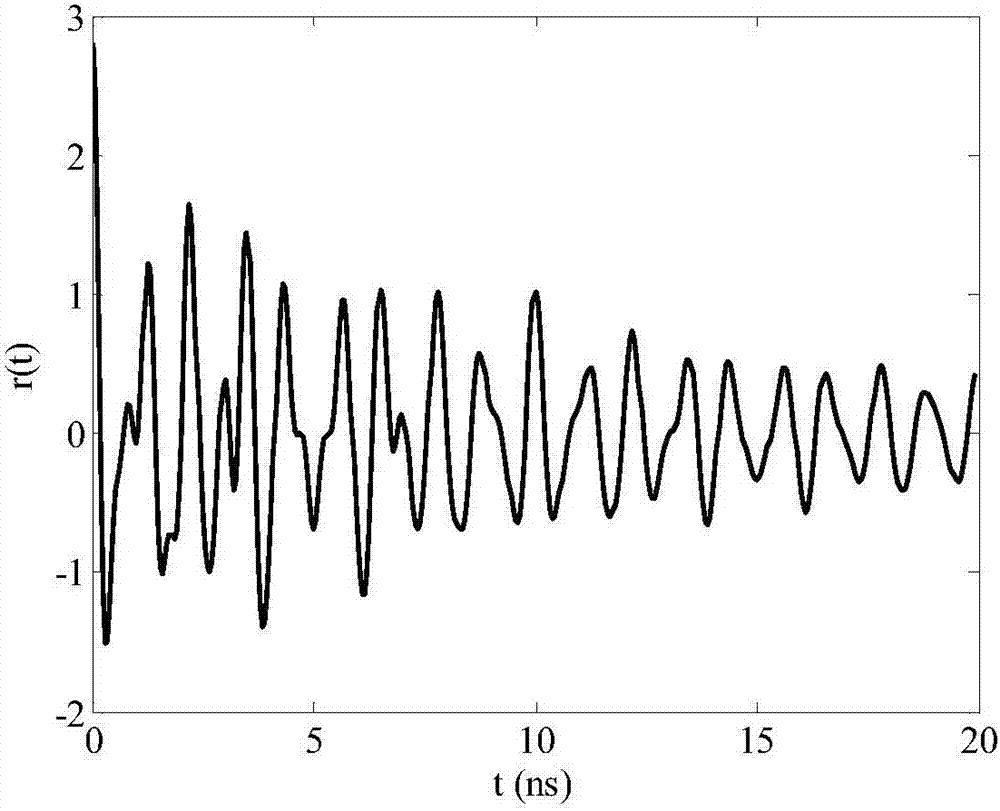
[0023] The first step is to set the time-domain echo of the radar target as h(t), the duration as T, and the starting time of the late echo as T L , which is defined as T L =(2R b +2R tr ) / c+T p , R b is the distance from the radar to the target, R tr for the target size, T p is the pulse width, and c is the propagation speed of the electromagnetic wave in free space. Note that the late part of the time domain echo of the radar target is r(t)=h(t+T L ), 0≤t≤T-T L .

[0024] The second step is to sample the late part r(t) of the time domain echo of the radar target, the sampling interval is △t, and...

the structure of the environmentally friendly knitted fabric provided by the present invention; figure 2 Flow chart of the yarn wrapping machine for environmentally friendly knitted fabrics and storage devices; image 3 Is the parameter map of the yarn covering machine
Login to View More

PUM

No PUM Login to View More

Abstract

The invention discloses a radar target pole extraction method based on the sparse representation theory. A singular point expansion model based on radar target later response converts a radar target pole extraction problem into a sparse representation problem, the sparse representation problem is solved through an orthogonal matching pursuit algorithm, and finally a target pole is acquired. The target pole can be accurately extracted, compared with a pole extraction method based on the spectrum estimation technology, the requirement for the echo signal to noise ratio can be remarkably lowered, and the practicality of the pole extraction method is improved.

Description

technical field [0001] The invention belongs to the field of radar signal processing, in particular to a radar target pole extraction method based on sparse representation theory. Background technique [0002] Through the special shape design and the use of radar absorbing materials, the radar scattering cross section of the aircraft can be greatly reduced, thereby realizing the stealth of the radar. However, these stealth methods are generally only effective for radar targets in the high-frequency region, and are ineffective for radar targets in the resonance region. This is because in the resonance region, the wavelength of the electromagnetic wave is equivalent to the size of the radar target, and a large number of targets are carried in the target scattering field. Therefore, it is of great significance to study the characteristics of radar targets in the resonance region for the development of anti-stealth technology. The pole is the most important feature of the radar...

Claims

the structure of the environmentally friendly knitted fabric provided by the present invention; figure 2 Flow chart of the yarn wrapping machine for environmentally friendly knitted fabrics and storage devices; image 3 Is the parameter map of the yarn covering machine
Login to View More

Application Information

Patent Timeline
no application Login to View More
Patent Type & Authority Patents(China)
IPC IPC(8): G01S7/41
CPCG01S7/292
Inventor 陈如山丁大志樊振宏宋大伟张欢欢
Owner NANJING UNIV OF SCI & TECH